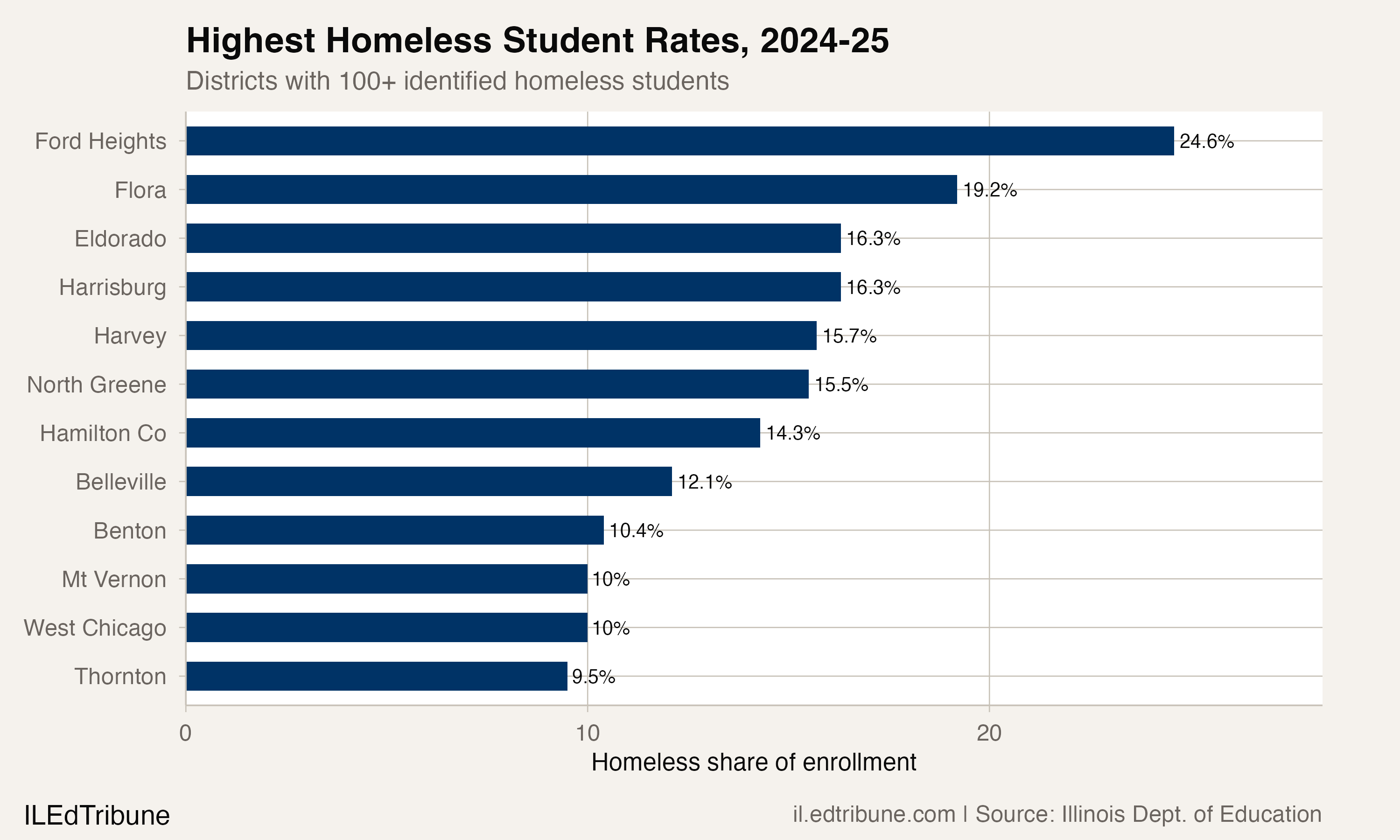
Harrisburg Community Unit School District 3, a district of 1,760 students in rural southern Illinois, identified 287 students who are currently homeless in 2024-25. That is 16.3% of enrollment, up from 1.7% six years ago. One in six students in Harrisburg is now classified as experiencing homelessness under the federal McKinney-Vento Act.
Harrisburg is not an outlier. Across southern Illinois, small districts are posting homeless rates that rival or exceed Chicago's. Flora CUSD 35: 19.2%. Eldorado CUSD 4: 16.3%. Hamilton County CUSD 10: 14.3%. These are not districts absorbing asylum seekers from the southern border. They are communities where the affordable housing stock has deteriorated and doubled-up living arrangements, the most common form of student homelessness, have become routine.
Two crises, one number
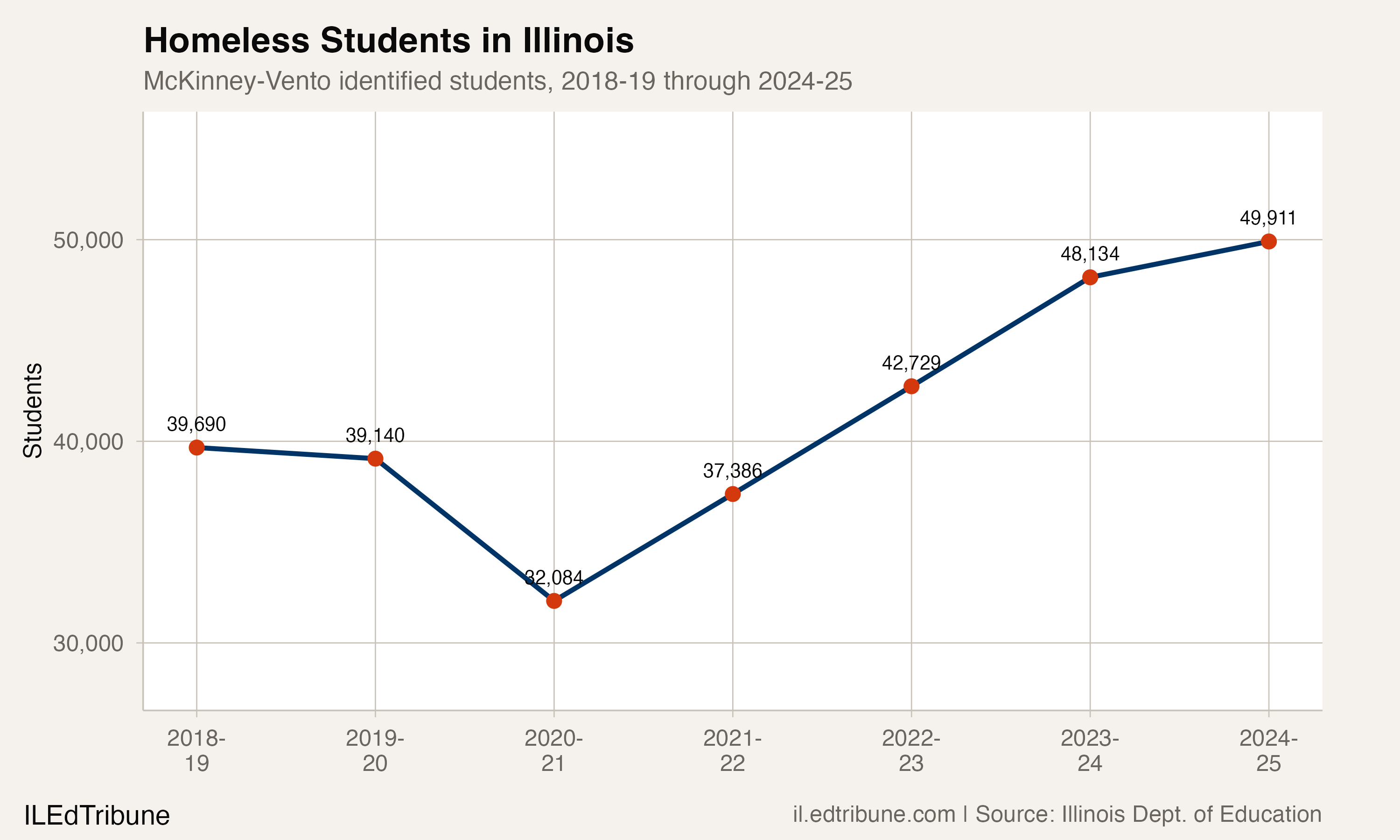
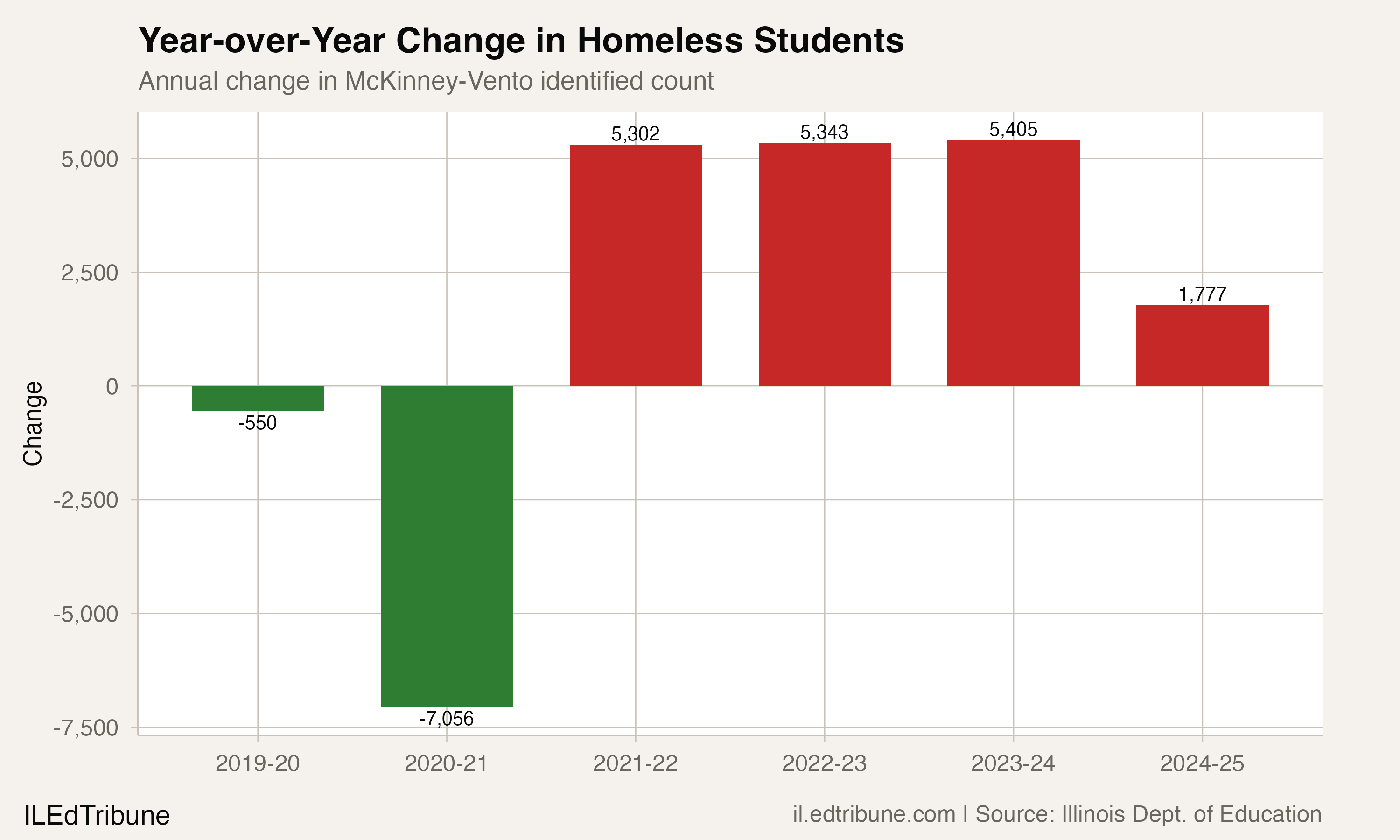
Illinois identified 49,911 students who are currently homeless statewide in 2024-25, the highest count in at least seven years of available data and a 25.8% increase over the 39,690 counted in 2018-19. The count dropped sharply during the pandemic, falling to 32,084 in 2020-21 as remote learning reduced contact between students and the school staff who typically identify housing instability. It has climbed every year since, adding roughly 5,000 students per year from 2021-22 through 2023-24 before slowing to 1,777 in 2024-25.
| Year | Homeless Students | Share of Enrollment | Year-over-Year Change |
|---|---|---|---|
| 2018-19 | 39,690 | 2.0% | — |
| 2019-20 | 39,140 | 2.0% | -550 |
| 2020-21 | 32,084 | 1.7% | -7,056 |
| 2021-22 | 37,386 | 2.0% | +5,302 |
| 2022-23 | 42,729 | 2.3% | +5,343 |
| 2023-24 | 48,134 | 2.6% | +5,405 |
| 2024-25 | 49,911 | 2.7% | +1,777 |
The statewide number conceals two distinct phenomena. In Chicago, the count is driven heavily by migrant arrivals. CPS identified 17,445 students who are currently homeless in 2024-25, 5.4% of district enrollment, up from 13,430 in 2022-23 when the district first appeared in the state data system. CPS alone accounts for 35% of the state's student who is currently homeless count.
In rural and south suburban districts, the increase predates the migrant crisis and appears linked to chronic housing shortages. Belleville SD 118 in the Metro East went from 200 students who are currently homeless (5.3%) to 389 (12.1%). Thornton Township HSD 205 in the south suburbs rose from 94 (1.9%) to 404 (9.5%). None of these districts have received asylum seekers. The growth is sustained and local.
Chicago: migrants and the McKinney-Vento count
CPS's 17,445 students who are currently homeless make it the largest contributor to the statewide total by a wide margin. The district's count rose by 4,015, or 30%, in just two years. Over 37,000 asylum seekers arrived in Chicago by early 2024, and schools were directed to use federal McKinney-Vento funding to support newly enrolled migrant students.
The timing aligns: CPS's sharpest jump, from 13,430 to 17,048, coincided with peak migrant shelter intake in 2023-24. But the enrollment data does not distinguish migrant students from other homeless-classified students, so how much of the increase comes from new arrivals is unclear. CPS does not separately report students who are currently homeless by immigration status, and the McKinney-Vento definition captures a broad range of housing instability, not only shelter stays.
"When you're thinking about funding distribution, they use enrollment data which doesn't capture all of the transiency that happens." — Erika Mendez, Latino Policy Forum, Chalkbeat, Mar. 2024
Illinois's overall homelessness count rose 116% in 2024, with 91% of the increase concentrated in Chicago. Of the roughly 13,900 newly homeless individuals counted in the HUD point-in-time survey, approximately 13,600 were migrants and asylum seekers. Non-migrant homelessness in Illinois still rose 22%, but the statewide surge is overwhelmingly a Chicago story.
The school-level count tells a different story. The districts with the highest rates and the steepest rate increases are not in Chicago. They are in Saline County, Clay County, Hamilton County, and the Metro East.
Southern Illinois: a housing crisis with no buses
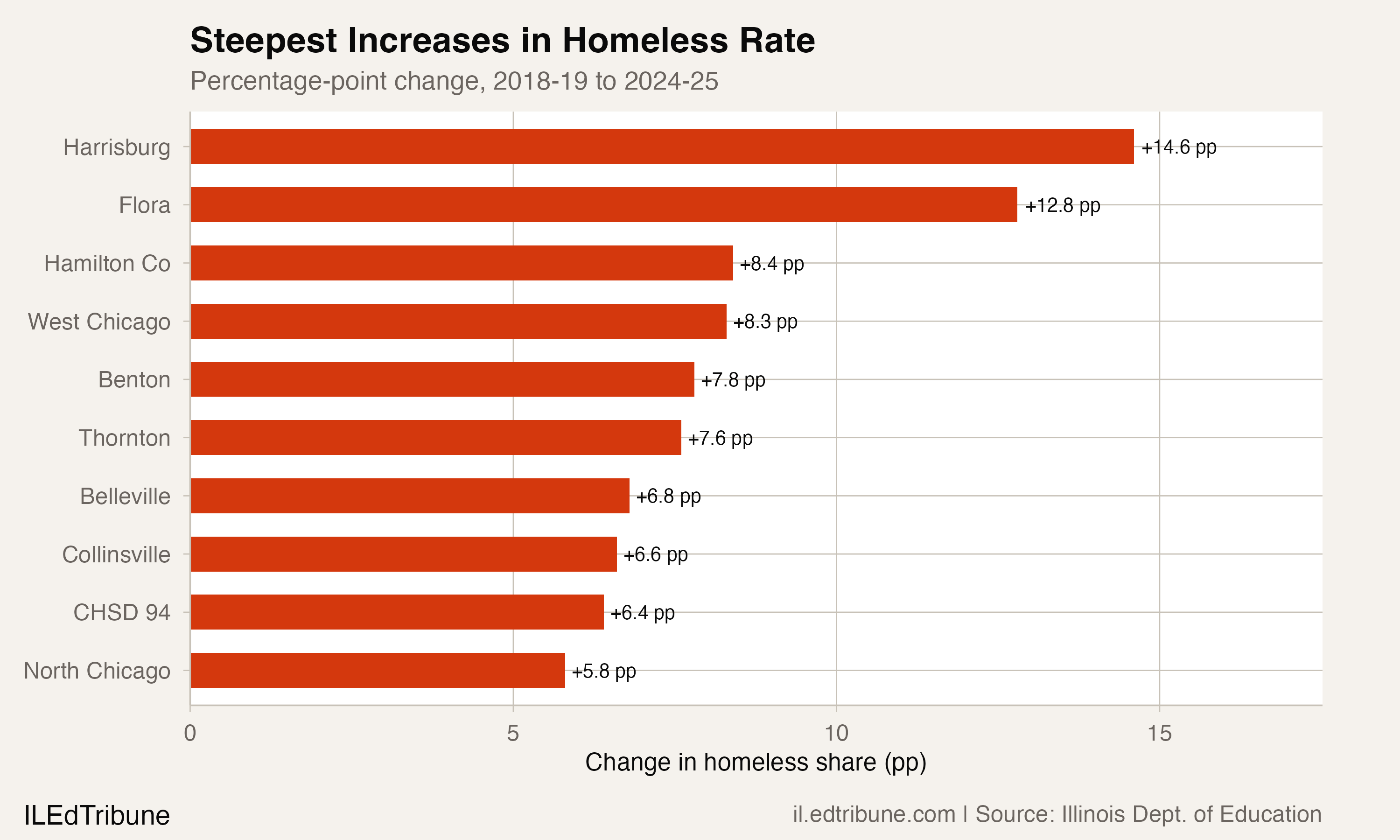
Harrisburg's 14.6 percentage-point increase in homeless share is the largest in the state. In 2018-19, the district identified 32 students who are currently homeless. By 2024-25, that number had grown nearly ninefold to 287. Flora CUSD 35, about 40 miles north of Harrisburg, went from 90 to 251 students who are currently homeless, pushing its rate from 6.4% to 19.2%.
| District | 2018-19 | 2024-25 | Rate 2019 | Rate 2025 | Change |
|---|---|---|---|---|---|
| Harrisburg CUSD 3 | 32 | 287 | 1.7% | 16.3% | +14.6 pp |
| Flora CUSD 35 | 90 | 251 | 6.4% | 19.2% | +12.8 pp |
| Hamilton Co CUSD 10 | 71 | 155 | 5.9% | 14.3% | +8.4 pp |
| West Chicago ESD 33 | 70 | 321 | 1.7% | 10.0% | +8.3 pp |
| Benton CCSD 47 | 30 | 103 | 2.6% | 10.4% | +7.8 pp |
| Thornton Twp HSD 205 | 94 | 404 | 1.9% | 9.5% | +7.6 pp |
Most students identified as homeless under McKinney-Vento are not living in shelters or on the street. They are "doubled up," sharing housing with other families due to economic hardship. In rural Illinois, where affordable rental housing is scarce and the state faces a shelter bed deficit of 5,379 statewide, doubled-up living may be less an emergency than a long-term condition. The enrollment numbers cannot separate worsening housing conditions from better identification by school staff trained in McKinney-Vento protocols. Both are probably in play.
Funding cut as counts rise
Districts that identify students as homeless are required to provide transportation to their school of origin, remove enrollment barriers, and connect families with services. The instructional programs associated with McKinney-Vento compliance carry costs that grow with the count.
The state's response to rising homelessness has been mixed. Governor Pritzker's Home Illinois initiative saw a $26.6 million cut in fiscal year 2026, dropping housing program funding from $290 million to $264 million even as the homeless count reached record levels. The Court-Based Rental Assistance Program, which helps families facing eviction, was reduced by $25 million.
"To be in the midst of this crisis...have the state cut funding was beyond disappointing." — Doug Kenshol, Illinois Shelter Alliance, Capitol News Illinois, Jul. 2025
At the federal level, the McKinney-Vento Education for Homeless Children and Youth program faces its own uncertainty. A proposal to consolidate 18 federal education programs into a block grant could eliminate dedicated funding for student who is currently homeless services, replacing categorical protections with discretionary state allocations.
What the count does and does not measure
The 2024-25 slowdown to 1,777 additional students who are currently homeless, after three years of roughly 5,300 per year, could signal that identification is catching up with reality. It could also reflect the sharp drop in migrant shelter intake in Chicago, where the shelter census fell "more than 60%" following border crossing restrictions in mid-2024. If migrant arrivals drove much of the 2022-24 surge, the deceleration makes sense. If the rural pattern is independent of migration, it may persist.
The question for districts like Harrisburg and Flora is not whether the numbers will keep rising. It is whether the state treats a district where one in six students is doubled up with another family as a housing crisis, not just an enrollment line item.
RELATED: Illinois enrollment nears a plateau after losing 136,000 studentsET
Detailed code that reproduces the analysis and figures in this article is available exclusively to EdTribune subscribers.
Discussion
Sign in to join the discussion.
Loading comments...