Valley View CUSD 365U, a district of 14,529 students straddling Will and DuPage counties, has lost students every year for 12 consecutive years. It has never been smaller in the two decades of enrollment data Illinois publishes. It is not alone. Three hundred and six other districts across the state can say the same thing.
Of the 860 Illinois school districts with at least four years of enrollment history through 2024-25, 307 are at their lowest recorded enrollment in the state's 20-year data window, 35.7% of the total. Just 50, or 5.8%, are at all-time highs. For every district setting a record at the top, six are setting one at the bottom.
The weight falls on the largest districts
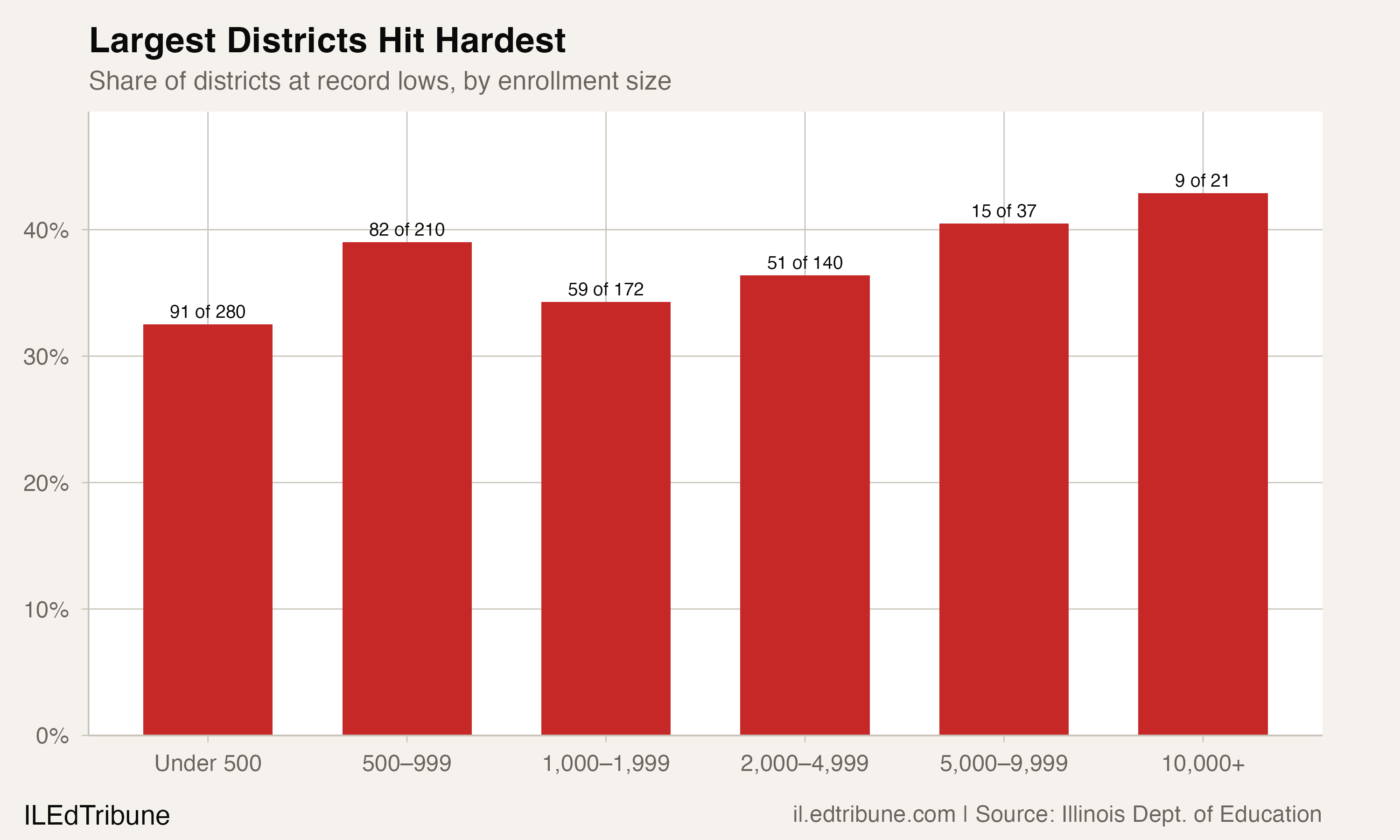
This is not a small-district story. Among districts enrolling 10,000 or more students, nine of 21 (42.9%) are at all-time lows. That includes SD U-46 in Elgin, the state's second-largest district after Chicago Public Schools, which enrolled 33,525 students in 2024-25, down 17.6% from its peak of 40,687 in 2012. Plainfield SD 202 (24,411 students, down 15.5%), Naperville CUSD 203 (15,899, down 8.8%), and Valley View (14,529, down 17.8%) round out the largest at record lows.
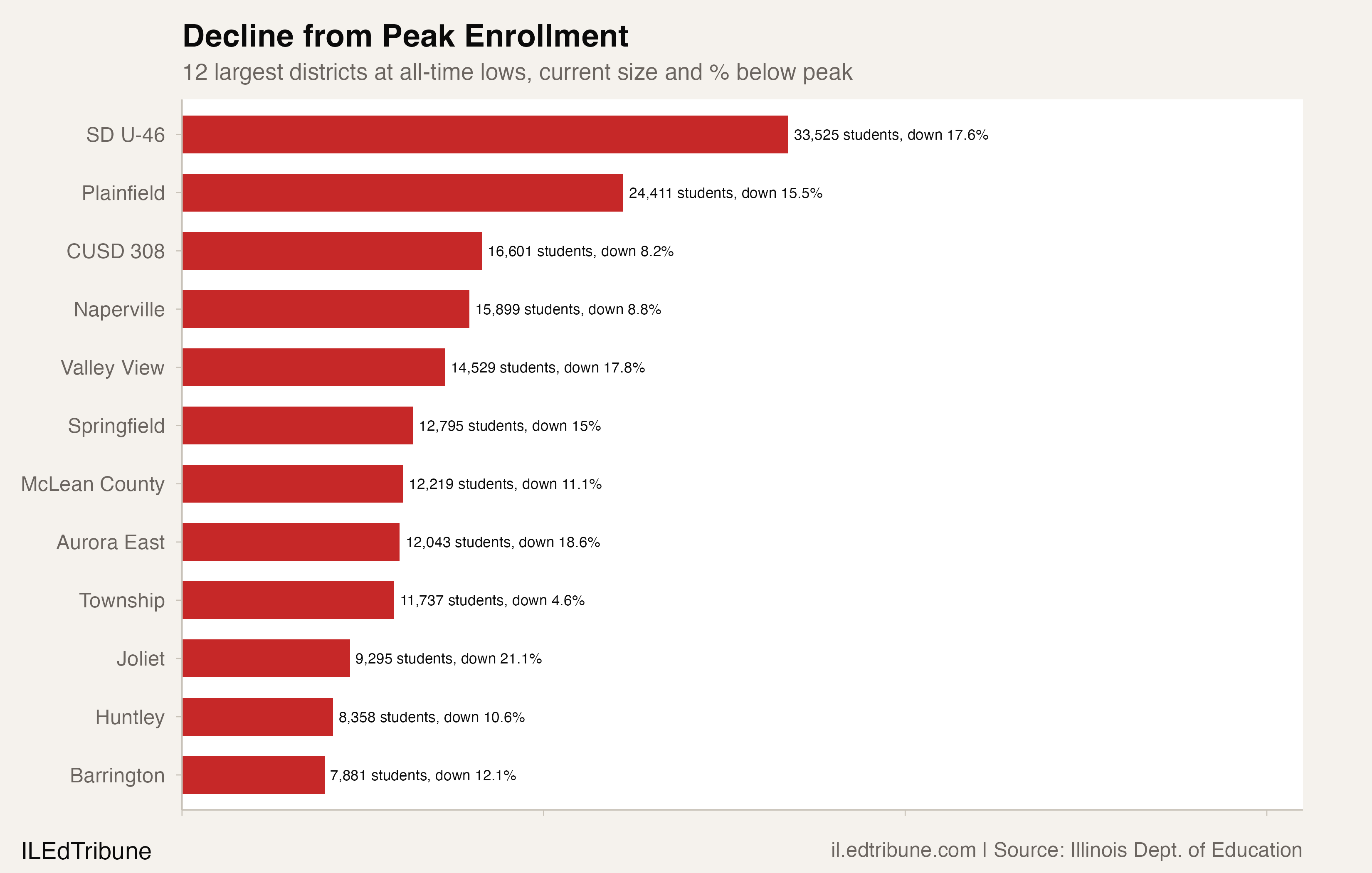
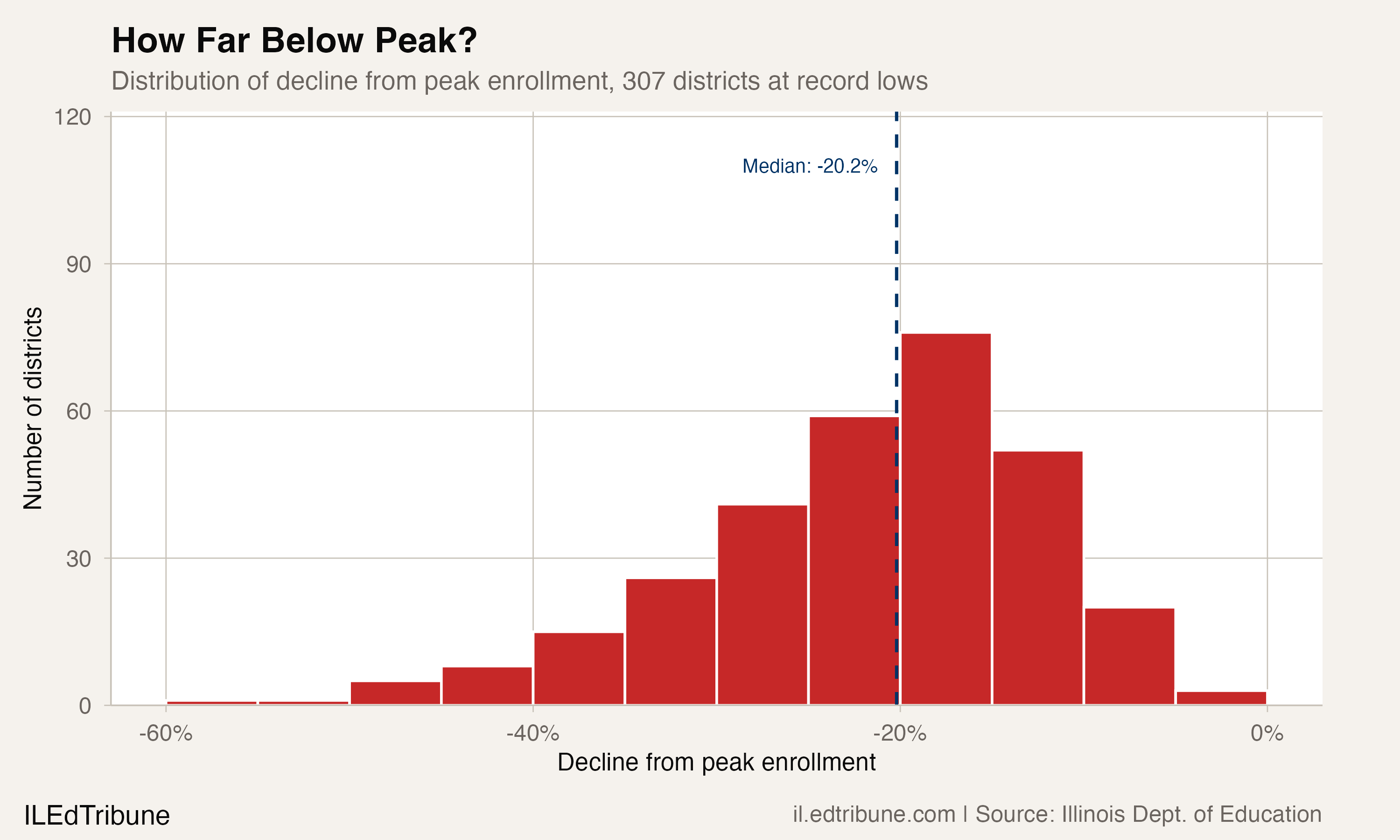
The 307 districts at all-time lows collectively enroll 583,838 students, 31.6% of the state's 1,848,560 total. Their cumulative gap from peak enrollment is 121,793 students. The median district at a record low has declined 20.2% from its highest point, and 55 districts have fallen more than 30% from peak.
COVID amplified the pattern, but did not create it
The share of districts at record lows spiked to 68.8% during the pandemic in 2020-21, when families pulled students from public schools across the state. By 2022-23, the share had fallen to 35.3% as some districts recovered. It has plateaued since: 36.7% in 2023-24, 35.7% in 2024-25. Before COVID, roughly 43% to 47% of districts were at record lows in any given year, so the current 35.7% is actually lower than the pre-pandemic norm.
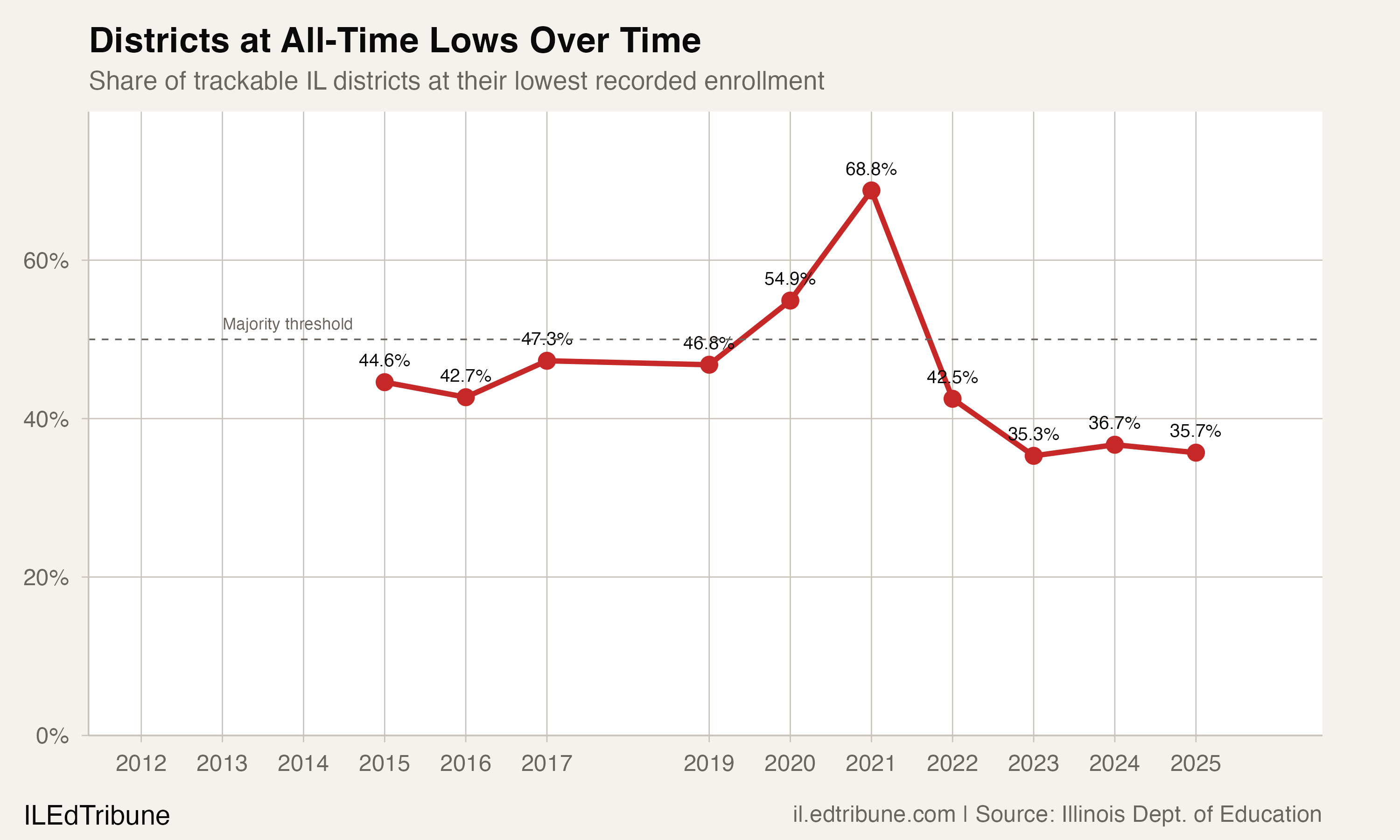
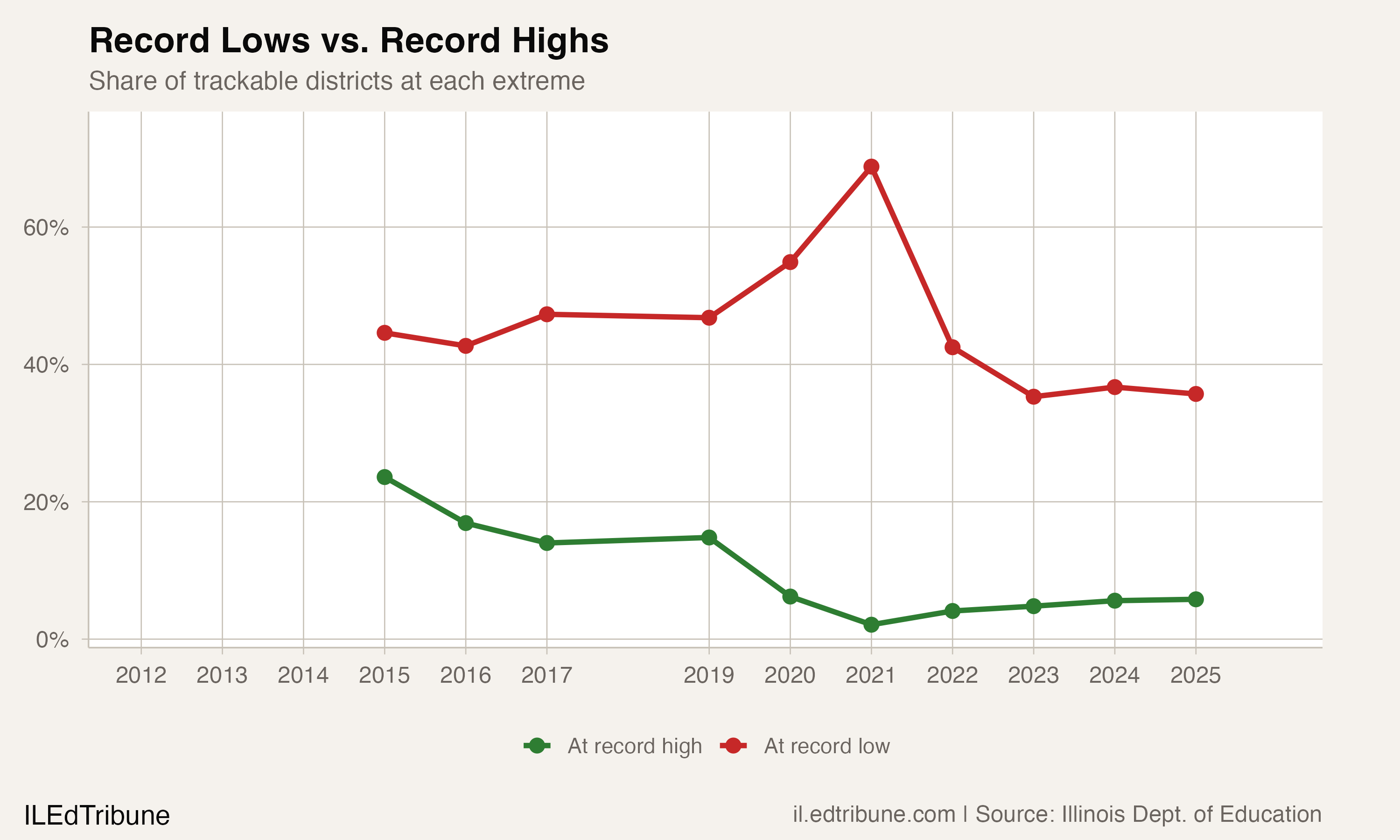
That apparent improvement is partly an artifact. COVID pushed so many districts to new lows in 2020-21 that even partial recovery registers as an improvement from the pandemic floor. The record-high share tells a starker story: it collapsed from 23.1% in 2014-15 to 5.8% in 2024-25. Districts are no longer reaching new enrollment peaks; they are just climbing back from pandemic troughs.
Seven districts have declined every year since 2012
Sixty districts have declined for seven or more consecutive years through 2024-25. Thirteen have streaks of 10 years or longer. Seven have never posted a single year of growth since 2012-13: Bradley SD 61, CHSD 155, Havana CUSD 126, Manteno CUSD 5, Pana CUSD 8, Summit Hill SD 161, and Valley View CUSD 365U.
These 12-year streaks span a period that includes a national economic recovery, a once-in-a-century pandemic, and billions of dollars in federal relief spending. None of it reversed the trajectory.
Statewide, 500 of 863 districts with comparable year-over-year data lost students from 2023-24 to 2024-25. Only 351 gained.
Fewer families, fewer students
The most likely driver is demographic: Illinois has lost 172,000 residents under 18 since 2020, a 6% decline that ranks as the highest rate among large states. That loss reflects both declining birth rates and persistent outmigration. Illinois lost 56,235 residents to other states in the year ending July 2024, according to Census Bureau estimates, with 64 of 102 counties losing population even as the state posted a modest overall gain from international immigration.
For suburban districts like U-46, birth rate decline is the primary factor. Brian Lindholm, U-46's chief of staff, told the Chicago Tribune that the district's enrollment has dropped for six consecutive years.
"The lower numbers are due primarily to declining birth rates." -- Chicago Tribune, Oct. 2024
U-46 projects continued declines of several hundred students per year until enrollment stabilizes around 30,000, roughly 10,000 fewer than its peak.
A competing explanation is school choice. Charter schools, private school enrollment shifts, and homeschooling persistence after COVID each siphon some students from traditional district counts. But the scale of the decline across 307 districts, including many in communities with no charter presence, points to population loss as the structural cause. School choice may redistribute students; it cannot explain district-wide record lows across a third of the state.
The districts still growing
The 50 districts at all-time highs are predominantly small. Their median enrollment is 877, compared with 862 for districts at record lows. Champaign CUSD 4, the largest at a record high (10,465 students), is the only one above 10,000. Yorkville CUSD 115 (7,097) and Central CUSD 301 (5,018) are the next largest.
Several of the growing districts are outer-ring suburbs absorbing development: Yorkville (Kendall County), Dunlap (Peoria-area), and Mascoutah (near Scott Air Force Base). Others, like Champaign and Carbondale ESD 95, are university towns where institutional employment provides a demographic buffer.
The funding formula's safety net has limits
Illinois's Evidence-Based Funding formula, enacted in 2017, includes a hold-harmless provision that prevents any district from receiving less state aid than the prior year, even as enrollment falls. That insulates declining districts from the immediate funding cliffs that enrollment-driven formulas impose in other states.
But the formula itself remains far from fully funded. In 2024, 49 districts were still below 70% of their adequacy targets, and one watchdog estimate projects the state will not reach adequate funding across all districts until 2034, seven years past the original deadline. A district whose enrollment is falling but whose per-pupil costs are rising, because specialized instructional programs carry higher costs as total enrollment drops, can be protected by the hold-harmless floor and still be inadequately funded.
The end of federal pandemic relief compounds the pressure. Illinois schools received $7.8 billion in Elementary and Secondary School Emergency Relief funds starting in 2020. As of mid-2024, more than $5.8 billion had been spent, and remaining funds had to be committed by September 2024. Districts that used ESSER money to hire interventionists, expand summer programs, or shore up bus routes now face the question of what to cut.
What to watch next
The statewide enrollment decline is decelerating. Illinois lost just 2,730 students in 2024-25, down from 6,500 the year before and 69,702 during the pandemic's worst year. Chicago Public Schools has added students for two consecutive years after hitting a modern low of 319,769 in 2022-23. If Chicago's gains hold and outmigration slows, the statewide number could stabilize.
The question is whether stabilization at the state level masks continued erosion at the district level. A state where 307 districts are at record lows and only 50 are at record highs is a state where the aggregate hides the distribution. For a superintendent in Pana or Havana or Bradley, watching enrollment fall for the 12th straight year, a statewide plateau is no consolation.
Detailed code that reproduces the analysis and figures in this article is available exclusively to EdTribune subscribers.
Discussion
Sign in to join the discussion.
Loading comments...