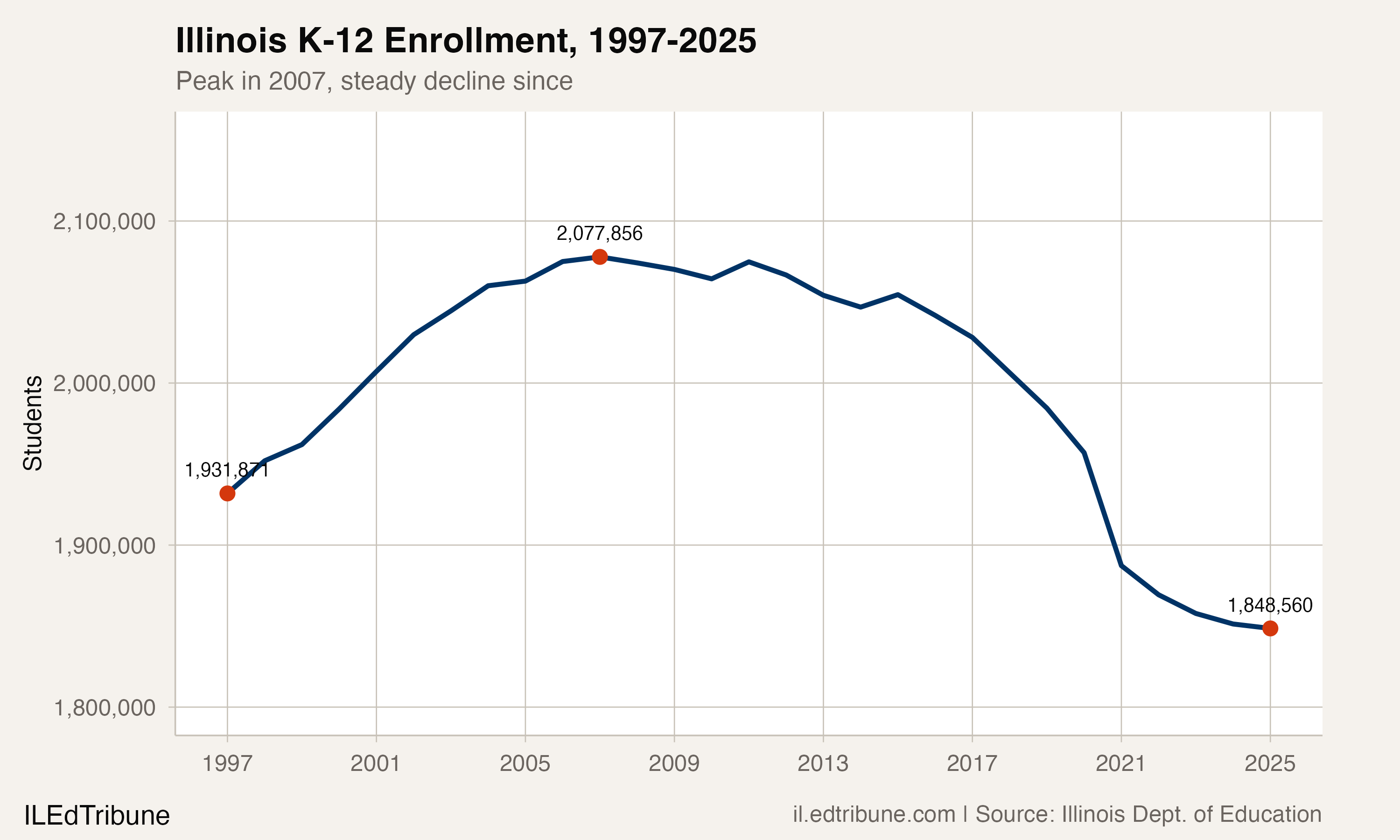
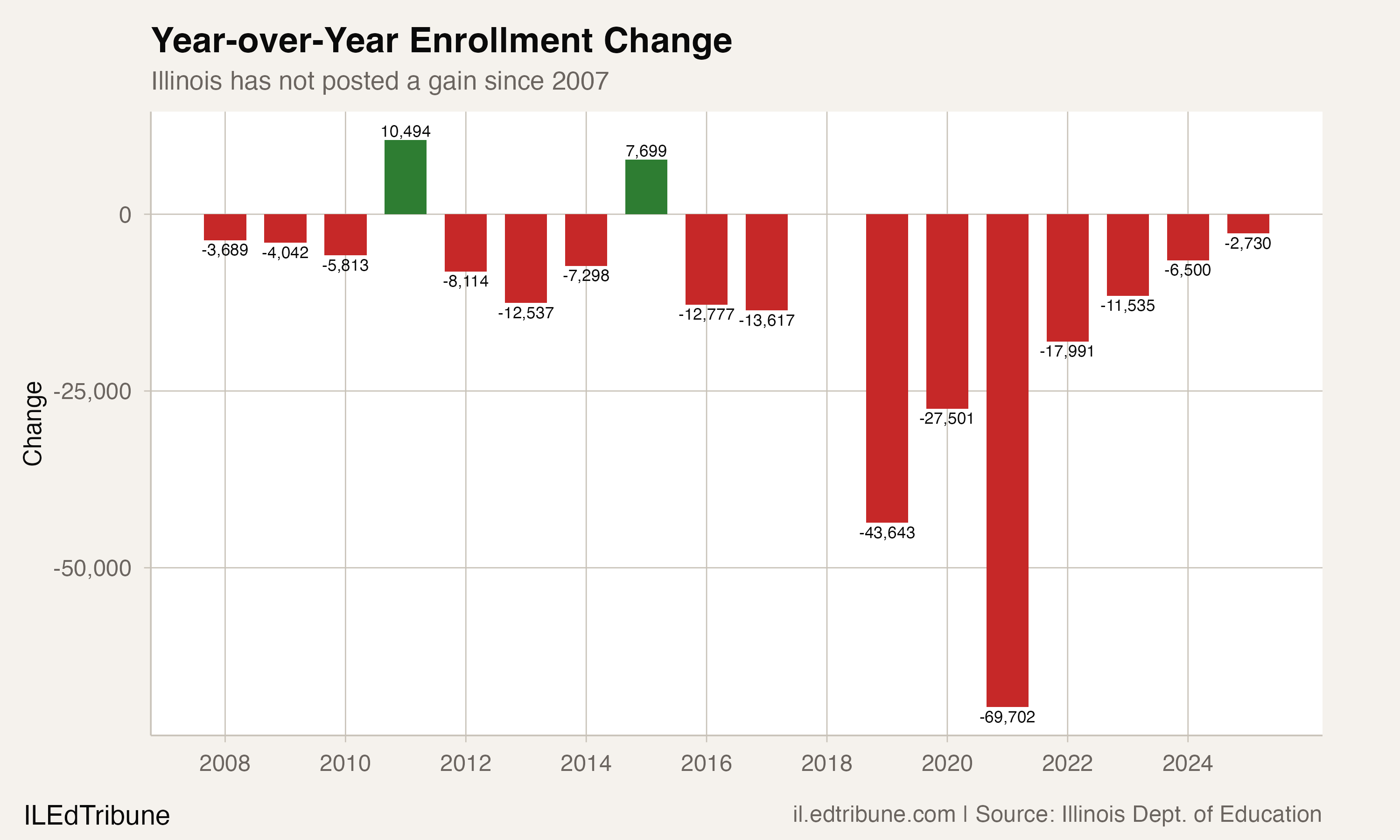
Illinois public schools enrolled 1,848,560 students in 2024-25, the lowest figure in at least 28 years of available data. The state has not posted a year-over-year enrollment gain since 2014-15. In the decade since, Illinois has lost students every single year — through budget impasses, through a pandemic, through the early stages of a migrant influx that added students in Chicago but not enough to offset losses everywhere else.
The 2024-25 total sits 83,311 students below where Illinois stood in 1996-97 and 229,296 below the 2006-07 peak of 2,077,856. That peak now looks less like a high-water mark and more like the midpoint of a contraction that has not reversed.
From peak to plateau
Illinois enrollment rose steadily through the late 1990s and early 2000s, climbing from 1,931,871 in 1996-97 to 2,077,856 in 2006-07. The decline since then has been steady, accelerating sharply during the pandemic.
| Year | Enrollment | Year-over-Year Change |
|---|---|---|
| 1996-97 | 1,931,871 | — |
| 2006-07 | 2,077,856 | (peak) |
| 2014-15 | 2,054,556 | +7,699 (last gain) |
| 2018-19 | 1,984,519 | — |
| 2019-20 | 1,957,018 | -27,501 |
| 2020-21 | 1,887,316 | -69,702 |
| 2021-22 | 1,869,325 | -17,991 |
| 2022-23 | 1,857,790 | -11,535 |
| 2023-24 | 1,851,290 | -6,500 |
| 2024-25 | 1,848,560 | -2,730 |
The pandemic year stands out. Between 2018-19 and 2020-21, the state lost 97,203 students in just two years. The pace of decline has moderated since — the 2024-25 loss of 2,730 students is the smallest in the post-pandemic period — but the system has never recovered. Each year since 2020-21 has simply been less bad than the last.
Four in five large districts are shrinking
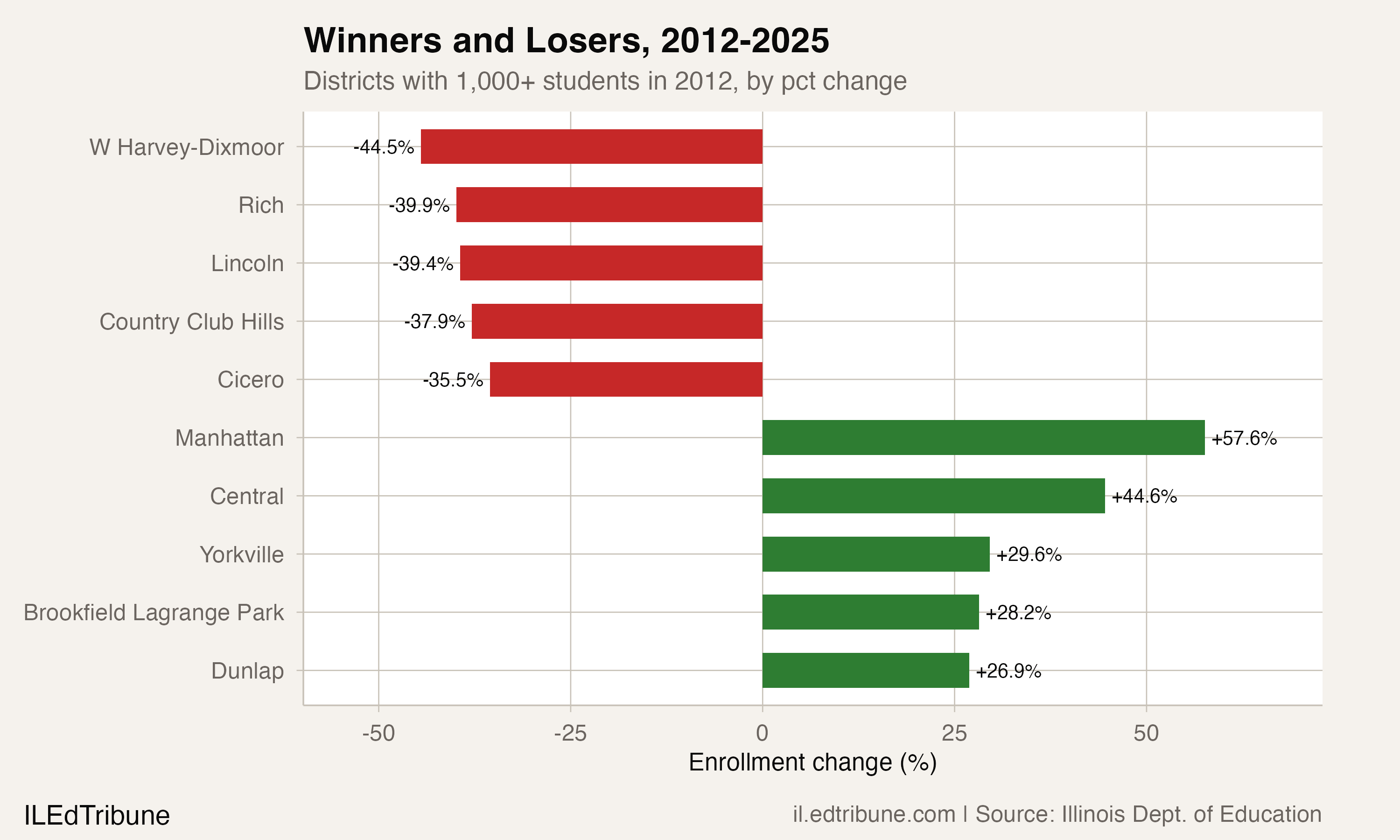
The contraction is not confined to a few struggling communities. Among 404 districts with at least 1,000 students in 2011-12, 333 — or 82% — had fewer students in 2024-25. Only 70 posted gains. The losses span every region, from Chicago to the collar counties to downstate.
The hardest-hit districts lost between a third and nearly half of their students over 13 years:
| District | 2011-12 | 2024-25 | Change |
|---|---|---|---|
| W Harvey-Dixmoor PSD 147 | 1,409 | 782 | -44.5% |
| Rich Twp HSD 227 | 3,905 | 2,347 | -39.9% |
| Lincoln ESD 156 | 1,132 | 686 | -39.4% |
| Country Club Hills SD 160 | 1,331 | 827 | -37.9% |
| Cicero SD 99 | 13,367 | 8,621 | -35.5% |
The south suburbs dominate the list. W Harvey-Dixmoor, Rich Township, and Country Club Hills are all in the same band of communities south of Chicago where population loss, housing deterioration, and school closures have fed a cycle of enrollment decline. Cicero SD 99, a large elementary district west of Chicago, lost 4,746 students — more than a third of its enrollment — and its losses alone exceed the total enrollment of most Illinois districts.
CPS: the largest single loss, and a recent exception
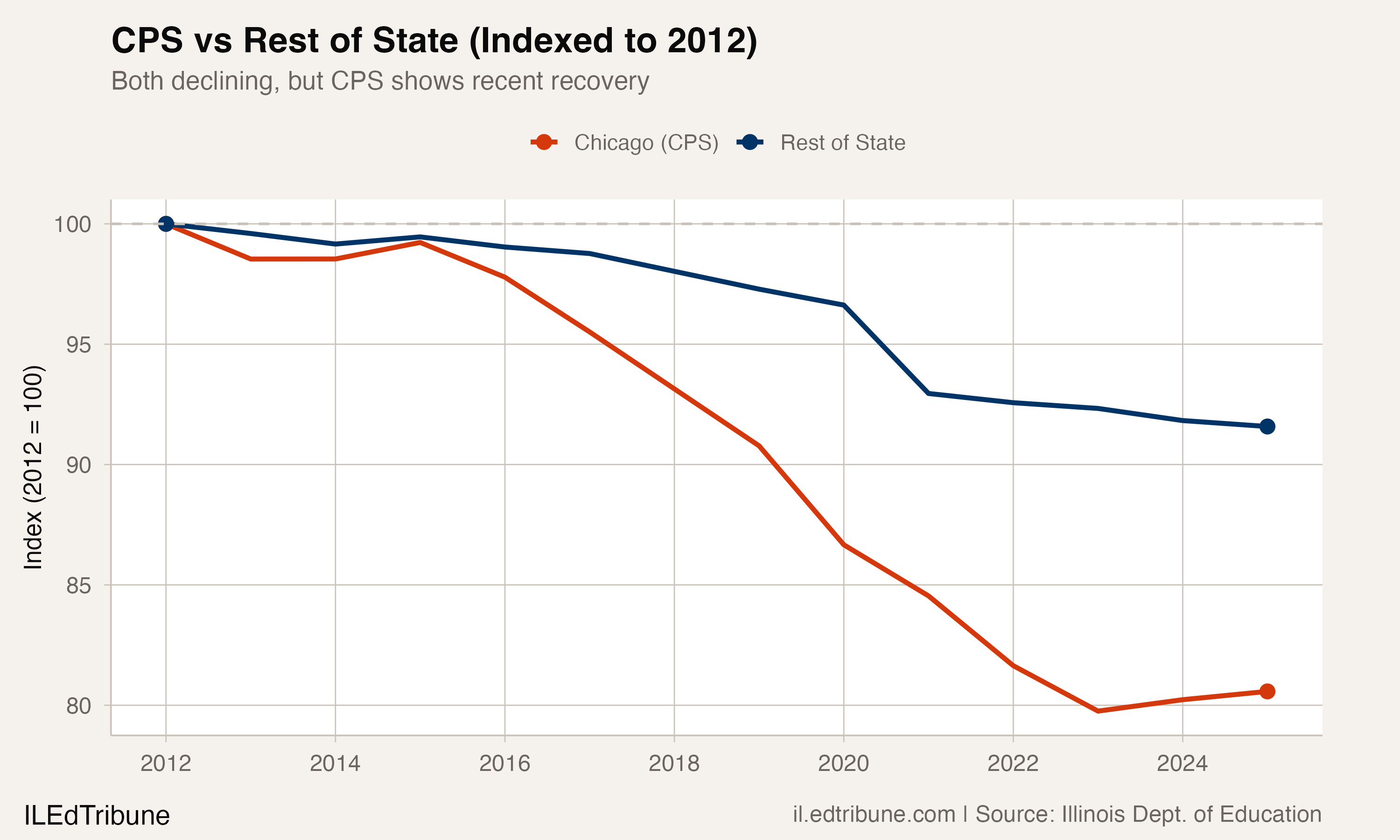
Chicago Public Schools enrolled 323,047 students in 2024-25, down from 400,931 in 2011-12. The decline of 77,884 students, a 19.4% loss, makes CPS the single largest contributor to the statewide contraction. CPS alone accounts for roughly a third of the total enrollment drop over this period.
But CPS's trajectory recently diverged from the rest of the state. The district gained students in both 2023-24 and 2024-25, driven partly by migrant families enrolling in Chicago schools. In 2024-25, CPS added 1,379 students while the rest of the state lost 4,817. Whether CPS can sustain that growth depends on immigration policy, charter dynamics, and housing costs -- none of which the enrollment data can predict.
The outer ring grows while everything else contracts
The districts posting gains share a common profile: they sit on the outer edge of the Chicago metropolitan region, in communities where new housing subdivisions are converting farmland into neighborhoods.
| District | 2011-12 | 2024-25 | Change |
|---|---|---|---|
| Manhattan SD 114 | 1,249 | 1,968 | +57.6% |
| Central CUSD 301 | 3,470 | 5,018 | +44.6% |
| Yorkville CUSD 115 | 5,474 | 7,097 | +29.6% |
| Brookfield-LaGrange Park SD 95 | 1,087 | 1,393 | +28.2% |
| Dunlap CUSD 323 | 3,785 | 4,805 | +26.9% |
Manhattan SD 114 in Will County grew by 57.6%. Central CUSD 301 in Kane County's western suburbs gained 1,548 students. These are exurban districts absorbing families who have moved outward from the inner suburbs and the city. Their growth reflects housing development and domestic population shifts, not a broader reversal of the state's enrollment decline. The 70 gaining districts are far outnumbered by the 333 that are shrinking.
Demography, outmigration, and the fiscal squeeze
The enrollment decline is inseparable from Illinois's decade-plus population slide. The state has posted net domestic outmigration every year since 2014, losing 56,235 residents to other states in 2024 alone — third-worst nationally. The departures skew young: the under-18 population shrank by 172,000 since 2020, a 6% decline. International immigration has added residents, but those arrivals concentrate in Chicago while the outmigration draws from the entire state.
For districts, fewer students means less money. Illinois's Evidence-Based Funding formula directs state aid based on enrollment, and the formula's hold-harmless provision only slows the fiscal impact — it does not prevent it. A district that has lost a third of its students is operating buildings and staffing positions designed for a population that no longer exists. At the same time, the fast-growing exurban districts face pressure to build new schools and hire staff to keep pace with demand, often without the tax base to support it.
"Illinois has reported population growth buoyed by 112,000 international migrants, but 56,235 residents left for other states in 2024 alone." — Illinois Policy Institute
Whether the deceleration to -2,730 students in 2024-25 signals an approaching floor or a brief pause depends on forces the enrollment data cannot measure. The 2027 kindergarten cohort, born during one of the lowest birth years in recent Illinois history, is two years from enrollment. If that cohort is smaller than the one it replaces, the decade of decline could extend well into the 2030s.
RELATED: Illinois enrollment nears a plateau after losing 136,000 studentsET
Detailed code that reproduces the analysis and figures in this article is available exclusively to EdTribune subscribers.
Discussion
Sign in to join the discussion.
Loading comments...