Of the 865 Illinois school districts that can be tracked from 2019 through 2024, only 155 have clawed their way back to pre-pandemic enrollment. The other 710, an 82.1% non-recovery rate, remain underwater. That is the worst rate among all states analyzed by The ILEdTribune, worse than Iowa (73%), Oregon (72%), and Florida (63%).
The pandemic did not create Illinois' enrollment problem. It accelerated one that had been building for a decade. But what distinguishes this state from others is not just the depth of the initial drop. It is that four years later, more than half the state's districts are still losing students, not recovering from the trough but sinking further below it.
A crater, then a slow leak
Illinois lost 97,203 students in the two school years spanning the pandemic, from 1,984,519 in 2019 to 1,887,316 in 2021. That 4.9% drop was severe but not unusual nationally.
What happened next was unusual. Instead of bouncing back, Illinois kept bleeding. The state lost another 38,756 students between 2021 and 2025, bringing enrollment to 1,848,560, its lowest point in at least two decades. Every single year since 2019 has been a loss.
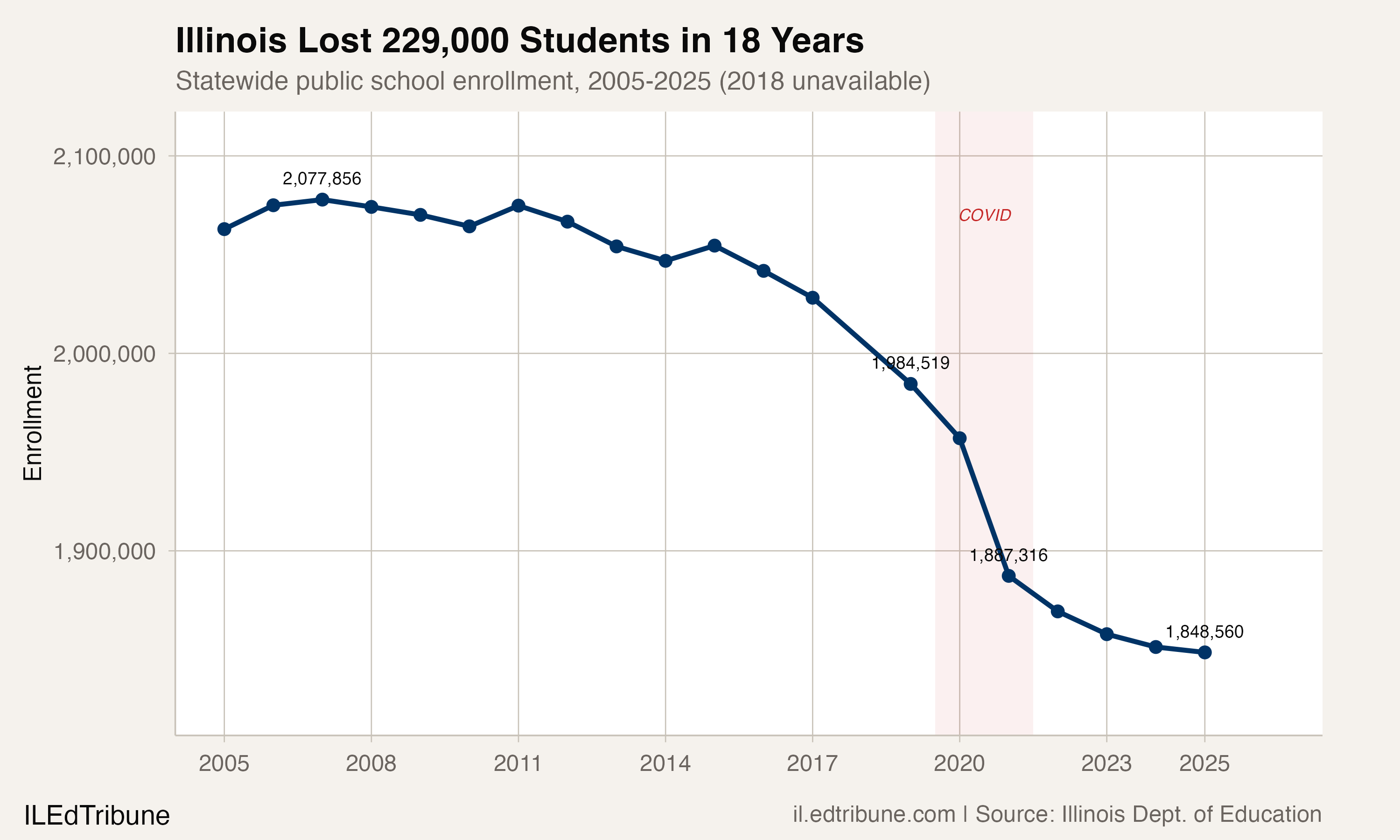
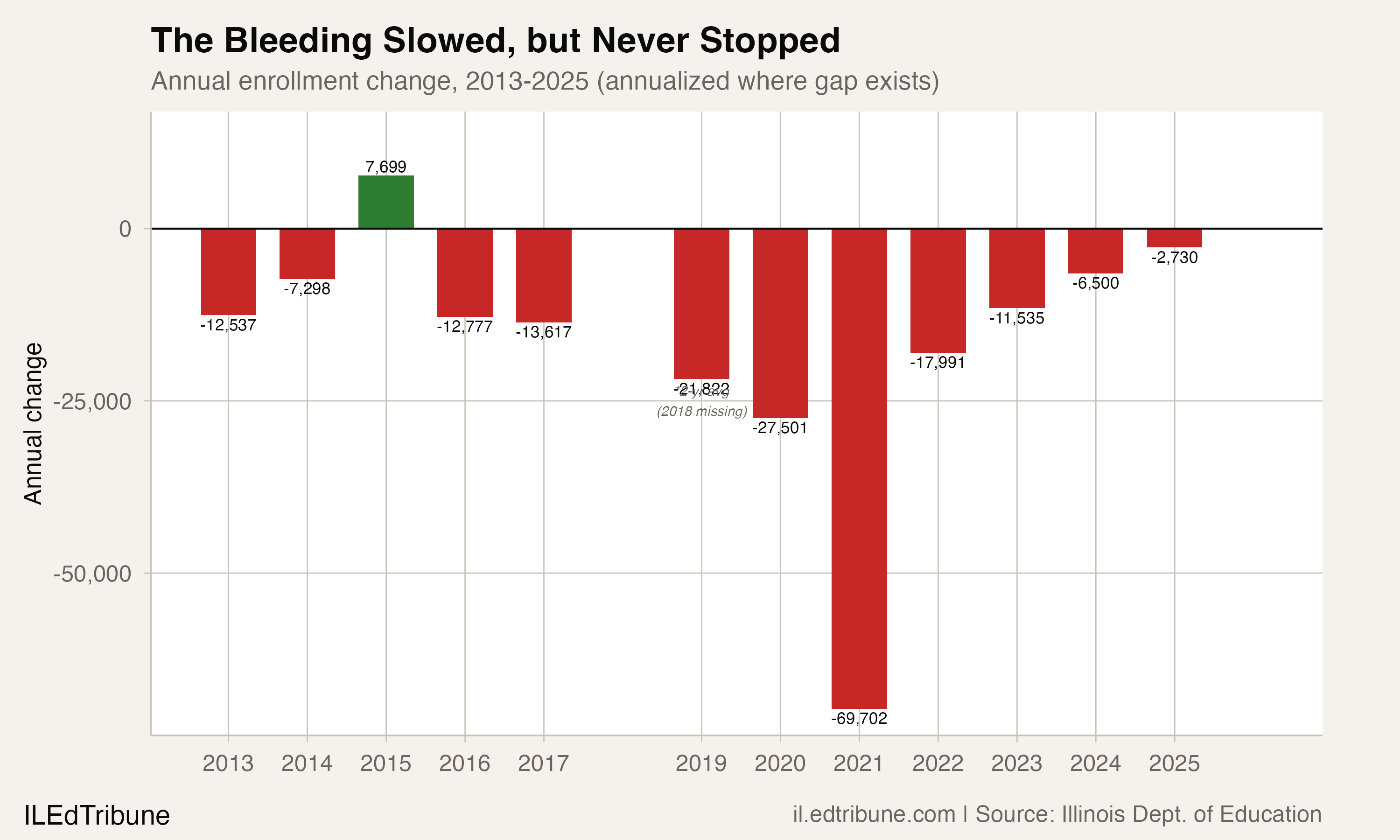
The rate of decline has slowed substantially: from 69,702 in 2021 to just 2,730 in 2025. That deceleration suggests Illinois may be approaching a floor. But it is a floor at 135,959 fewer students than 2019, and 229,296 fewer than the 2007 peak.
Chicago drives a quarter of the damage
City of Chicago SD 299 lost 42,286 students between 2019 and 2024, an 11.6% decline that accounts for 25.4% of all losses statewide. The district enrolled 363,954 students in 2019 and 321,668 in 2024. The top 20 districts by absolute loss collectively account for 44.5% of the statewide decline.
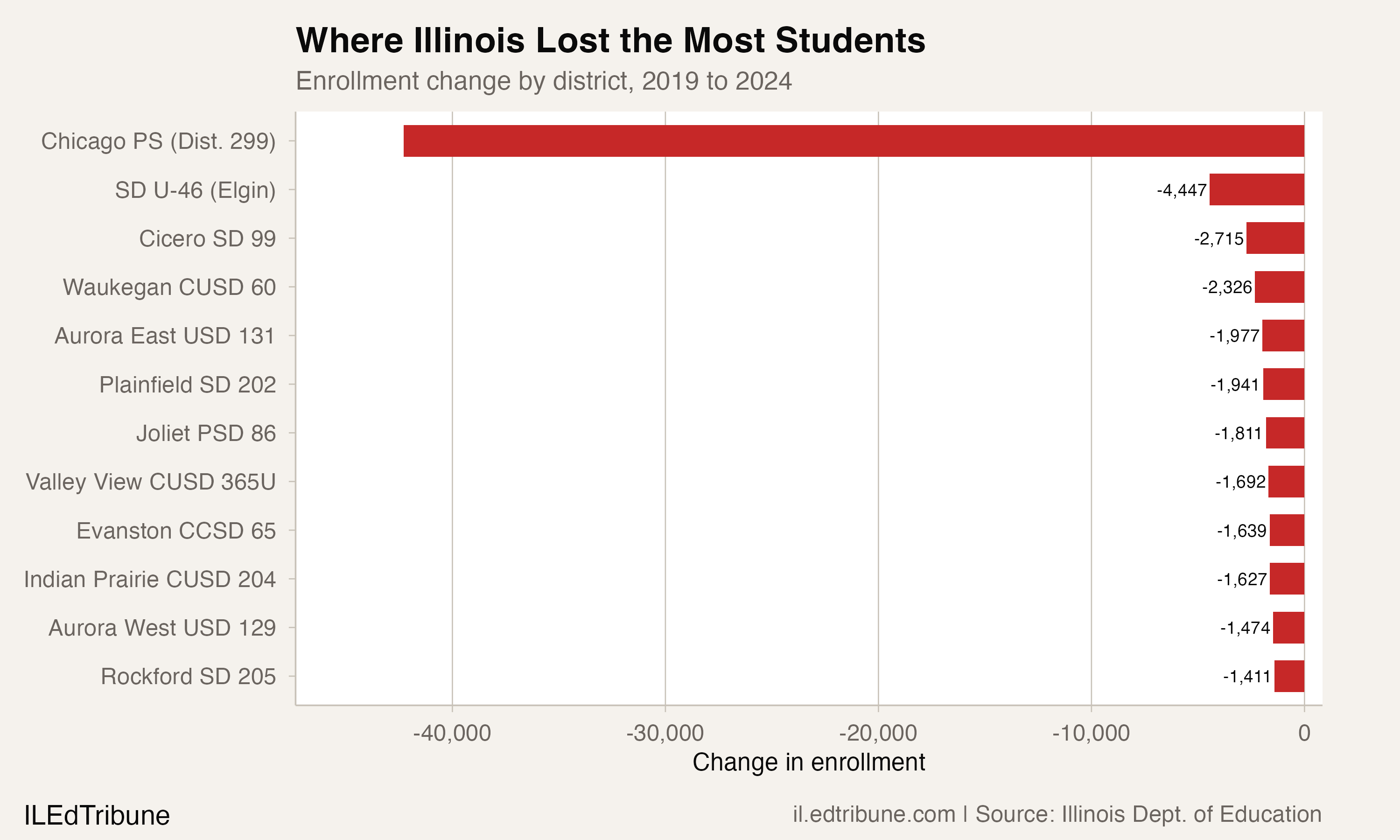
Behind Chicago, the losses are concentrated in the collar counties and industrial corridors. SD U-46 in Elgin lost 4,447 students (11.6%). Cicero SD 99, a majority-Latino elementary district west of Chicago, lost 2,715 (24.1%). Waukegan CUSD 60 lost 2,326 (14.7%).
Several of these districts share a common profile: majority-Latino, working-class, and located in communities where the cost of living has been rising faster than wages.
The size gradient
District size is the single strongest predictor of whether a district recovered. Among the 24 largest districts (10,000+ students), only two, or 8.3%, reached their 2019 enrollment by 2024. Among the 255 smallest districts (under 500 students), 63, or 24.7%, recovered.
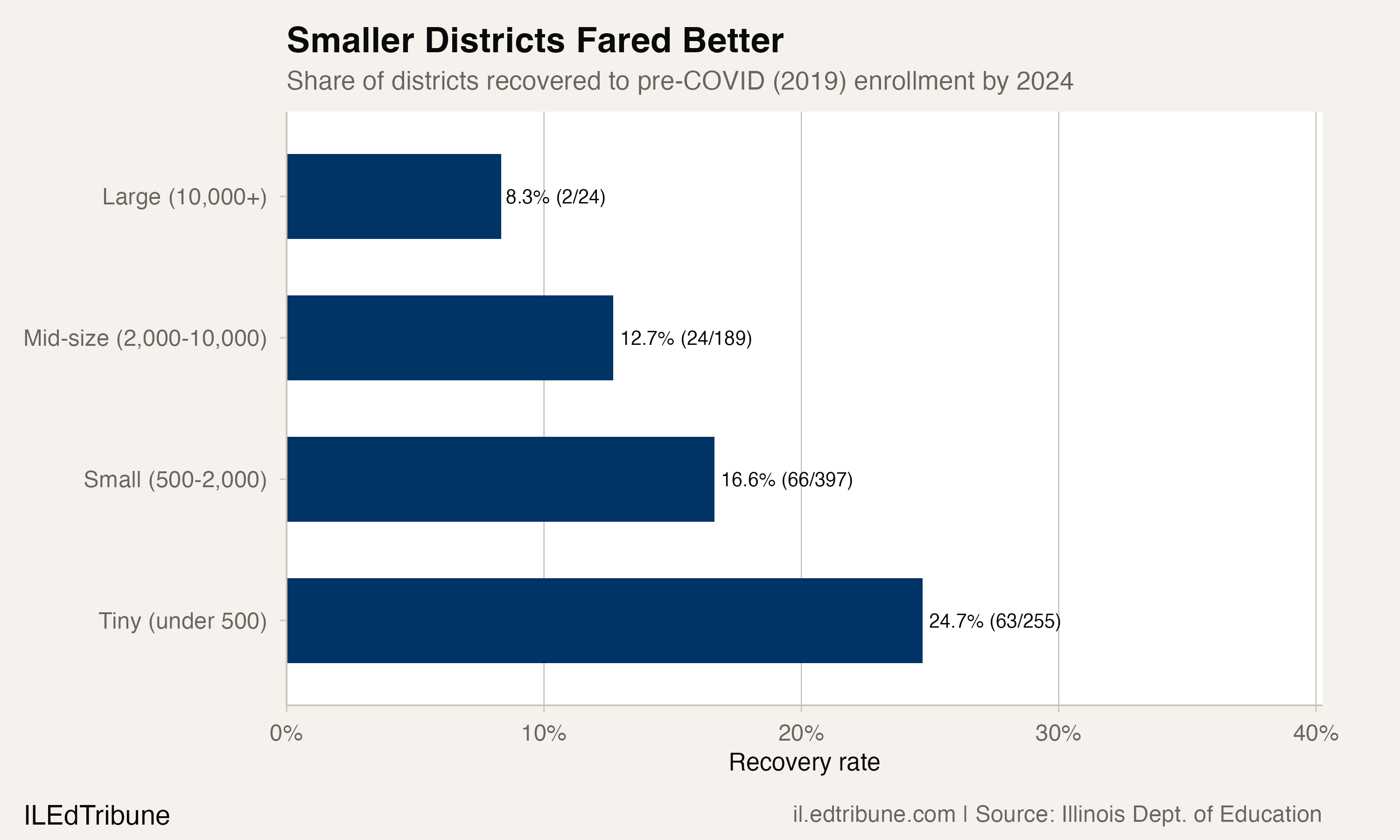
This is not a simple story about small districts being more resilient. Small districts move on smaller margins: gaining 15 students in a district of 300 is a 5% recovery. Large districts need thousands of new enrollments to close the gap, and thousands of new students are not materializing.
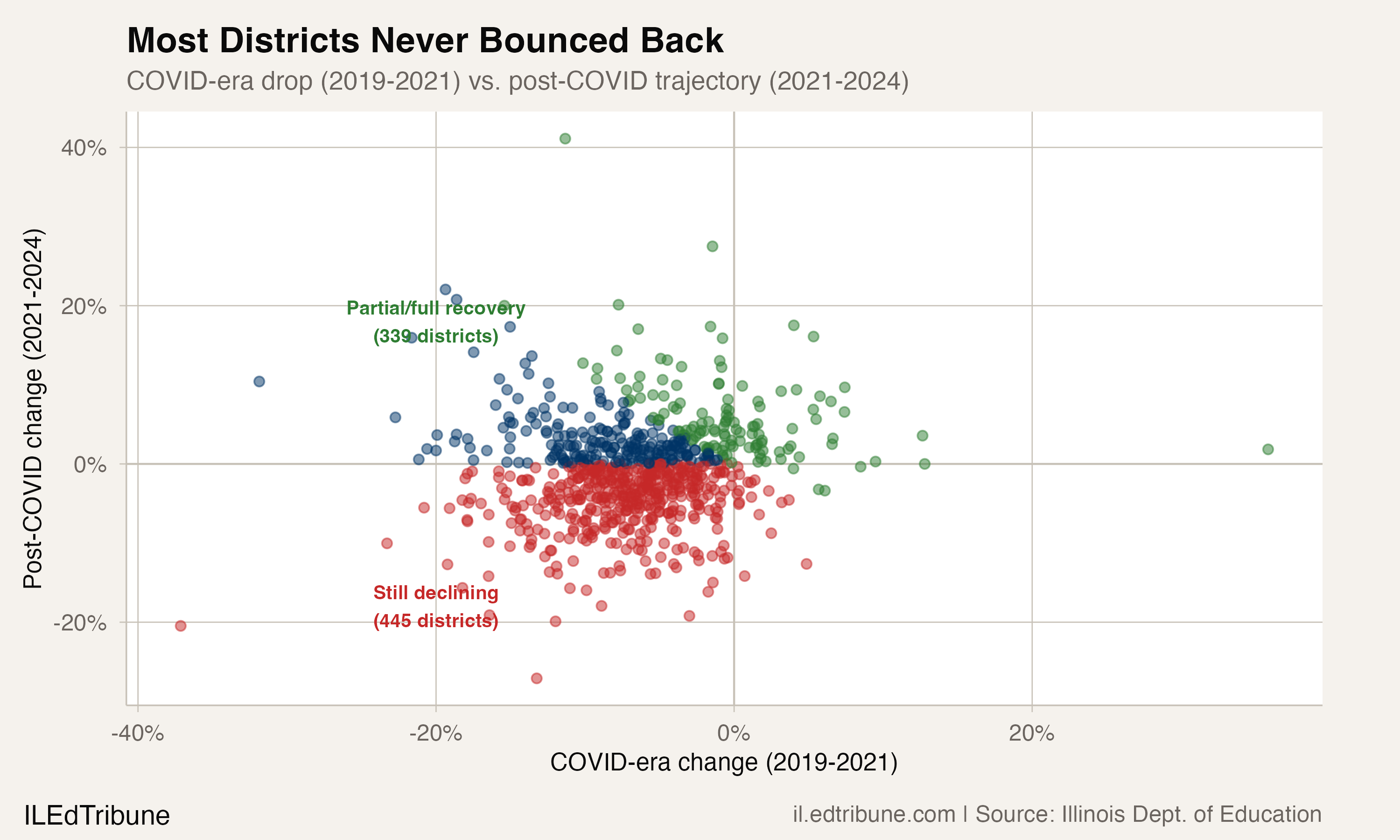
More troubling: 55.2% of all districts (478 of 866) were still losing students between 2021 and 2024, not recovering from their trough but extending the decline. The pandemic did not just knock enrollment down. For the majority of Illinois districts, it broke whatever stabilizing mechanism previously existed.
What is pulling students out of the system
Three forces are converging. Their relative contributions cannot be cleanly separated in enrollment data alone, but each has supporting evidence.
The most direct driver is demographic. Illinois has lost more than 172,000 residents under 18 since 2020, a 6% decline that ranks as the highest percentage youth population loss of any state. Chicago births fell from roughly 44,000 per year in 2009 to 33,000 in 2019, according to a Kids First Chicago analysis, shrinking the pipeline of kindergarten-eligible children by about 11,000 annually.
Out-migration compounds the birth rate decline. Chicago has lost more than 260,000 Black residents since 2000, driven by factors including the demolition of public housing, school closures, and cost of living. Chicago's cost of living is 31% higher than the state average.
A third factor, harder to quantify, is the shift to alternatives. Illinois does not require homeschool families to register, making precise counts impossible. Nationally, about 3.3% of students were homeschooled before the pandemic. Multiple surveys suggest that figure has risen substantially since 2020, with the Census Bureau's Household Pulse Survey estimating roughly 6% nationally. If Illinois tracks that pattern, even a modest increase on a base of 1.85 million students represents tens of thousands of children no longer in public school counts.
The fiscal cliff behind the enrollment cliff
The enrollment losses arrived alongside, and were partially masked by, an unprecedented influx of federal money. Illinois schools received approximately $7.9 billion in ESSER pandemic relief funds, which districts used for construction, technology, tutoring, and temporary staffing. That money is now gone.
"This is not permanent money." — Northern Public Radio, Aug. 2024
Districts that used ESSER funds to maintain staffing levels despite enrollment losses now face the compound pressure of fewer students and fewer federal dollars simultaneously. The Trump administration rescinded $77 million in remaining Illinois ESSER funds that 27 districts and several grantees had planned to spend through 2026, cutting programs for students experiencing homelessness, students with disabilities, and English learners.
In Chicago, enrollment losses have left 58% of CPS schools operating below 70% capacity, with 144,000 empty seats across the system. The Civic Federation found that underutilized high schools spend nearly $36,000 per student, compared with $23,662 at efficiently utilized schools, a $12,338 gap that reflects the fixed costs of heating, maintaining, and staffing buildings designed for students who are no longer there.
What the enrollment data cannot resolve
The 82.1% non-recovery rate establishes that the vast majority of Illinois districts have not returned to pre-pandemic levels. It does not establish that these students left because of the pandemic specifically. Illinois was losing roughly 10,000 to 13,000 students per year before COVID arrived. The pandemic accelerated the annual loss rate to 69,702 in 2021, and the rate has since decelerated to 2,730 in 2025, which is actually below the pre-pandemic trend. Whether the state has reached a genuine new equilibrium or is simply in a temporary lull before the smallest-ever kindergarten cohorts work through the system remains an open question.
A stabilization that satisfies no one
The 2025 loss of 2,730 students is the smallest annual decline in the dataset. By the narrow measure of year-over-year change, Illinois is stabilizing. By the broader measure of where the system sits relative to five years ago, it is stabilizing at a level that leaves four in five districts permanently smaller than they were, in buildings designed for students they no longer have, funded by formulas that follow children who have gone elsewhere. The question is no longer whether Illinois recovers its lost enrollment. It is whether the infrastructure, staffing models, and funding formulas built for two million students can be restructured to serve 1.85 million.
Detailed code that reproduces the analysis and figures in this article is available exclusively to EdTribune subscribers.
Discussion
Sign in to join the discussion.
Loading comments...