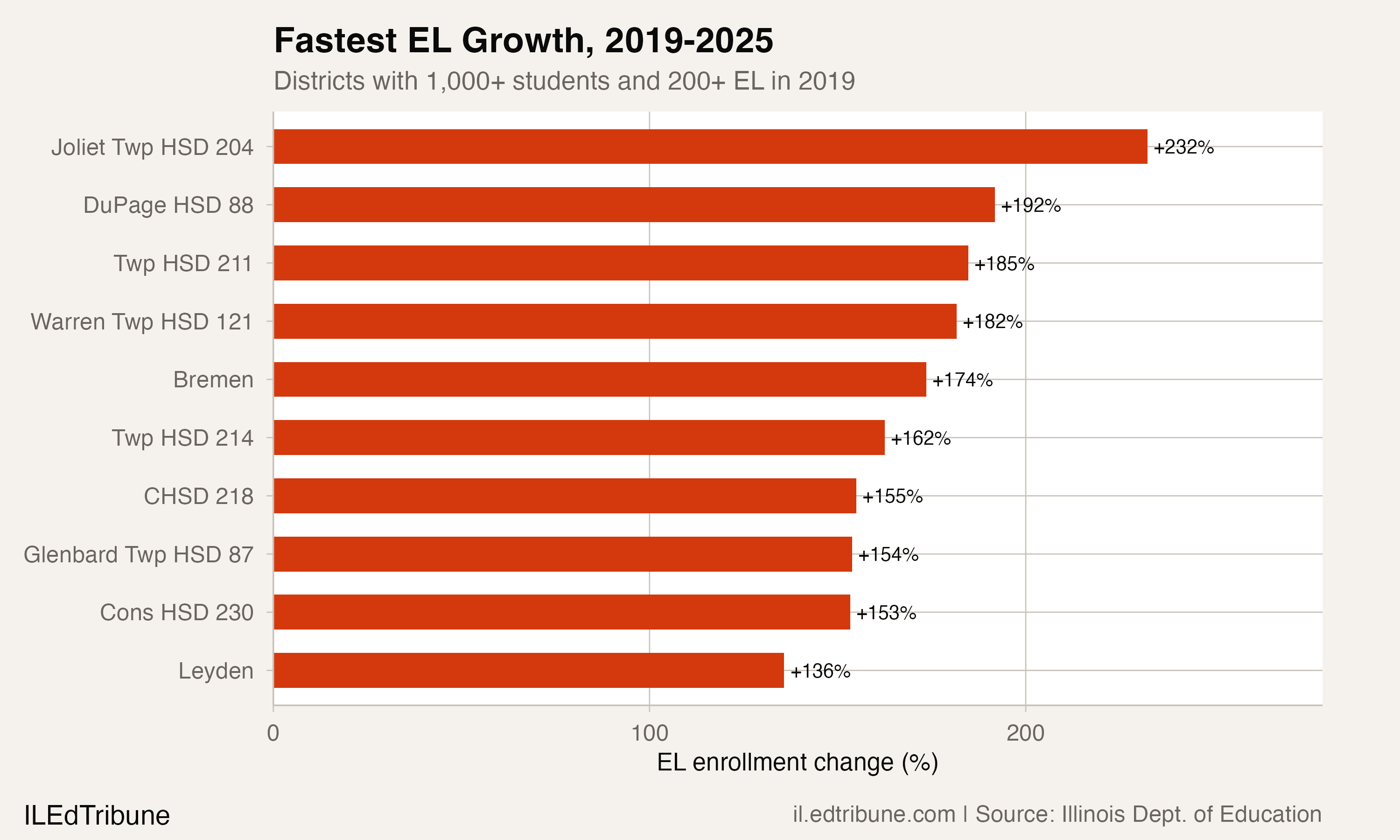
Joliet Township High School District 204 enrolled 494 English learners in 2018-19. By 2024-25, that number had tripled to 1,642 — a 232% increase that pushed the district's English learner share from 7.3% to 24.8%. One in four Joliet Township high school students now requires bilingual or ESL services, in a district that six years ago could have run its EL programs with a handful of classrooms.
Joliet is the most extreme case, but suburban high school districts across the Chicago collar counties are posting triple-digit growth rates. DuPage HSD 88: up 192%. Township HSD 211 (Palatine-Schaumburg): up 185%. Township HSD 214 (Arlington Heights): up 163%. These are comprehensive high schools built for a monolingual student body that has changed faster than their bilingual staffing.
83,000 more English learners statewide
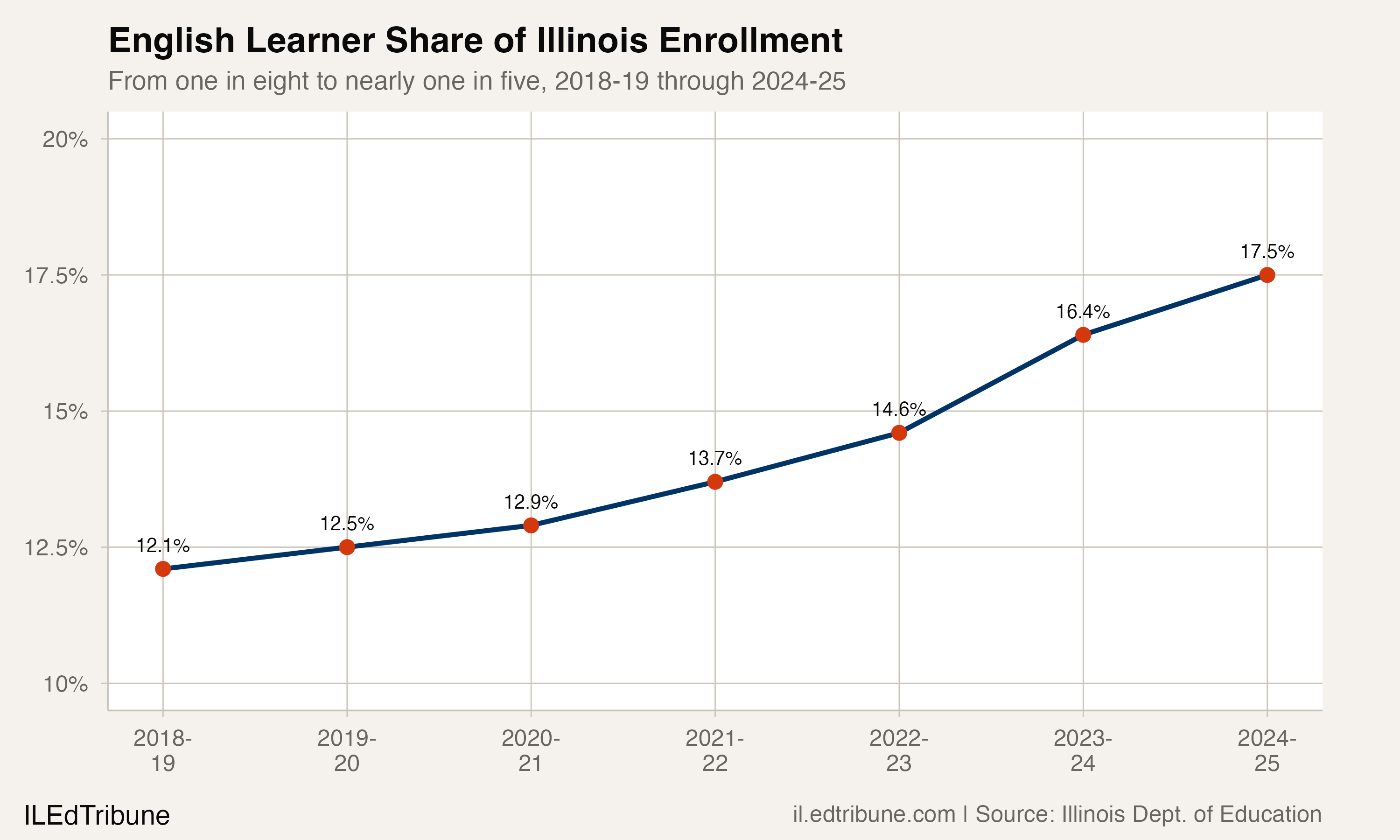
Illinois schools identified 323,498 English learners in 2024-25, up from 240,127 in 2018-19 — a gain of 83,371 students and a 34.7% increase. The English learner share of enrollment rose from 12.1% to 17.5%, meaning nearly one in five Illinois students now receives EL services.
| Year | English Learners | EL Share | Year-over-Year Change |
|---|---|---|---|
| 2018-19 | 240,127 | 12.1% | — |
| 2019-20 | 244,627 | 12.5% | +4,500 |
| 2020-21 | 243,464 | 12.9% | -1,163 |
| 2021-22 | 256,098 | 13.7% | +12,634 |
| 2022-23 | 271,237 | 14.6% | +15,139 |
| 2023-24 | 303,612 | 16.4% | +32,375 |
| 2024-25 | 323,498 | 17.5% | +19,886 |
The acceleration was sharpest in 2023-24, when the state added 32,375 English learners in a single year — more than the combined growth of the first three years in the series. Growth slowed to 19,886 in 2024-25 but remained well above the pre-pandemic pace. The share climbed even in 2020-21, when the raw EL count dipped slightly, because overall enrollment fell faster.
Where three in five students are English learners
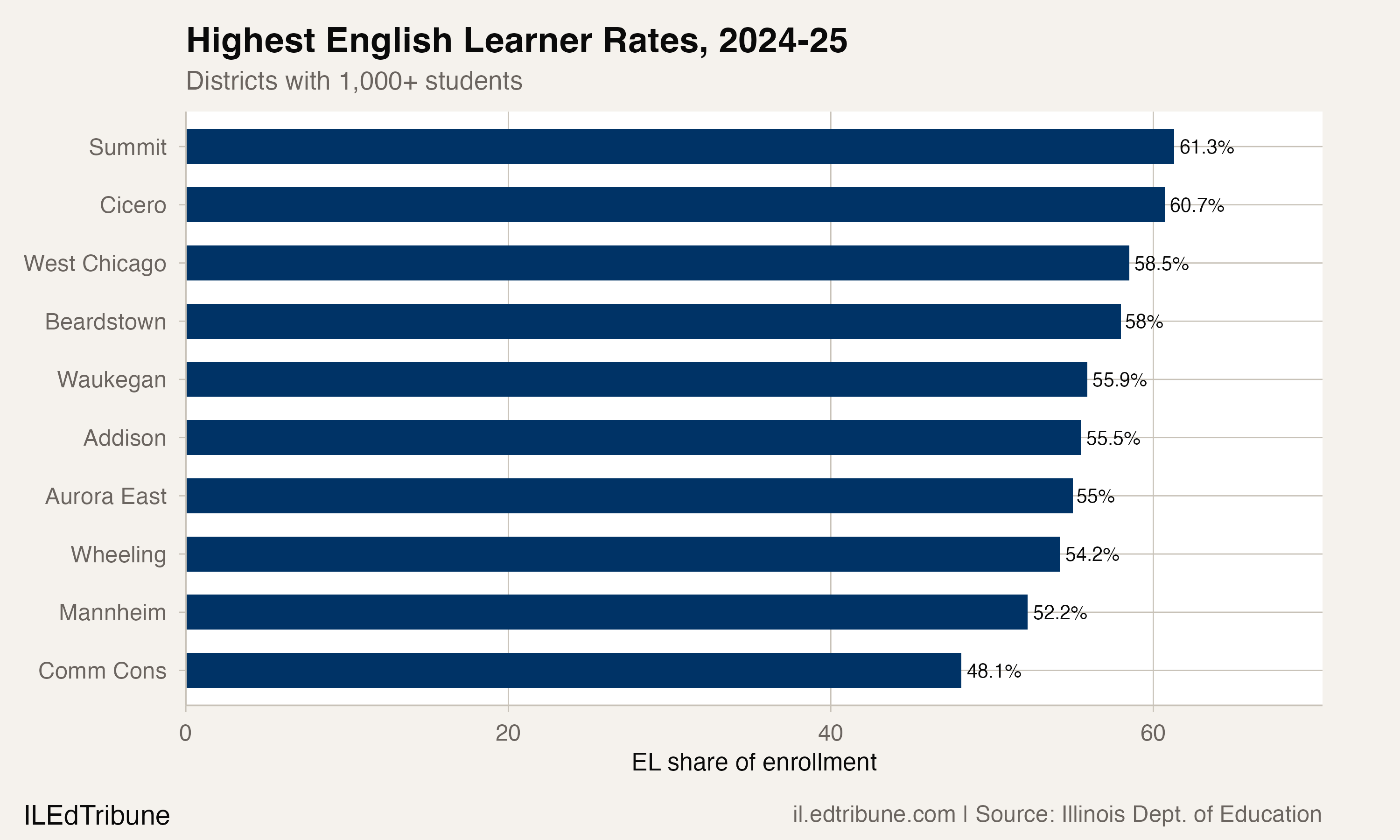
The districts with the highest EL concentrations are not suburban high schools. They are majority-Hispanic elementary and unit districts where bilingual education has been a core function for years:
| District | EL Students | Total | EL Share |
|---|---|---|---|
| Summit SD 104 | 873 | 1,424 | 61.3% |
| Cicero SD 99 | 5,233 | 8,621 | 60.7% |
| West Chicago ESD 33 | 1,878 | 3,211 | 58.5% |
| Beardstown CUSD 15 | 865 | 1,492 | 58.0% |
| Waukegan CUSD 60 | 7,575 | 13,551 | 55.9% |
| Addison SD 4 | 1,871 | 3,371 | 55.5% |
| Aurora East USD 131 | 6,624 | 12,043 | 55.0% |
Cicero SD 99 has operated majority-EL classrooms for more than a decade. Waukegan CUSD 60 has built a bilingual infrastructure that serves 7,575 students. These districts know what it means to run a school system where English learner services are not a supplemental program but the core instructional model.
The challenge is different in suburban high school districts where the EL population has grown from 5-8% to 15-25% in six years. A high school that had one ESL teacher per building in 2019 may now need bilingual-certified teachers across English, math, science, and social studies — in a state where 1,360 of 4,000 teaching vacancies are already in special education and bilingual positions are equally hard to fill.
The districts absorbing the most growth
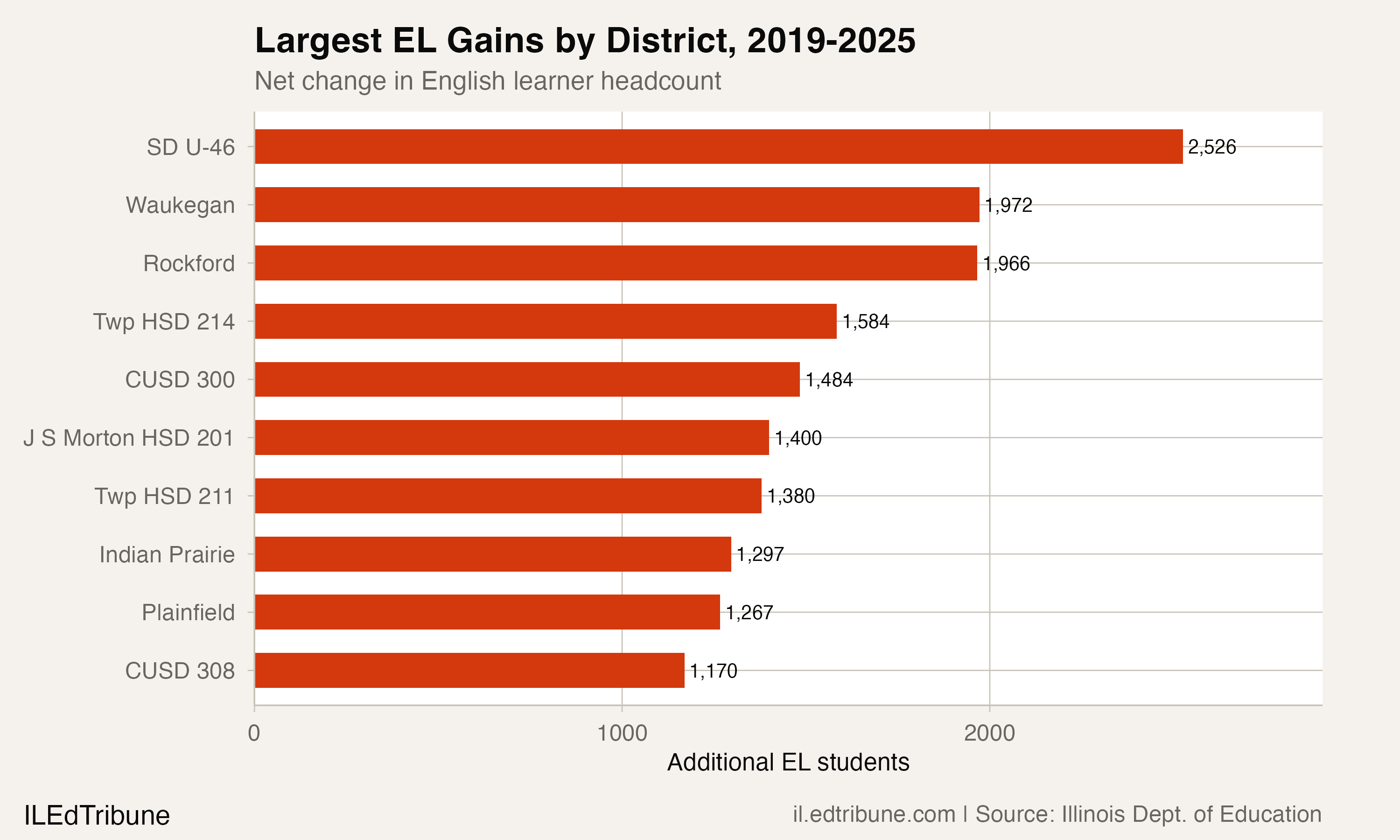
In absolute terms, the largest EL gains are in large suburban unit districts that combine elementary and secondary enrollment:
| District | 2018-19 EL | 2024-25 EL | Gain | EL Share 2025 |
|---|---|---|---|---|
| SD U-46 (Elgin) | 12,862 | 15,388 | +2,526 | 45.9% |
| Waukegan CUSD 60 | 5,603 | 7,575 | +1,972 | 55.9% |
| Rockford SD 205 | 4,990 | 6,956 | +1,966 | 24.7% |
| Township HSD 214 | 975 | 2,559 | +1,584 | 21.8% |
| CUSD 300 | 3,573 | 5,057 | +1,484 | 24.3% |
| J S Morton HSD 201 | 1,523 | 2,923 | +1,400 | 38.6% |
| Township HSD 211 | 747 | 2,127 | +1,380 | 17.3% |
SD U-46, based in Elgin and one of the state's largest districts, added 2,526 English learners and now serves 15,388 — 45.9% of its enrollment. Rockford SD 205 added 1,966 EL students, growing from a 17.4% share to 24.7%. Township HSD 214, covering Arlington Heights and surrounding northwest suburban communities, added 1,584 EL students to reach 2,559 — more than a fifth of its enrollment, up from 8.1%.
A shortage that predates the surge
The bilingual teacher pipeline was already inadequate before the EL population grew by 83,000 students. Bilingual certification in Illinois requires additional testing and coursework beyond a standard teaching license, and university preparation programs are not producing enough candidates. A 2024 analysis from the Latino Policy Forum found that the state lacked the pipeline to staff bilingual classrooms even at pre-surge enrollment levels.
An ISBE survey found that 43% of school leaders received no or few qualified applicants for open positions, with bilingual and special education positions the hardest to fill. Statewide, 87% of school leaders reported teacher shortages as a persistent problem.
The state created a $45 million Teacher Vacancy Grant program to help 170 districts fill positions, and Governor Pritzker's fiscal year 2026 budget includes another $45 million for the program. But the grants are not targeted specifically at bilingual education, and districts competing for the same small pool of bilingual-certified candidates are bidding against each other.
Whether the 83,371-student EL increase reflects newly arrived immigrant families, broader identification of existing students who qualify for services, or some combination is not something the enrollment data can answer. ISBE does not publish enrollment by immigration status. What is clear is that suburban high school districts built for English-speaking students now serve a different population, and the staffing has not caught up.
RELATED: Illinois enrollment nears a plateau after losing 136,000 studentsET
Detailed code that reproduces the analysis and figures in this article is available exclusively to EdTribune subscribers.
Discussion
Sign in to join the discussion.
Loading comments...