Chicago Public Schools enrolled 160,004 Black students in the 2012-13 school year. By 2024-25, that number had fallen to 110,482. The 49,522-student loss, a 31.0% decline, accounts for 82.2% of the 60,216 Black students Illinois public schools lost statewide over the same period. No other district comes close. The next-largest loss outside Chicago, in East St. Louis, was 911 students.
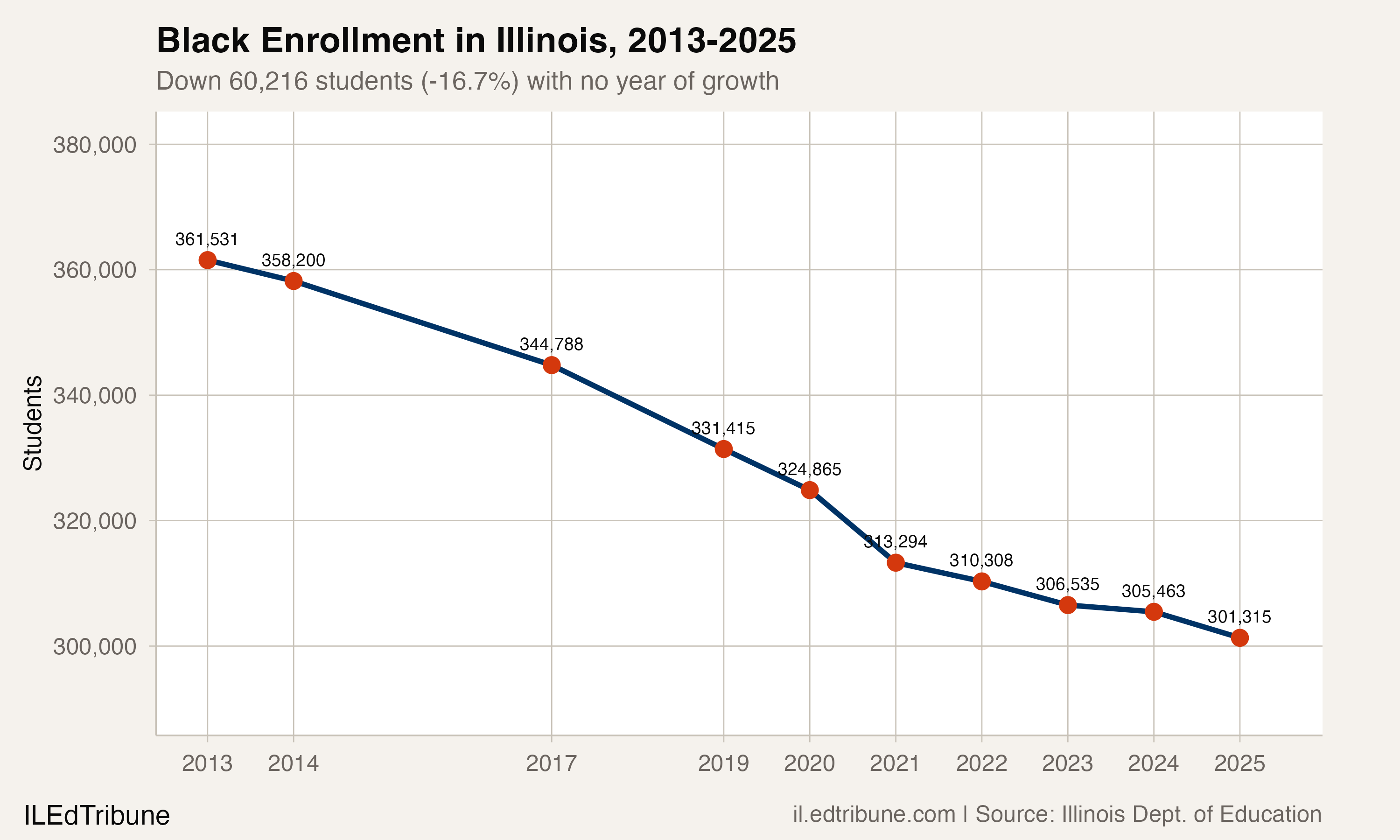
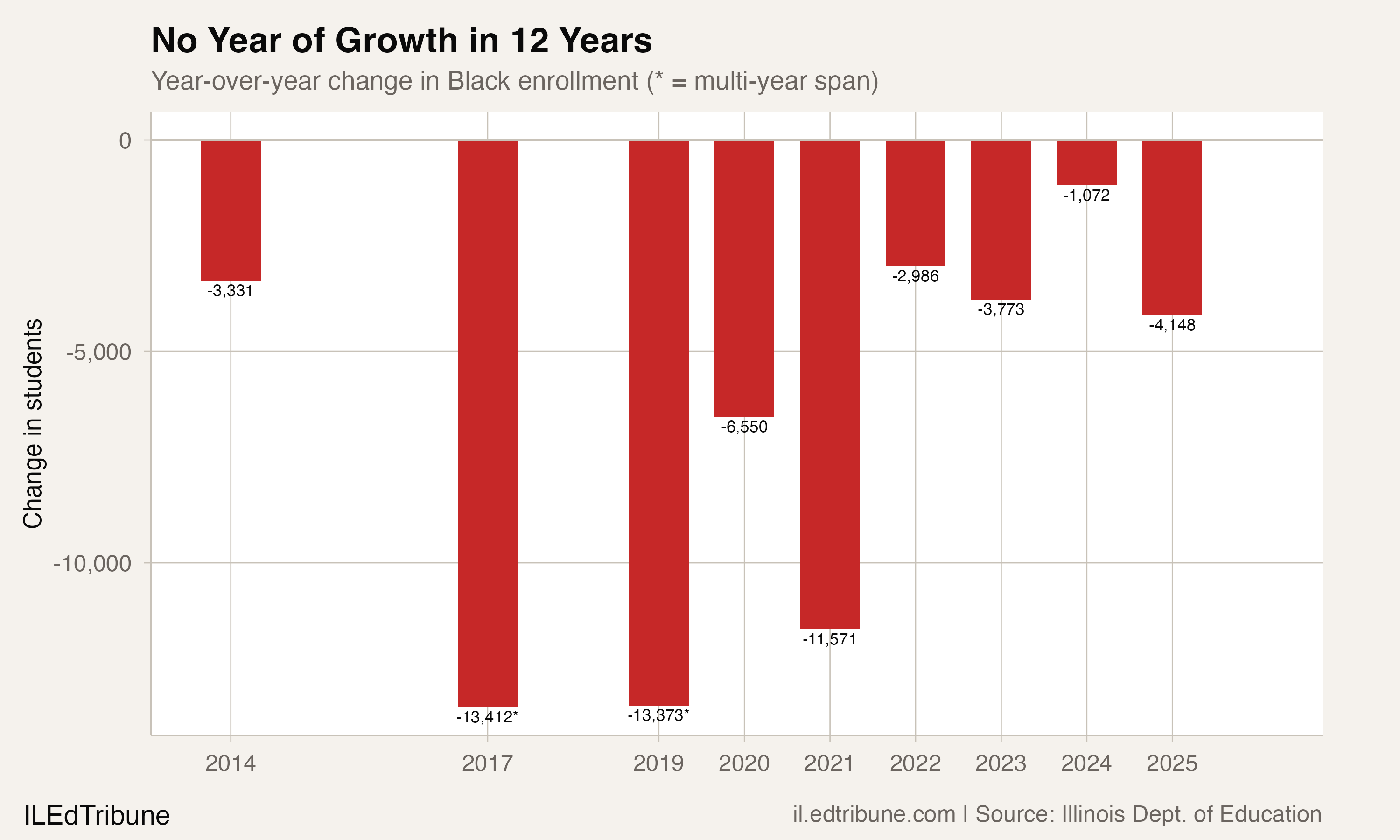
The statewide decline is unbroken. Black enrollment fell in every measured year from 2013 to 2025, dropping from 361,531 to 301,315. That 16.7% contraction is steeper than Illinois's overall enrollment decline of 10.0% over the same period. Black students accounted for 29.3% of total enrollment losses despite making up just 17.6% of students at the start.
One district, four-fifths of the loss
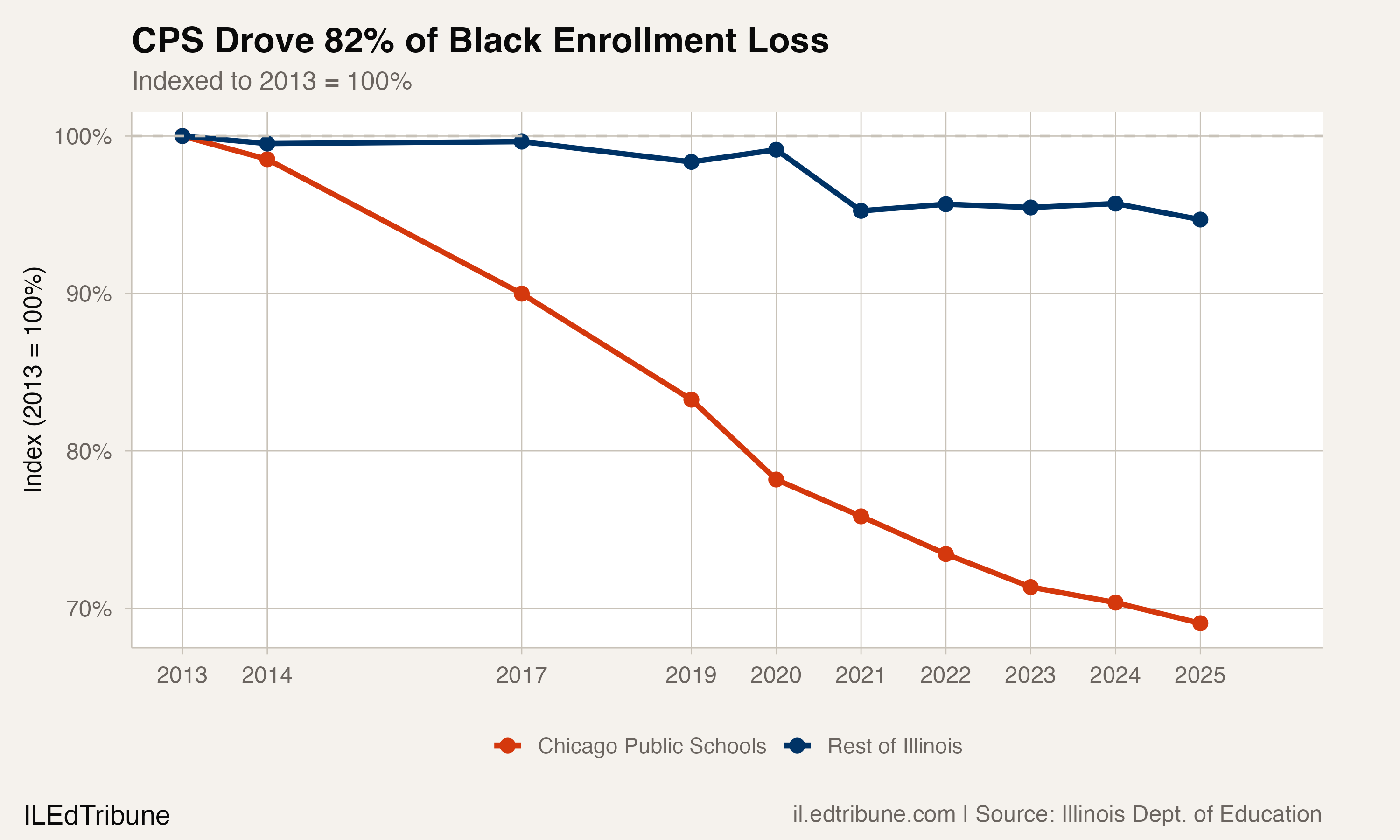
The divergence between Chicago and the rest of the state is stark. Outside CPS, Black enrollment fell from 201,527 to 190,833 between 2013 and 2025, a decline of 5.3%. Inside CPS, the drop was 31.0%. Indexed to 2013, the rest of Illinois held at roughly 95% of its baseline while Chicago cratered to 69%.
Within CPS, Black students went from 40.5% of district enrollment to 34.2%. Hispanic students, who also declined in absolute terms within CPS (from 169,603 to 153,124), now hold a 42,642-student lead over Black students. In 2013, that lead was 17,778. The shift means Hispanic students now compose 47.4% of CPS enrollment while Black students sit at 34.2%, a gap that has more than doubled in a decade.
The enrollment decline maps onto a broader population exodus. A 2020 report from the University of Illinois at Chicago found that Chicago's Black population had declined by more than 350,000 since peaking at nearly 1.2 million in 1980, driven by public housing demolition, school closures, foreclosure fallout, and lack of neighborhood amenities. Most departing residents relocated not to the South but to nearby counties: Will, Kendall, Kane, and McHenry. The report noted that outmigrants moved to areas with lower educational attainment and earnings compared to white outmigrants from the same city.
The school closure spiral
CPS closed 49 elementary schools and one high school in 2013, the largest mass school closure in modern American history. The closures disproportionately fell in Black neighborhoods. A decade later, the underenrollment problem has worsened. A ProPublica investigation found that 47 CPS schools now operate at less than one-third capacity, with roughly 150 schools sitting at least half-empty. Frederick Douglass Academy High School had 28 students at a per-pupil cost of $93,000. The 47 most severely underenrolled buildings had absorbed $213 million in maintenance and renovations since 2017.
"Deep distrust" of CPS persists in neighborhoods disproportionately affected by closures, particularly communities like Bronzeville. -- ProPublica, 2024
The closures were supposed to consolidate students into stronger schools. Instead, they appear to have accelerated the departure of families from the system. Kids First Chicago reported that between 2000 and 2015, more than 180,000 Black residents left the city while CPS lost 64,000 students. Declining birth rates compound the problem: Chicago births fell from roughly 44,000 in 2009 to 33,000 in 2019, a 25% drop that shrinks every incoming kindergarten class regardless of migration patterns.
The south suburbs are hollowing out
Outside Chicago, the largest Black enrollment losses are concentrated in Cook County's south suburbs and a handful of older industrial cities. Thornton Township HSD 205 lost 869 Black students between 2019 and 2025, a 21.0% decline. Joliet PSD 86 lost 861 (-33.5%). Country Club Hills SD 160 lost 449 (-39.6%). Harvey SD 152 lost 419 (-33.2%).
| District | 2019 | 2025 | Change | % Change |
|---|---|---|---|---|
| East St. Louis SD 189 | 5,273 | 4,362 | -911 | -17.3% |
| Thornton Twp HSD 205 | 4,145 | 3,276 | -869 | -21.0% |
| Joliet PSD 86 | 2,571 | 1,710 | -861 | -33.5% |
| Waukegan CUSD 60 | 2,222 | 1,504 | -718 | -32.3% |
| Rich Twp HSD 227 | 2,600 | 1,990 | -610 | -23.5% |
| Dolton SD 149 | 2,494 | 1,963 | -531 | -21.3% |
| Country Club Hills SD 160 | 1,134 | 685 | -449 | -39.6% |
| Harvey SD 152 | 1,261 | 842 | -419 | -33.2% |
These communities represent a second wave of the same pattern that emptied Chicago's South Side. Census estimates show that Country Club Hills, Dolton, Harvey, Flossmoor, Homewood, and Park Forest all lost 3% or more of their total population between 2020 and 2024 alone. The south suburbs that once absorbed Black families leaving Chicago are now losing them to the next ring out.
Where the gains are
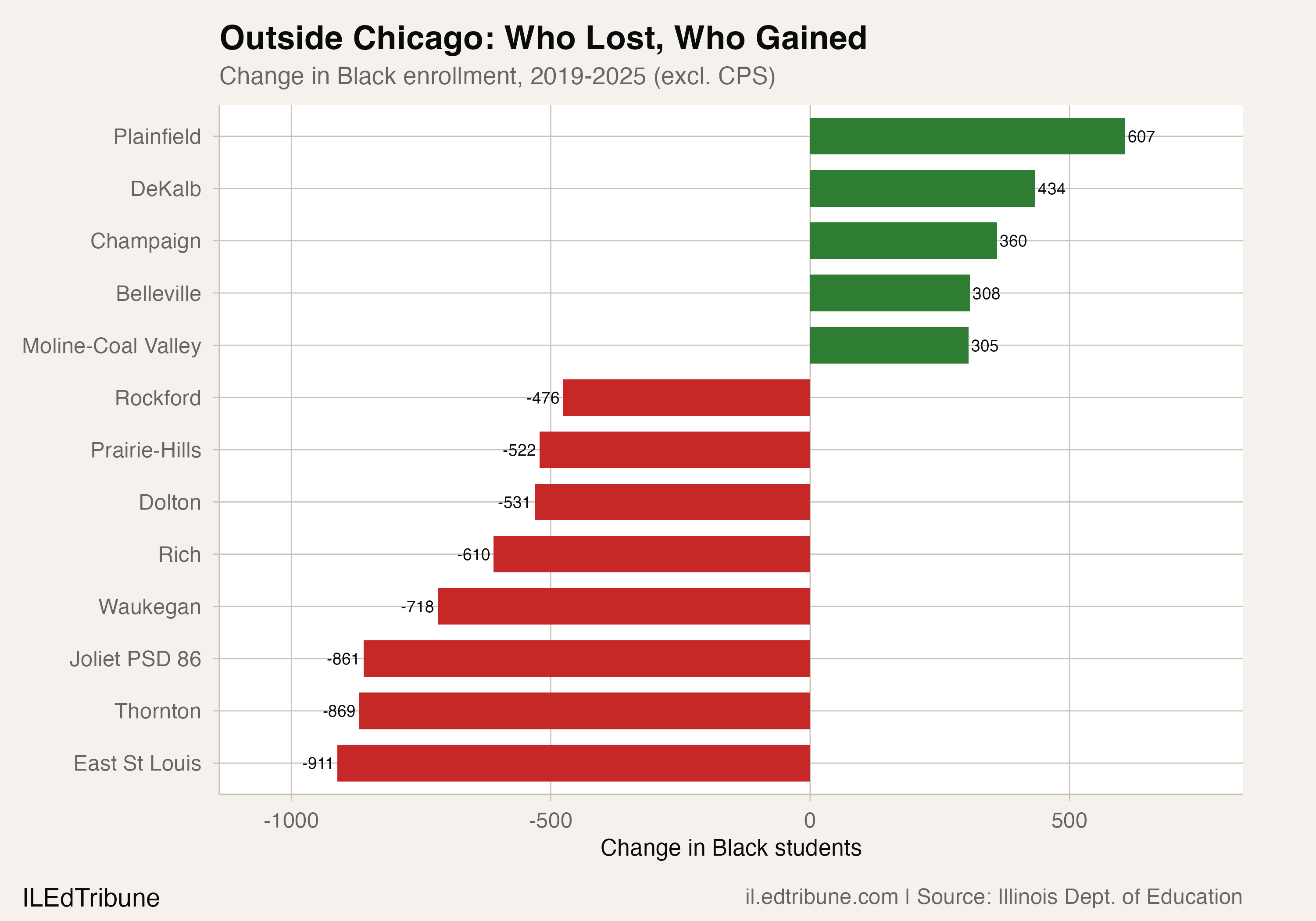
Among 283 districts with at least 50 Black students in 2019, 170 saw declines by 2025 while 110 posted gains. The gaining districts share a profile: they are farther from Chicago, faster-growing, and cheaper. Plainfield SD 202 in Will County added 607 Black students (+21.4%). DeKalb CUSD 428, home to Northern Illinois University, gained 434 (+30.8%). Champaign CUSD 4 added 360 (+10.0%). Belleville Township HSD 201 in the Metro East gained 308 (+16.3%).
The UIC report's finding that Black outmigrants from Chicago tend to move to nearby counties rather than leaving the state entirely is consistent with this pattern. Will County, which contains Plainfield and Joliet, and DeKalb County both appear in both the census growth data and the school enrollment gains. Crain's Chicago Business reported that safety was a primary motivator, with one Bronzeville family describing multiple shootings near their home before relocating. But housing affordability is the structural driver: median home prices in Plainfield and DeKalb are a fraction of Chicago's, and Will County's property tax rates, while still high by national standards, are lower than south Cook County's.
The gains, however, do not offset the losses. The seven largest exurban gainers added a combined 2,282 Black students between 2019 and 2025. CPS alone lost 22,725 over the same period.
The widening gap
In 2013, Hispanic students outnumbered Black students statewide by 6.5 percentage points: 24.1% to 17.6%. By 2025, the gap had nearly doubled to 12.3 points, with Hispanic students at 28.6% and Black students at 16.3%. Hispanic enrollment grew by 33,637 students (+6.8%) over the period while Black enrollment fell by 60,216 (-16.7%). Multiracial enrollment surged by 21,560 (+35.0%), from 61,625 to 83,185.
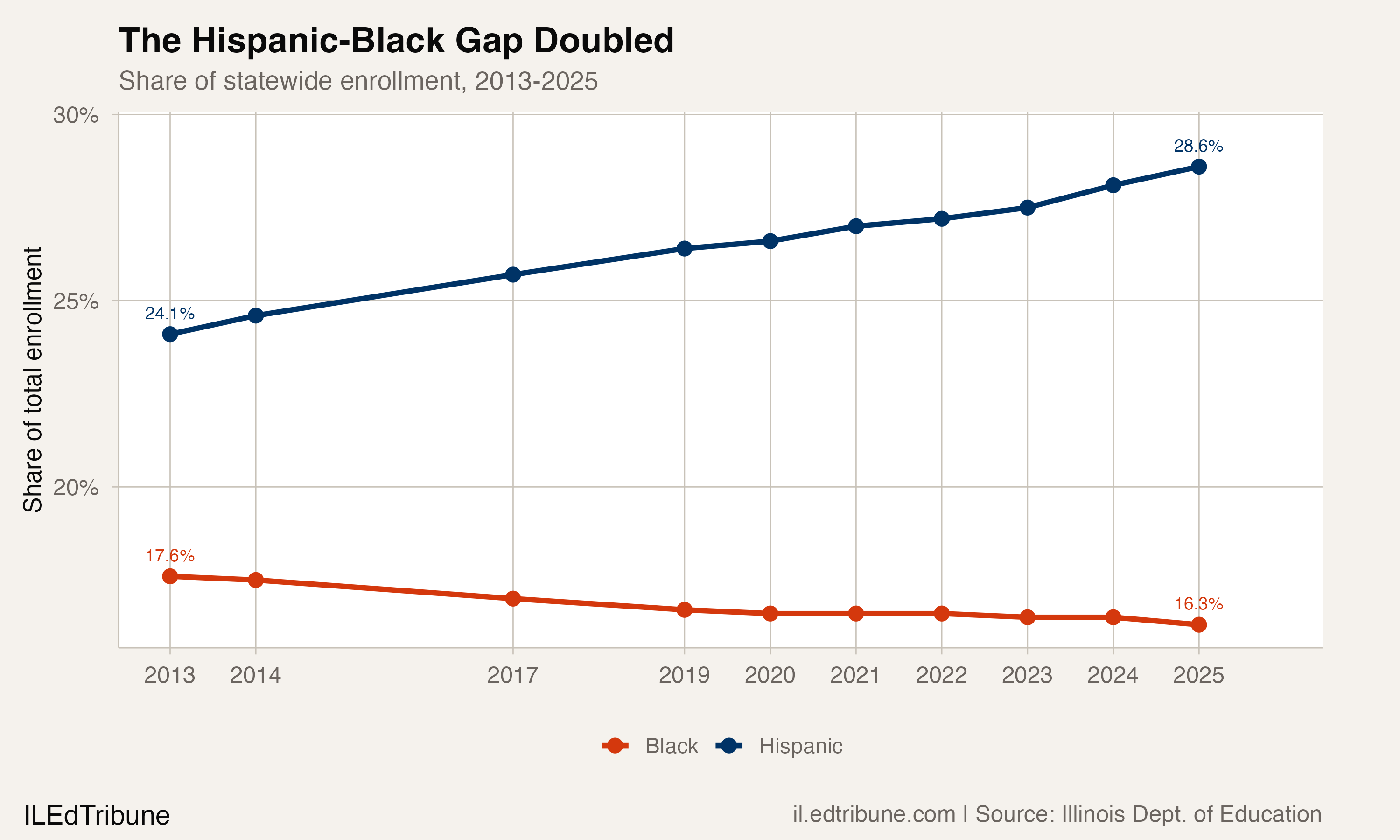
The gap widened through both addition and subtraction. Hispanic enrollment dipped during COVID but has recovered strongly since 2022, adding nearly 20,000 students in the last three years alone. Black enrollment, by contrast, showed no COVID recovery at all. The sharpest single-year Black enrollment loss was 11,571 students in 2020-21, during the pandemic. The 2024-25 loss of 4,148 students, after what looked like a brief deceleration in 2023-24 (a loss of just 1,072), suggests the decline has not stabilized.
What birth rates cannot explain
Declining birth rates are the most commonly cited cause of enrollment decline across Illinois. They are real: Kids First Chicago documented a 25% drop in Chicago births between 2009 and 2019. But birth rate decline cannot explain why Black enrollment fell at nearly twice the rate of overall enrollment statewide, or why the loss is so overwhelmingly concentrated in one district. White enrollment fell by 220,490 students (-21.2%) over the same period, spread across hundreds of districts. Black enrollment fell by 60,216, but 82.2% of it came from CPS. The geographic concentration points to place-specific forces: housing policy, school governance, neighborhood disinvestment, and the compounding effect of population loss itself.
Whether the families leaving CPS are leaving public education or simply moving to other districts matters enormously for policy. If the loss reflects migration to suburbs, the state's total Black enrollment should eventually stabilize as exurban districts grow. If families are switching to private schools, homeschooling, or leaving the state entirely, the loss is permanent. The enrollment data alone cannot distinguish between these scenarios, though the modest gains in Will County and downstate suggest at least some redistribution within Illinois.
The 2025-26 kindergarten cohort will be the first to reflect births from the pandemic years. If Black enrollment losses accelerate again in that data, demographic forces will have tightened their grip. If they ease, the outmigration pipeline may finally be slowing.
Detailed code that reproduces the analysis and figures in this article is available exclusively to EdTribune subscribers.
Discussion
Sign in to join the discussion.
Loading comments...