Twenty Illinois districts lowered their chronic absenteeism rate in each of the four annual updates from 2020-21 through 2024-25. Among the 785 districts with complete data for that span, 765 did not. Put another way: 97.5% of comparable districts had at least one year when the rate rose or did not fall.
The 20 districts enrolled 47,411 students in 2024-25, equal to 2.6% of statewide public school enrollment. The group is small, but the streak is strict: four separate year-over-year declines in the same district.
Rochelle: the largest drop in the group
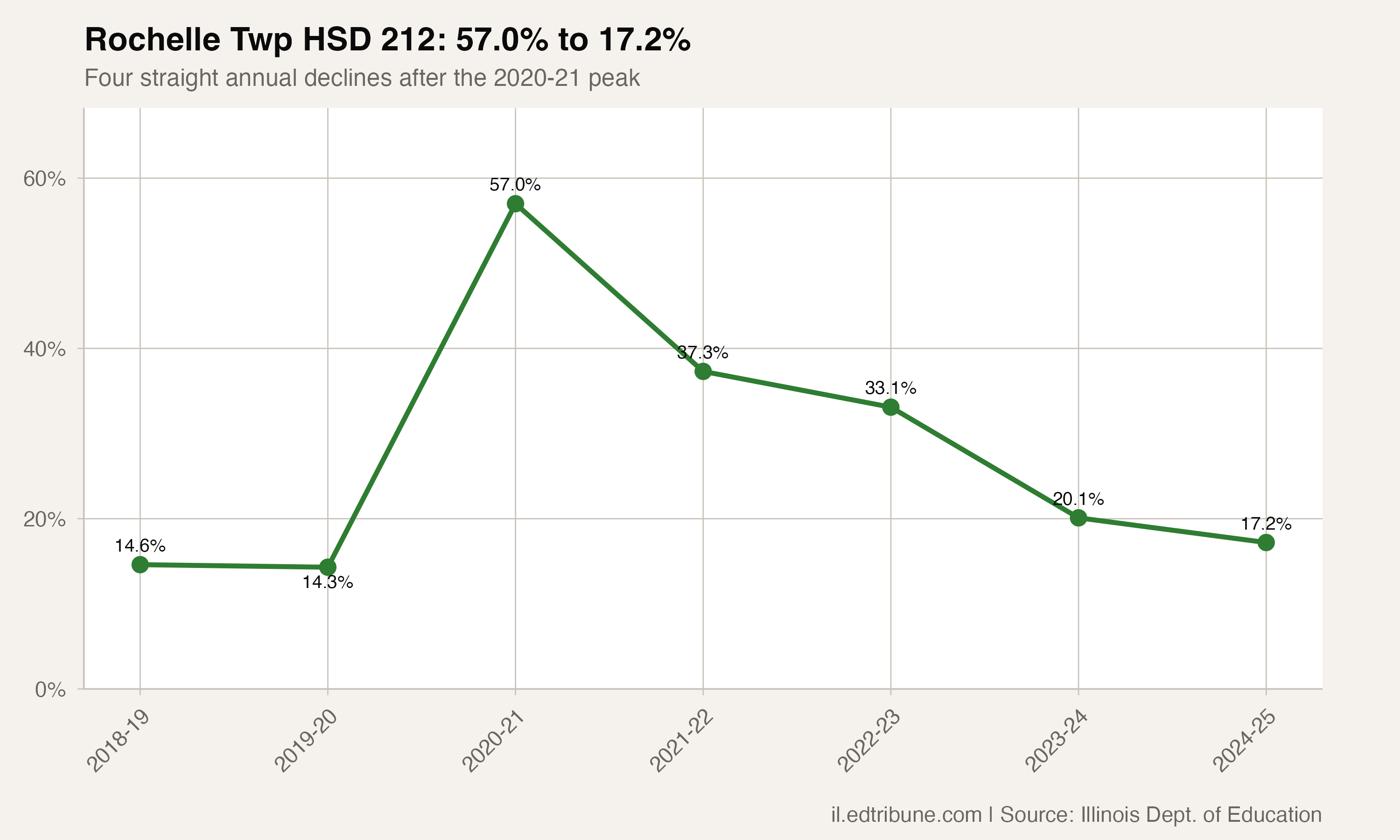
Rochelle Twp↗ET HSD 212 had the largest drop among the 20 four-year improvers. Its chronic absenteeism rate moved from 57.0% in 2020-21 to 37.3%, 33.1%, 20.1% and 17.2% in the next four reports.
That is a 39.8-point decline. Rochelle's 2024-25 rate was also below the statewide 25.4% rate.
The narrower superlative matters. Rochelle was not the largest raw 2020-21 to 2024-25 decline statewide; it ranked second among districts with complete data. It was the largest decline among districts that improved every year.
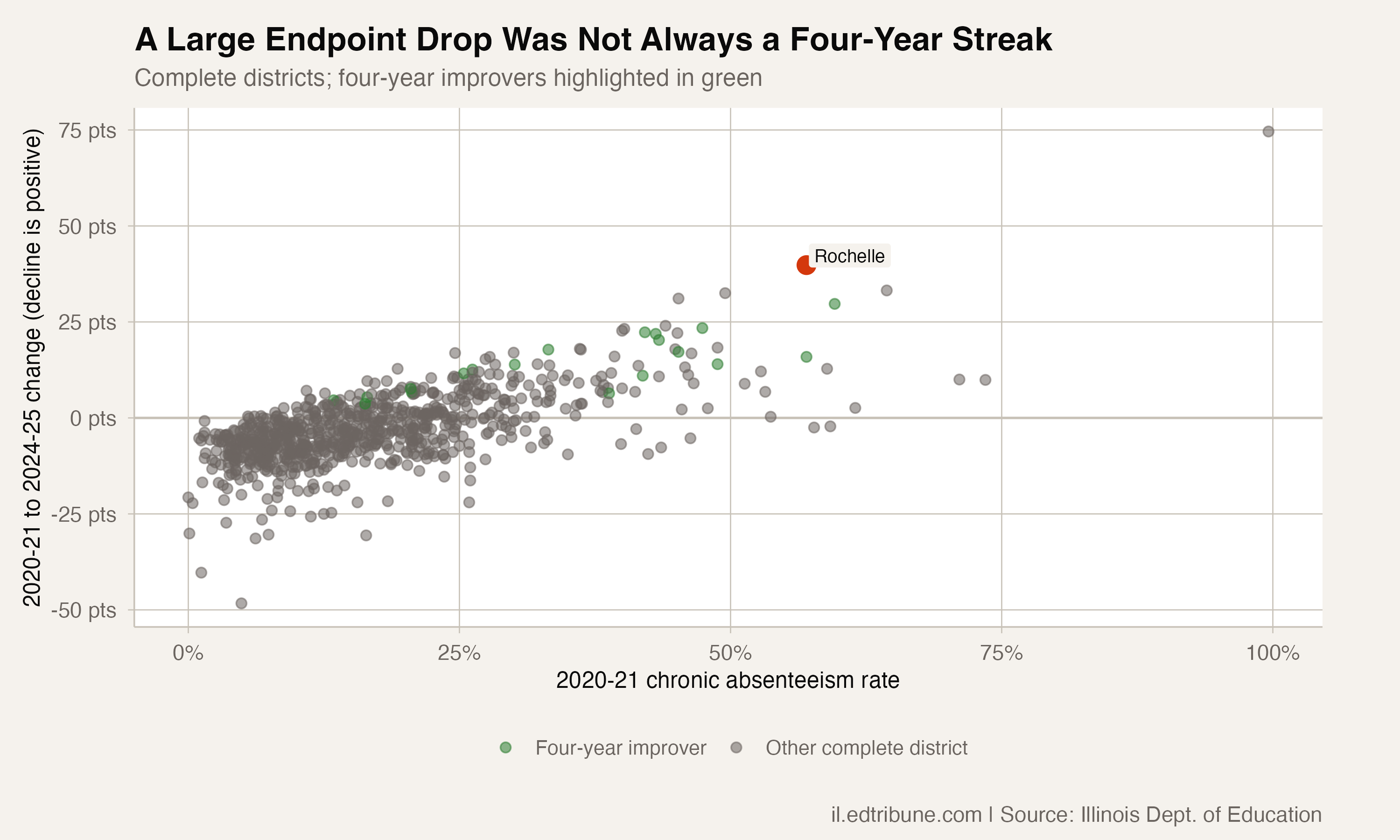
Direct evidence: the district recorded four separate annual drops, not a one-year rebound. Unresourced: the data do not show whether the improvement came from attendance practice, transportation, family outreach, staffing, or some combination.
The improver profile
At some point from 2020-21 to 2024-25, 13 of the 20 districts reached at least 30%, and 10 reached at least 40%.
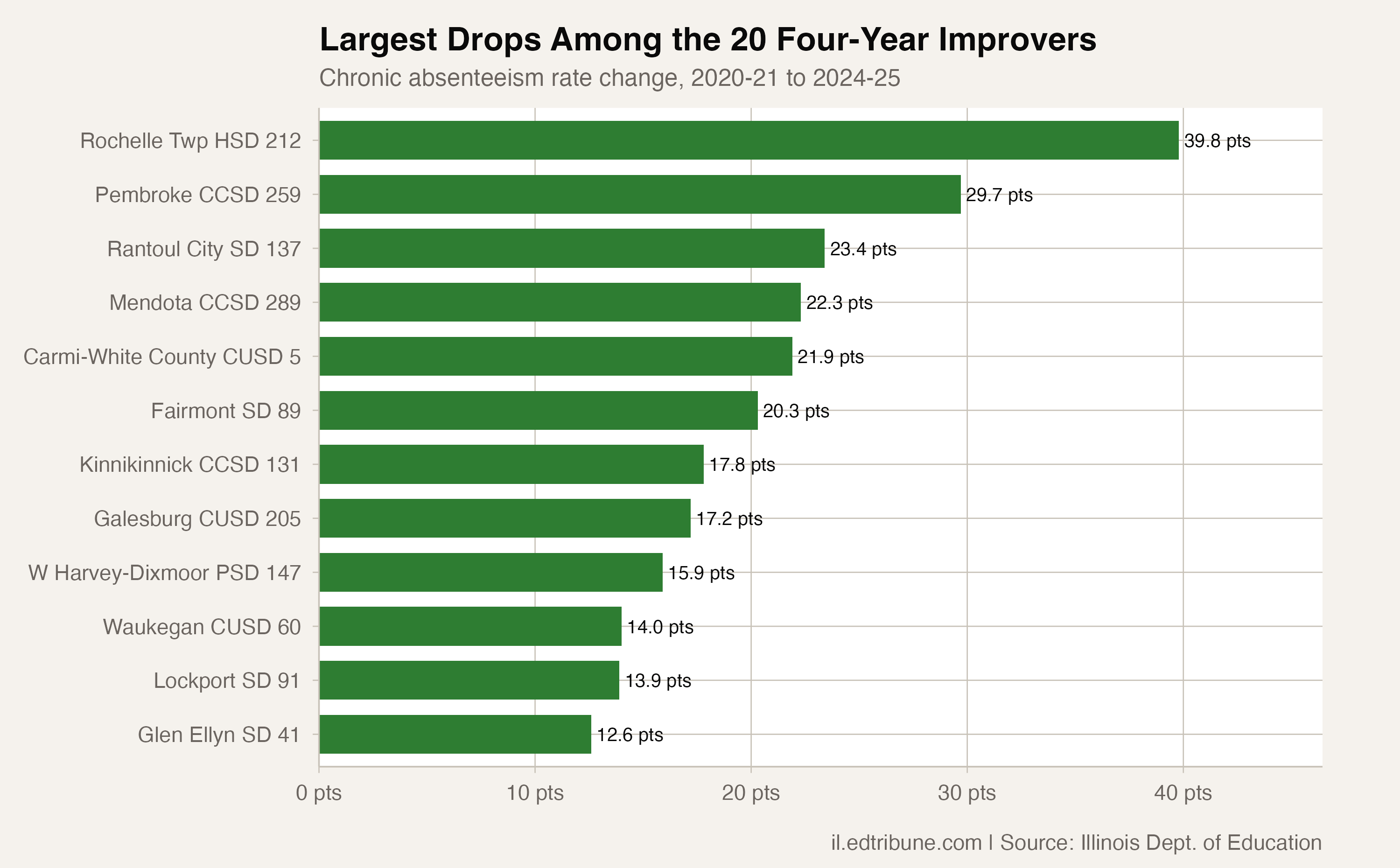
Pembroke CCSD 259 fell 29.7 points, from 59.6% to 29.9%. Rantoul City SD 137 fell 23.4 points, from 47.4% to 24.0%. Mendota CCSD 289 fell 22.3 points, from 42.1% to 19.8%.
Waukegan↗ET CUSD 60 stayed on the four-year list while remaining above the statewide rate, falling from 48.8% to 34.8%. Galesburg CUSD 205 fell from 45.2% to 28.0%.
Central↗ET CHSD 71 is the low-rate case. It moved from 13.4% to 8.8%, the lowest 2024-25 rate among the 20 four-year improvers, and below its 11.0% rates in both 2018-19 and 2019-20.
Central: what the low-rate district says
Dustin Foutch, the district's superintendent, answered written questions from The ILEdTribune about how a district that was already in reasonable shape before the pandemic kept moving. "Attendance has always been one of our top priorities because if a student isn't at school, it makes it much more difficult for them to learn," Foutch wrote. He put school culture next to it: "Ultimately, we want for our students to feel like they belong at Central." He also credited what the district built after 2021: "Since 2021, we have also added a variety of clubs and extra-curricular opportunities to help students find a home here."
Asked what the community expects, Foutch answered with a local work ethic rather than a district program: "The general culture in Clinton County is extremely hard working." He continued, "We are the #1 dairy producing county in the State of Illinois, and many of our families carry that strong work ethic with them at both school and work." He described the local norm this way: "It is generally unacceptable in our community to tolerate absences." That is his characterization of the county he serves, not something the state attendance data measure.
For the students who are still chronically absent, Foutch pointed to a survey the district runs on its own rather than to state reporting. "9% of our students also stated they didn't feel like they 'belong' here," Foutch wrote of that survey. He went on, "We also noticed that there is a massive correlation between the percentage of students who don't feel like they belong and the percentage of students who experience chronic absenteeism." Central's survey is a district instrument, its results are not part of the ISBE reporting behind the rest of this article, and the correlation is his reading of his own data. He closed on those students: "I think constantly about these students and lose sleep thinking about how we can connect with them to improve their overall school experience."
What four years of improvement shows
Direct evidence: a four-year streak is rare in this dataset. Only 20 of 785 comparable districts met the test, and those districts served 2.6% of Illinois public school enrollment in 2024-25.
The data do not identify the cause. Central's superintendent answered that question for his own district, and his answer is his account rather than a measured effect. The rest of the group remains open, and the reporting step is the same: ask what changed locally, then separate practices that have documentary support from explanations that remain unresourced.
Chronic absenteeism rates and enrollment counts come from the Illinois State Board of Education's Report Card Data Library.
Detailed code that reproduces the analysis and figures in this article is available exclusively to EdTribune subscribers.
Discussion
Sign in to join the discussion.
Loading comments...