Twelve of thirteen grades improved their chronic absenteeism rates in Illinois in 2024-25. Kindergarten led the way, dropping 3.0 percentage points. First grade fell 1.8 points. Even high school freshmen and sophomores improved. The sole exception was 12th grade, which worsened from 41.0% to 41.5%, continuing a trend that no other grade shares.
The senior-year exception matters because it suggests that whatever is driving chronic absence among older students operates independently of the forces that are slowly pulling younger students back to regular attendance. Elementary schools are recovering. Middle schools are recovering. Even the lower high school grades are recovering. But seniors, the students closest to either entering the workforce or enrolling in college, are drifting further away.
The grade-by-grade picture
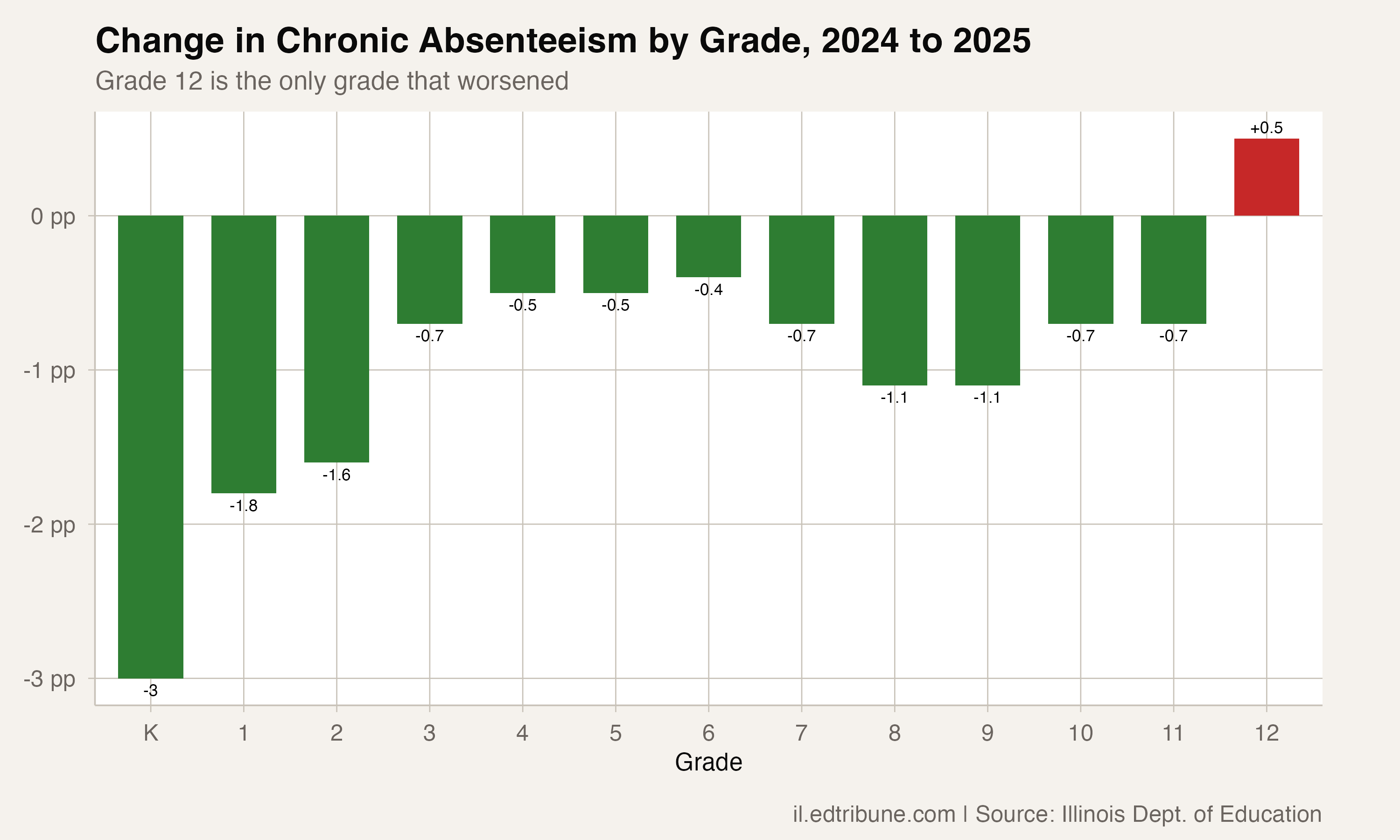
Kindergarten's 3.0-point drop is the largest single-grade improvement in the chart. These are families making a fresh choice: their children were not in school the year before, and they are deciding, in large numbers, to re-engage with regular attendance. First and second grade followed with improvements of 1.8 and 1.6 points.
The recovery flattens through upper elementary. Improvements ranged from 0.4 to 0.7 points in 3rd through 7th grade. Then 8th and 9th graders posted larger gains of 1.1 points each, a meaningful step down in chronic absence as students moved through the high school transition. By 10th and 11th, improvements settled back to 0.7 points. And in 12th grade, the direction reversed entirely.
The escalation from elementary to senior year
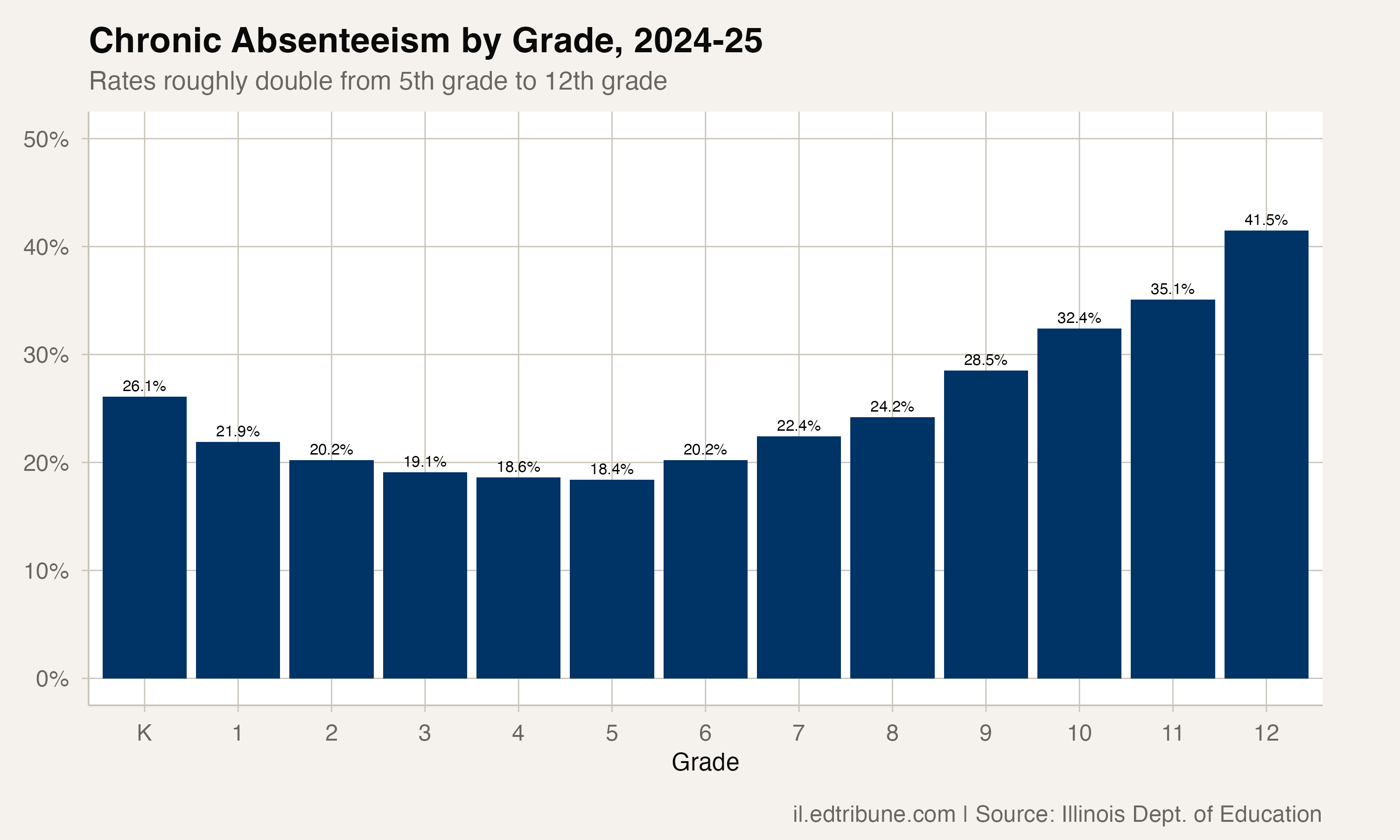
The statewide grade profile reveals a sharp escalation. In 5th grade, 18.4% of students are chronically absent. By 9th grade, the rate has jumped to 28.5%. By 12th grade, it reaches 41.5%, meaning more than two in five seniors are missing at least 18 days of school. The gap from 5th grade to 12th grade is 23.1 percentage points.
The 9th-grade transition is especially sharp: chronic absenteeism jumps from 24.2% in 8th grade to 28.5% in 9th grade, a 4.3-point leap that coincides with the transition to high school.
Why seniors are different
The data cannot tell us why 12th grade is worsening while other grades improve. Several explanations are plausible, and they likely operate simultaneously. Students who have accumulated enough credits may see diminishing academic returns from attendance. Work obligations — particularly in low-income families — often escalate in senior year. Senioritis, the informal term for late-year disengagement, appears to have metastasized into a year-long phenomenon in the post-COVID era.
There is also a selection effect at play. Some of the most chronically absent students drop out before 12th grade, meaning the seniors who remain include a disproportionate share of students whose attendance was already marginal. But this same selection effect existed before COVID, and senior-year chronic rates were not approaching 42%.
The senior-year worsening puts a fine point on a broader challenge: Illinois's attendance recovery is real but uneven, strongest in the grades where families have the most control and weakest in the grades where students exercise the most individual agency about whether to show up.
Detailed code that reproduces the analysis and figures in this article is available exclusively to EdTribune subscribers.
Discussion
Sign in to join the discussion.
Loading comments...