In eleven Illinois school districts, a majority of students were chronically absent in 2024-25, meaning more students missed at least 10% of the school year than attended regularly. The threshold itself is sobering: when chronic absenteeism exceeds 50%, the term "chronic" starts to lose its clinical edge. It is no longer the outlier condition. It is the norm.
Brooklyn UD 188↗ET in St. Clair County leads the list at 63.6%. Cahokia↗ET CUSD 187 is at 61.1%. East St. Louis↗ET SD 189 sits at 60.2%. The geographic concentration is striking: five of the eleven districts are clustered in St. Clair and Madison counties, the Metro East region just across the Mississippi River from St. Louis.
The 11 districts
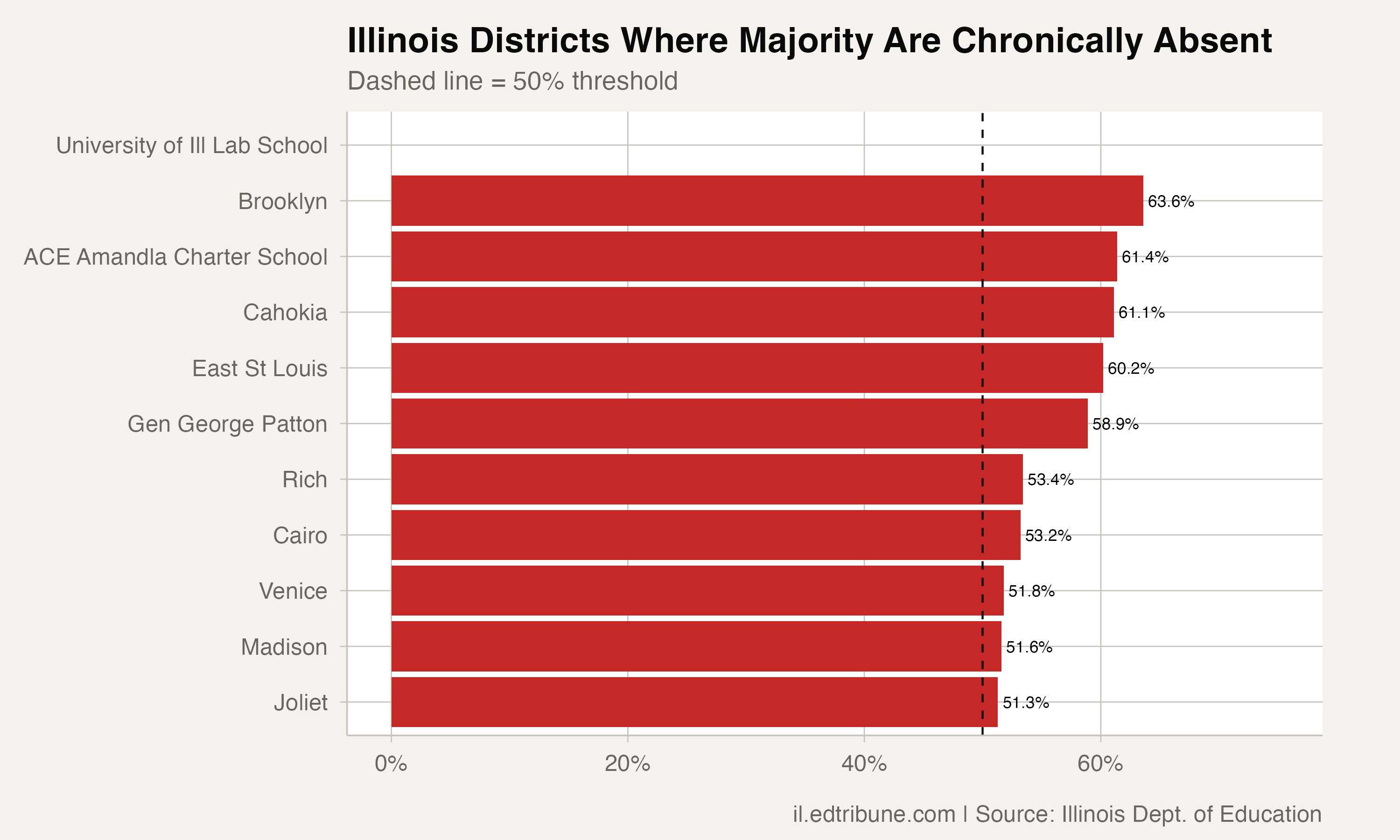
The full list reveals two distinct clusters. The Metro East corridor (Brooklyn, Cahokia, East St. Louis, Venice CUSD 3 at 51.8%, and Madison CUSD 12 at 51.6%) accounts for nearly half the list. These are small to mid-sized districts in predominantly Black, low-income communities that have struggled with attendance for years but crossed the majority threshold during or after COVID.
The Cook County contingent includes ACE Amandla Charter School (61.4%), Gen. George Patton SD 133 (58.9%), and Rich Twp↗ET HSD 227 (53.4%), all serving south suburban communities. Cairo USD 1 (53.2%), in Alexander County at the southern tip of Illinois, and Joliet Twp↗ET HSD 204 (51.3%), in Will County, round out the list. The University of Illinois Lab School reports 98.1%, but this is a reporting artifact common to university laboratory schools.
The Metro East emergency
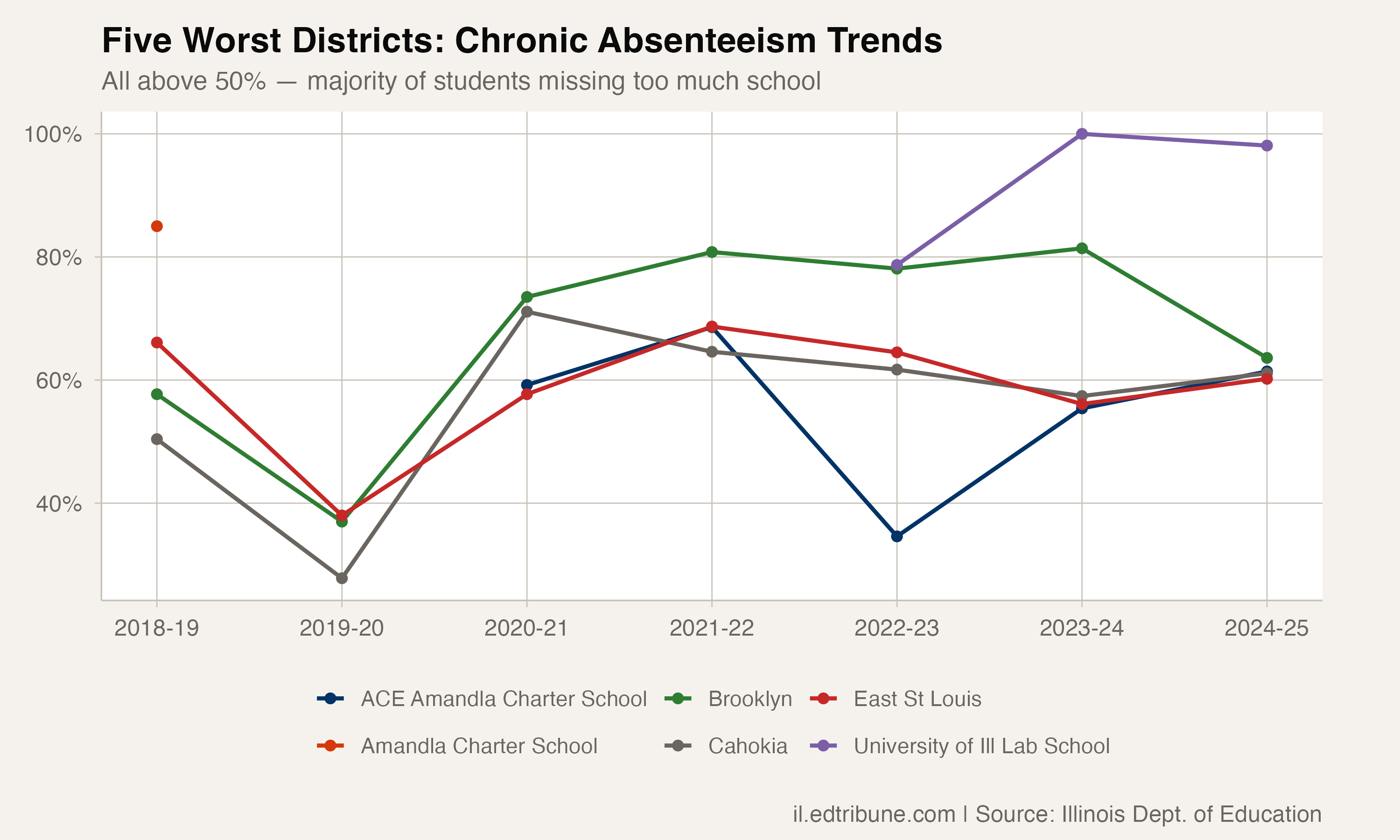
The Metro East cluster deserves particular attention because of its geographic concentration and the trajectory of some of its districts. Venice CUSD 3 had a chronic absenteeism rate of 9.1% in 2019-20. Five years later, it is 51.8%, a 42.7-point increase that represents one of the most dramatic deteriorations anywhere in the state. Venice is a village of roughly 2,000 people, and its school district serves fewer than 200 students. Small enrollment makes rates volatile, but a jump of this magnitude over this many years cannot be dismissed as statistical noise.
East St. Louis, by contrast, actually improved from its 2019 level of 66.1% to 60.2%. The district earned seven commendable school ratings in 2024, evidence that academic quality can improve even as attendance remains deeply troubled. The pattern suggests that East St. Louis is doing meaningful instructional work with the students who do show up, while the larger attendance crisis continues to limit how many students benefit.
Joliet: the outlier in the group
Joliet Twp HSD 204, serving roughly 6,600 students, is the largest district on the list by a wide margin. Its trajectory is uniquely troubling: the district has worsened in five of the last six years, climbing steadily from a pre-COVID rate that was already elevated. Unlike the Metro East districts, which saw a COVID spike and partial recovery, Joliet has experienced a slow, grinding deterioration that shows no sign of bottoming out.
The district serves a racially diverse, majority-minority student body across two large high schools and is the primary feeder for the Joliet Junior College service area. Persistent worsening in a district this size affects thousands of students per year and carries long-term implications for the region's workforce pipeline.
What majority absent means
When more than half a district's students are chronically absent, the concept of a "normal" school day becomes strained. Teachers cannot sequence instruction assuming their students were present yesterday. Social dynamics shift when a significant portion of any classroom's seats are empty on a given day. Administrative resources tilt toward compliance and outreach rather than instruction.
These eleven districts collectively serve a small fraction of Illinois's 1.8 million students. But they represent the sharpest edge of a statewide crisis, the places where the post-pandemic attendance collapse has been most devastating, and where recovery, if it comes, will be hardest.
Detailed code that reproduces the analysis and figures in this article is available exclusively to EdTribune subscribers.
Discussion
Sign in to join the discussion.
Loading comments...