Chicago's chronic absenteeism has been widely covered. Far less attention has gone to the suburban Cook County high school districts just outside the city limits, where several report rates that rival or exceed Chicago Public Schools' own 40.1%.
Rich Twp↗ET HSD 227 leads the group at 53.4%, meaning a majority of its students were chronically absent. Proviso Twp↗ET HSD 209 sits at 47.9%. Thornton Twp↗ET HSD 205 is at 47.0%, and Bloom Twp↗ET HSD 206 at 45.4%. These are comprehensive high school districts, not small communities where a handful of students can swing the rate. Rich Twp alone serves about 2,300 students across two high schools.
A concentrated cluster
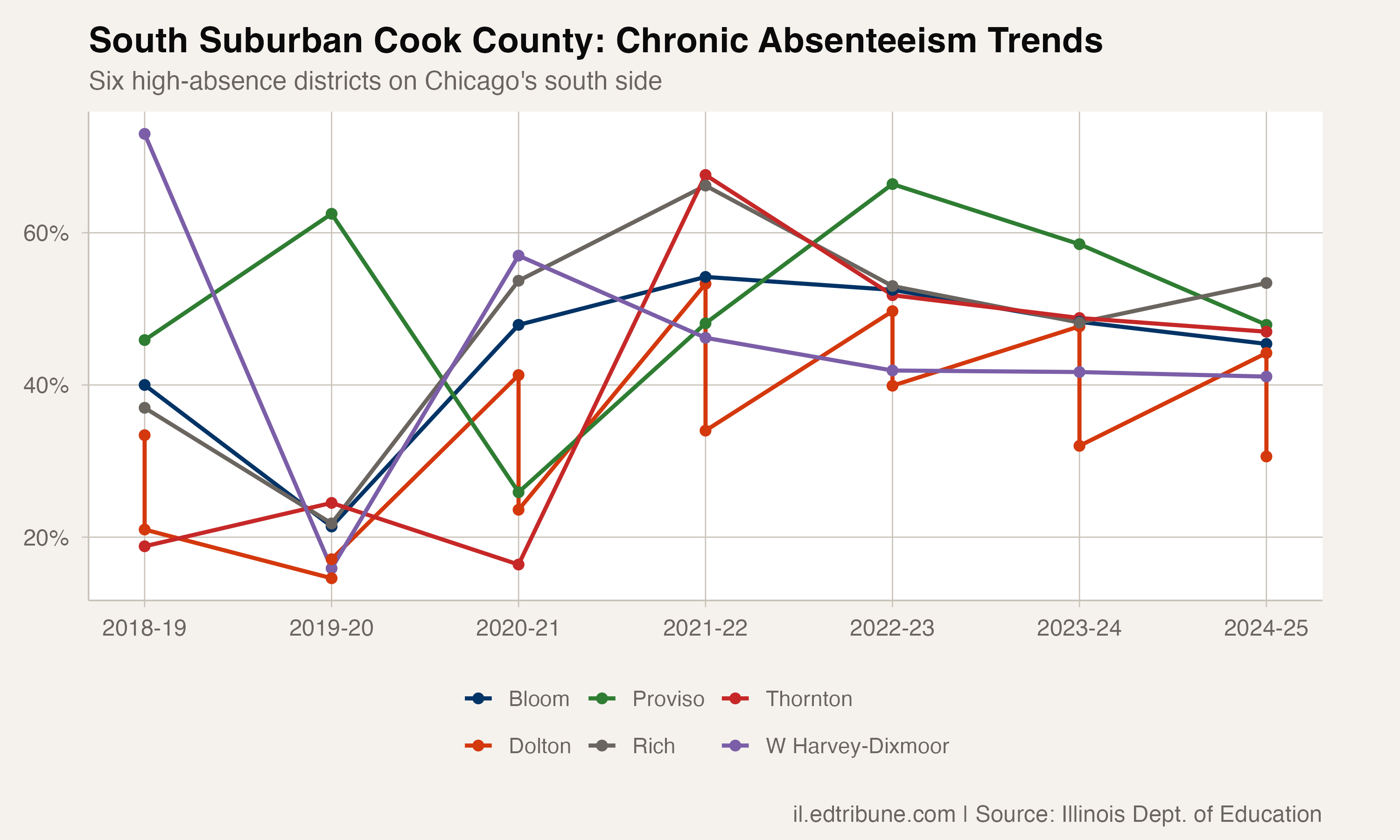
Most of these districts share a geography and a demographic profile. They span predominantly Black, low-income communities stretching south from Chicago: Harvey, Dolton, Markham, Richton Park, Matteson, and their neighbors. They feed students into community colleges and the regional workforce, and the high absenteeism rates touch that pipeline.
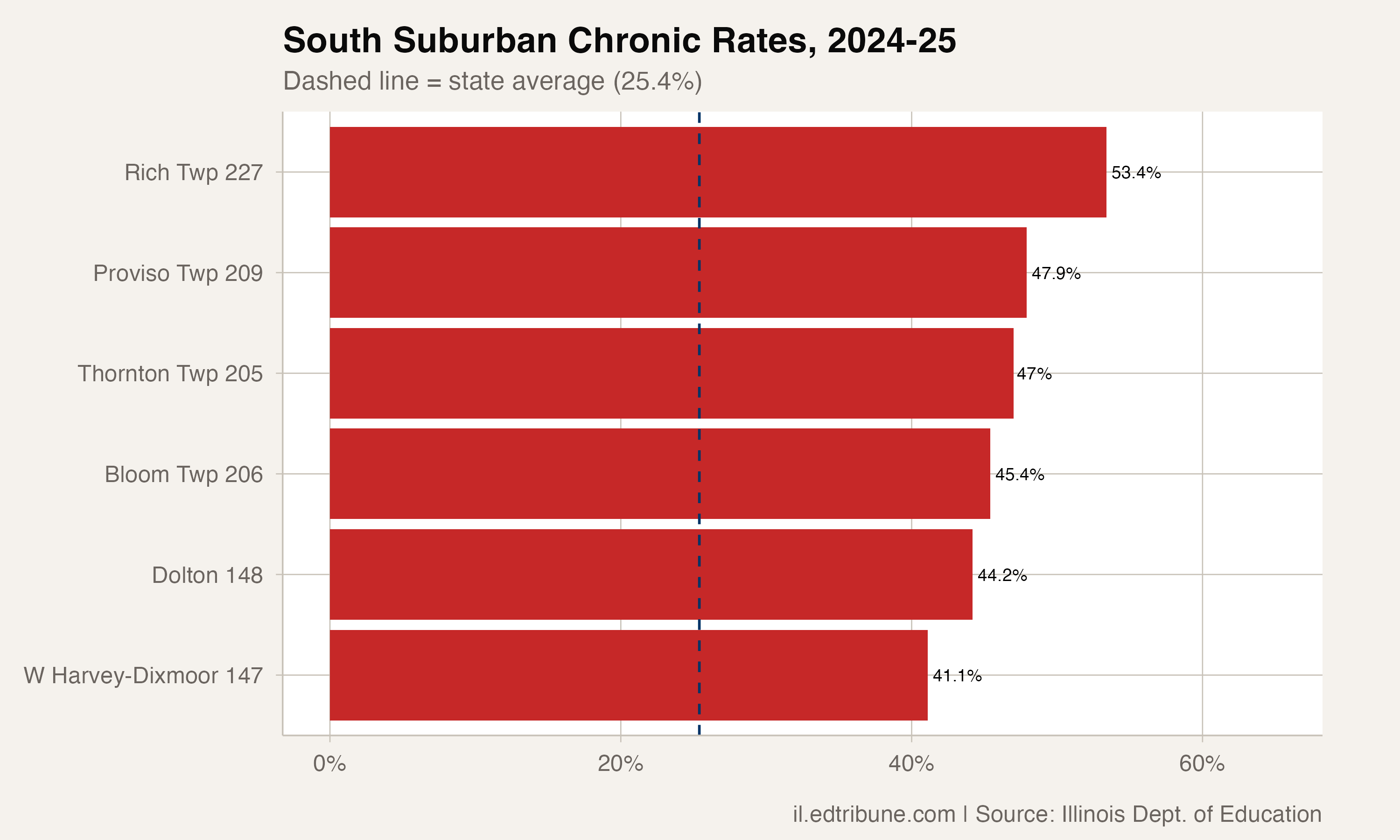
The feeder elementary districts show similarly elevated rates. Dolton SD 148 reports 44.2% chronic absenteeism. W. Harvey-Dixmoor PSD 147 is at 41.1%. These elementary students feed into the high school districts where rates reach the 50s, which suggests chronic absence is not a phenomenon that begins in high school. It is being inherited.
Separate from CPS, but connected
This cluster is often invisible in statewide data because it gets folded into either the "Cook County" aggregation, where CPS's large enrollment dominates, or the "suburban" category, where collar county affluence pulls averages down. Neither frame captures what is happening in these specific communities.
These are not suburban districts in the way most people use the word. They are inner-ring communities that share more with the adjacent Chicago neighborhoods than with Naperville or Winnetka. The economic base has eroded over decades. Property values, and the tax revenue they generate, have declined. School funding has tightened. And the pandemic hit these communities hard.
The concentration of high-absence districts in a single area suggests that regional, rather than district-by-district, approaches may help. Transportation networks, health care access, and economic opportunity do not follow school district boundaries, and attendance barriers that span multiple districts may call for solutions that span them as well.
Detailed code that reproduces the analysis and figures in this article is available exclusively to EdTribune subscribers.
Discussion
Sign in to join the discussion.
Loading comments...