
Martin Son became superintendent/principal of Germantown SD 60↗ET on July 1, returning as the district's leader to the Clinton County school where he once taught junior high math.
He taught at Germantown from 2018 to 2020. "Returning to Germantown is especially meaningful because this school played an important role in my growth as an educator and leader, and I'm excited to build upon the strong foundation that already exists here," Son said in written answers to The ILEdTribune.
His career has run mostly through middle school classrooms. He taught middle school mathematics in Kentucky and Illinois before moving into school administration, he wrote, and after leaving Germantown he served as principal at Brownstown Elementary School. Most recently he taught sixth-grade math at Roxana Junior High while serving as the head boys varsity soccer coach at Roxana High School. He succeeds Robin Becker, whom the state's school directory listed as the district's administrator before him.
Asked what drew him back, Son pointed to the people he met the first time. "During my time here as a junior high math teacher, I developed a real appreciation for the people and the culture of the district," he said. "Germantown has always felt like a place where relationships come first, and when the opportunity presented itself to return in this role, it just felt like the right fit for both my family and me."
One school, and a steady count
Germantown is a district with a single building. The state's enrollment records show one school, Germantown Elementary School, serving prekindergarten through eighth grade, and a combined superintendent/principal post to lead it.
The district enrolled 260 students in 2025-26, the most recent school year in the state's published data. That figure, from the state's fall enrollment count, includes 23 prekindergarten students and is two more than the same count a year earlier. Counts for the current 2026-27 school year, Son's first, will differ once the state publishes them.
The state's longer record, its annual report card count, runs through 2024-25 and counts students a little differently, so the two are not compared against each other here. On the report card, Germantown enrolled 257 students in 2024-25, three fewer than the 260 it reported in 2014-15. Over the same decade, total enrollment across Illinois fell 10.0%.
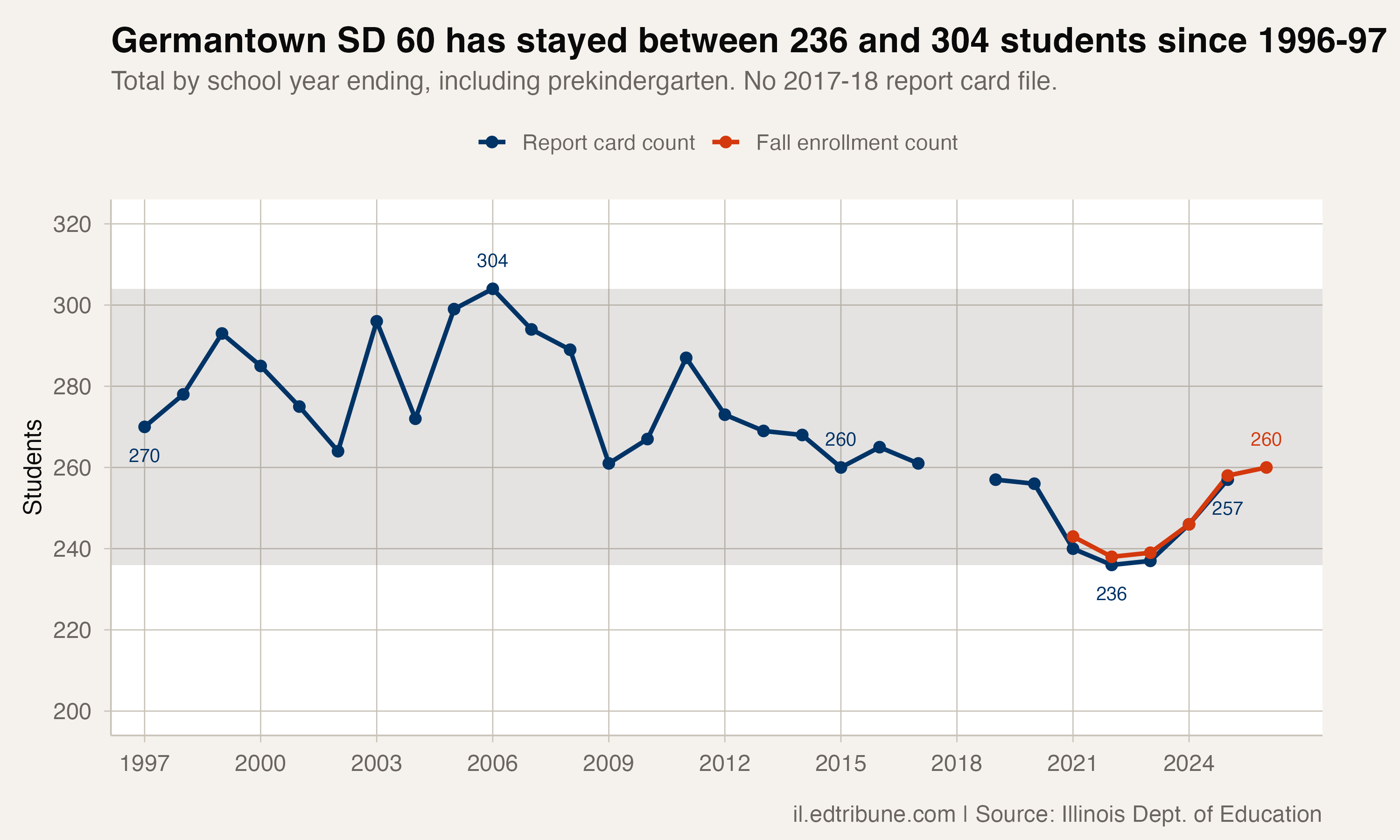
The count was not flat the whole way. On the report card, enrollment fell by 16 students in 2020-21 and reached 236 the following year, the district's lowest figure in any year since 1996-97. The fall count, which the state has published since 2020-21, shows the same turn: 238 students in 2021-22, then a gain in each of the four years since, adding 22 students. Across the whole report card record, Germantown has never enrolled fewer than 236 students or more than 304, a peak it reached in 2005-06. Illinois did not publish a report card enrollment file for 2017-18, so that year is missing from the record.
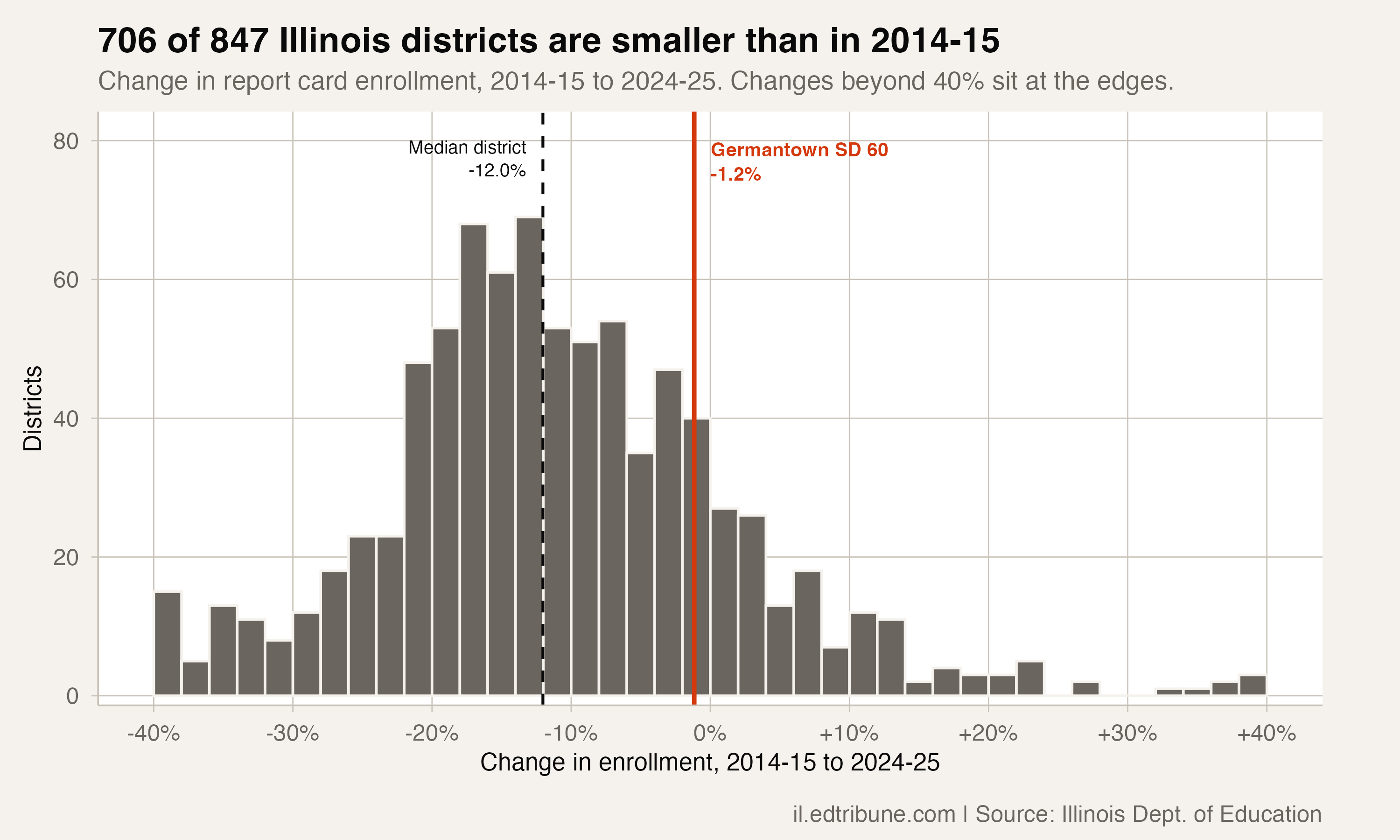
The statewide picture looks different. Of the 847 Illinois districts with a report card total in both 2014-15 and 2024-25, 706 were smaller at the end of that span. The median district's enrollment fell 12.0%. Germantown is one of only 20 that finished within three students of where they started.
Son sees that stability as room to plan. "One of the greatest advantages of being a small district is the opportunity to truly know our students and families," he said. "Those relationships allow us to respond to individual needs while creating opportunities that might not be possible in a larger school system."
"Stable enrollment also gives us the ability to think strategically about the future," he added.
Classes that stay together
In a school this size, the steadiness shows up grade by grade. On the state's fall count, Germantown's classes ranged from 20 students in fourth grade to 36 in third grade in 2025-26. Those sizes belong to the children, not to the grades. The 20 fourth graders were 20 third graders a year earlier, and the 36 third graders were 35 second graders. Every class from first through eighth grade finished the move up within three students of its size the year before.
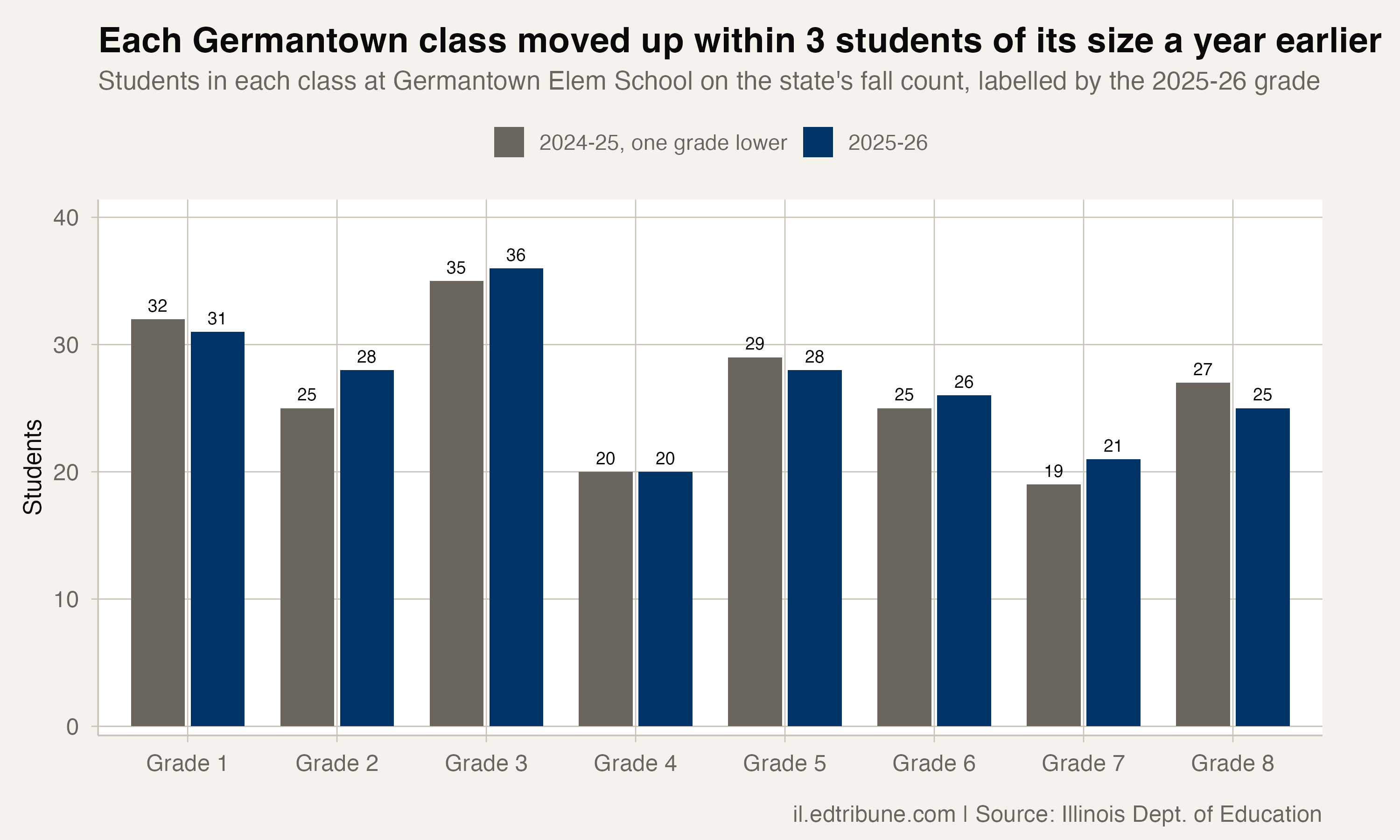
That pattern gives a small school a measure of predictability. A large class tends to stay large as it moves through the building, which bears on how many teachers and rooms each grade needs from year to year. One year of grade-level movement is a description of what happened in 2025-26, not a forecast, and the state's records cannot say why families stay or leave.
Listening first
Son was clear that he did not arrive to start over. "Robin Becker and the staff have done an outstanding job over the years, and I want to honor that work while collaborating with our faculty, Board of Education, families, and community as we continue moving the district forward," he said.
He described how he intends to go about it. "I believe the best progress happens by listening first, building trust, and making thoughtful decisions that always keep students at the center."
His list of priorities reaches from the classroom to the staff room. "Whether it's expanding STEM opportunities, strengthening student leadership, enhancing technology, or continuing to invest in our staff, our focus is on making thoughtful, long-term decisions that benefit students for years to come," he said.
He closed on the welcome. "I'm grateful for the warm welcome I've received, and I'm excited to be back in Germantown," Son said.
Enrollment figures come from two Illinois State Board of Education public enrollment records: the annual report card count, covering 1996-97 through 2024-25, and the fall enrollment count, covering 2020-21 through 2025-26, the most recent year the state has published. The two count students differently, so every comparison in this article stays within one of them. Illinois did not publish a 2017-18 report card figure. Martin Son responded in writing; quotations are reproduced as he wrote them. He supplied the headshot used with this profile.
Detailed code that reproduces the analysis and figures in this article is available exclusively to EdTribune subscribers.
Discussion
Sign in to join the discussion.
Loading comments...