While Illinois celebrates a record 89% graduation rate, one group of students remains far outside the progress: students in foster care.
In 2025, 61.3% of students in foster care graduated from an Illinois public high school within four years. That is 27.7 percentage points below the state average, the widest gap of any student group tracked by the Illinois State Board of Education, wider than the gaps for students who are currently homeless, English learners, or students with disabilities.
Improvement that still falls far short
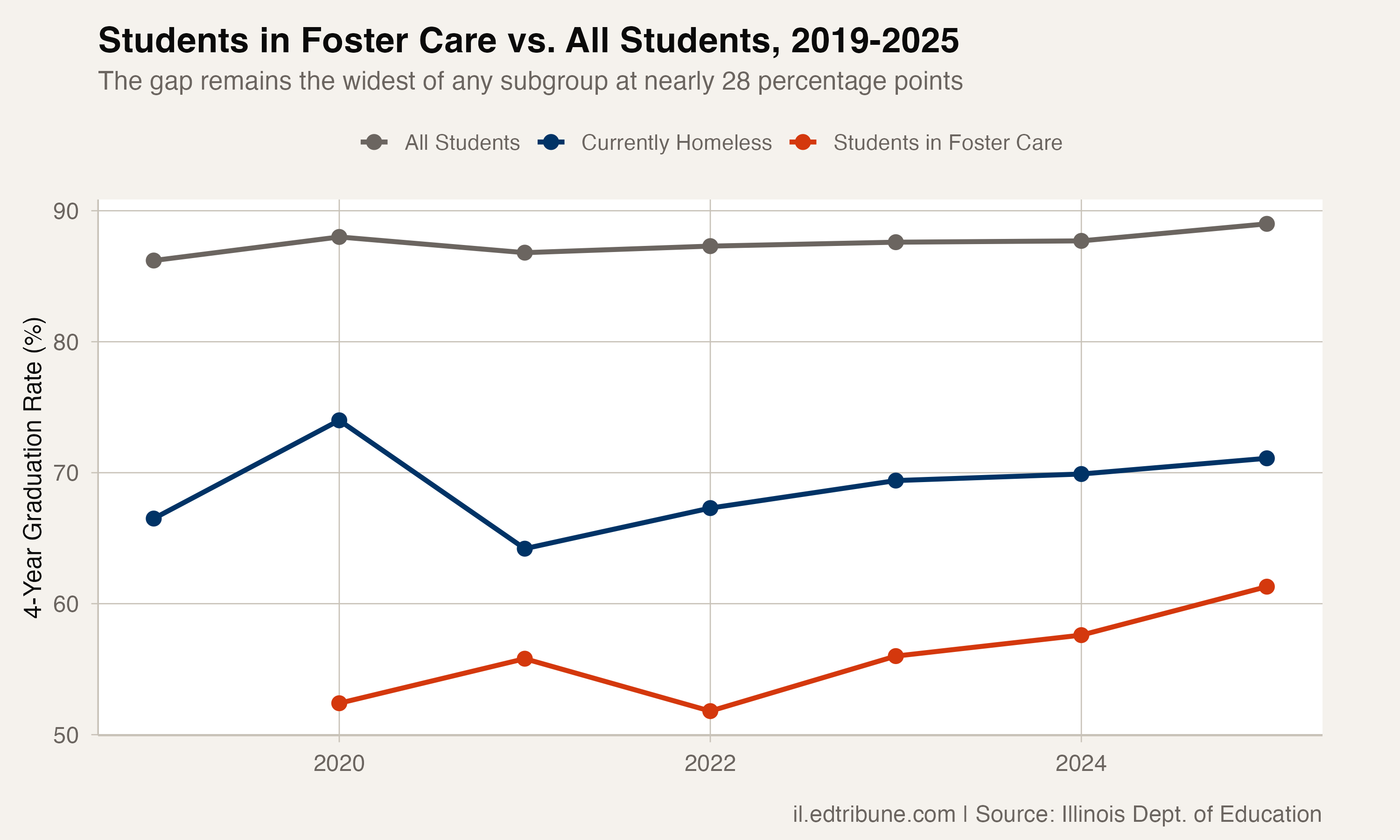
The graduation rate for students in foster care has improved from its low point of 51.8% in 2022. The 9.5-point gain over three years is genuine progress. But it still leaves students in foster care graduating at a rate lower than any other tracked subgroup.
Illinois has reported the group separately since 2020, and the six years of data show persistent disadvantage: 52.4% in 2020, 55.8% in 2021, 51.8% in 2022, 56.0% in 2023, 57.6% in 2024, and 61.3% in 2025. The series has slipped back once, in 2022, and the overall rate remains in territory that would trigger alarm for any other student population.
In Chicago, the numbers are worse
At Chicago Public Schools, the state's largest school district, only 43.9% of students in foster care graduated in four years in 2025. That means more than half of CPS students in foster care do not earn a diploma on time.
CPS's foster care rate sits nearly 39 points below the district's overall rate of 82.5%. How far that pattern extends is not knowable from the published data: the group is small enough that Illinois suppressed the rate for 257 of the 263 districts reporting one in 2025. Among the six districts with a published rate, CPS was the lowest and Rockford SD 205, at 44.4%, was the second.
The extra year does not help
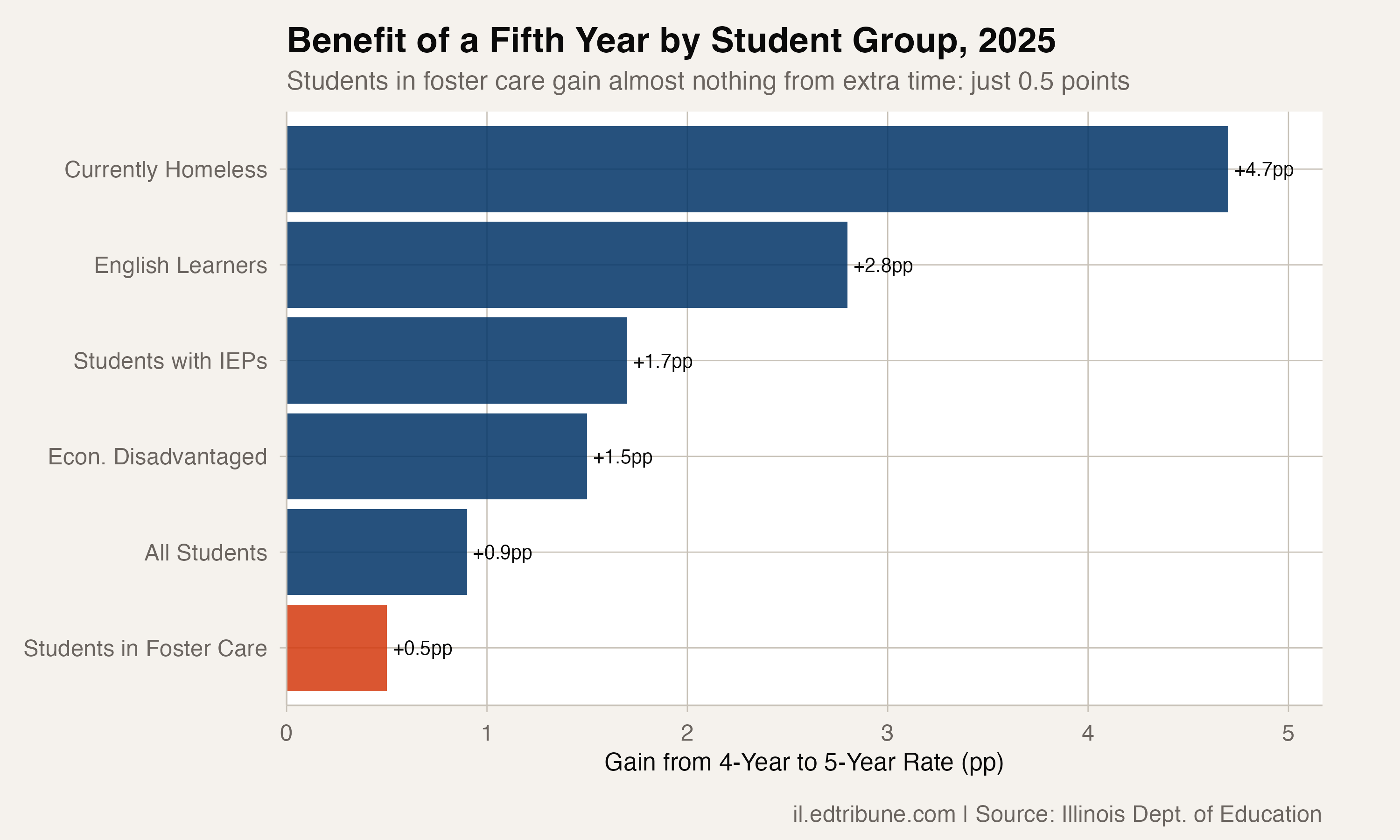
For most struggling student groups, a fifth year of high school provides a meaningful boost. Students who are currently homeless gain 4.7 percentage points when given an extra year. English learners gain 2.8 points. But students in foster care gain just 0.5 points, climbing from 61.3% to 61.8%.
The Illinois data do not identify why the fifth-year gain is so small. Suggestive context: U.S. Department of Education guidance says students in foster care often face high mobility and emphasizes limiting school disruption when placements change. That evidence points to educational stability as one possible factor, but it does not establish the cause of Illinois' graduation-rate pattern. (U.S. Department of Education)
Where foster care fits among vulnerable populations
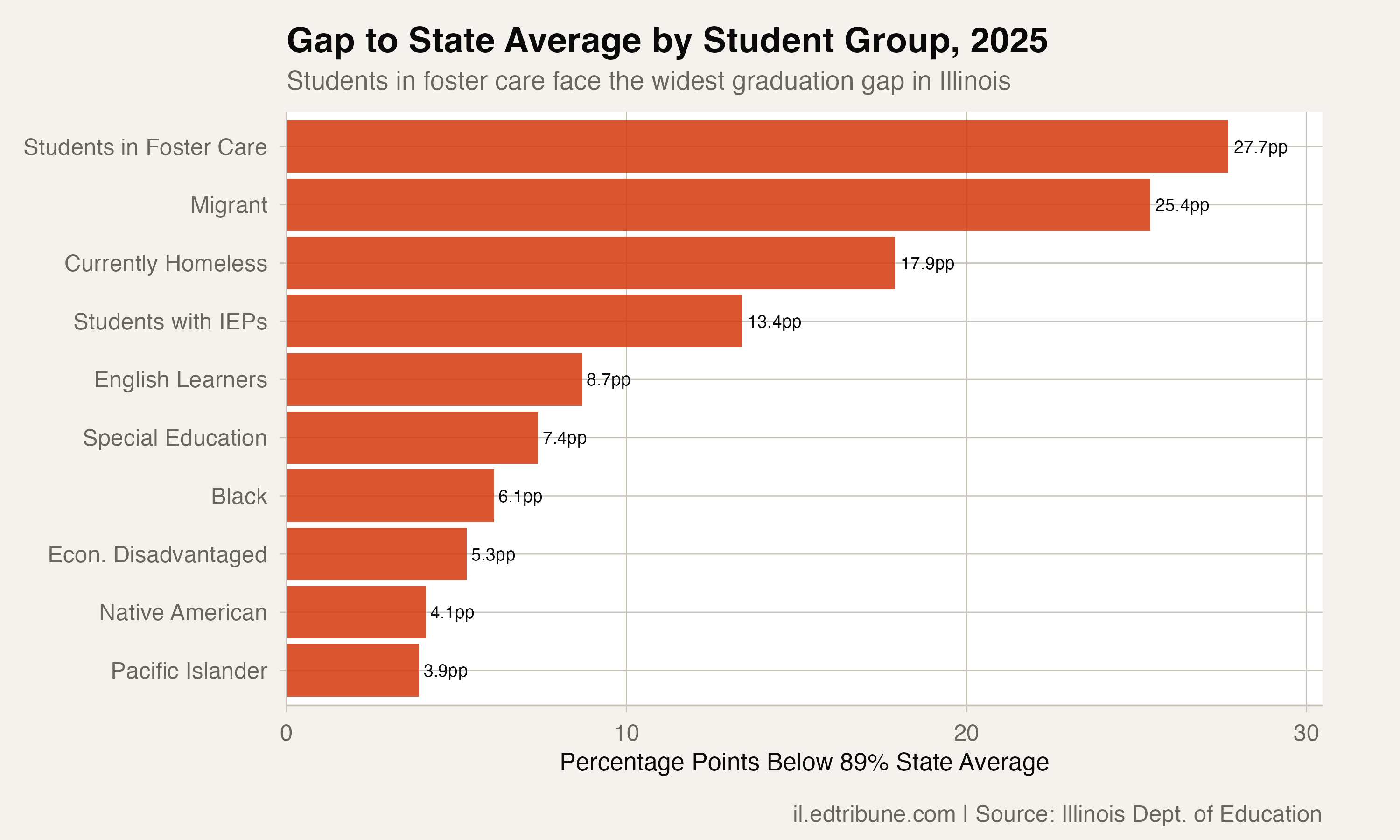
The hierarchy of vulnerability in Illinois graduation data is consistent and stark. Students in foster care face the largest gap at 27.7 points. Migrant students trail by 25.4 points. Students who are currently homeless are 17.9 points behind. Students with IEPs are 13.4 points back.
Every other subgroup, including English learners, students who are economically disadvantaged, and Black students, graduates above 80%. Students in foster care and migrant students are the only two groups graduating below 70%, and close to four in ten students in foster care do not earn a diploma in four years.
The gap is closing, from very far back
Several Illinois graduation gaps have narrowed since 2019. The White-Black gap fell from 14.3 points to 9.5. The gap between all students and students who are economically disadvantaged fell from 7.9 points to 5.3. The gap between female and male students fell from 5.7 points to 3.3.
The foster care gap has narrowed too, and by more than those three combined: 35.6 points in 2020, 27.7 points in 2025. That is 7.9 points of closure against 2.1 for the White-Black gap, 1.6 for the gender gap, and 0.7 for the poverty gap over the same six years. It is also the clearest measure of how far back the group started, because even after that much closure the foster care gap is still nearly three times the size of the White-Black gap.
The 2025 data shows that 61.3% is the highest four-year graduation rate for students in foster care in the six years Illinois has reported the group separately. But measuring progress from a low base obscures how far these students remain from the outcomes their peers achieve. In a state graduating 89% of its students, close to four in ten students in foster care not finishing on time is a result that record-setting statewide numbers do not settle.
Data source: Illinois State Board of Education. Analysis covers the four-year adjusted cohort graduation rate for public school districts, 2019-2025.
Detailed code that reproduces the analysis and figures in this article is available exclusively to EdTribune subscribers.
Discussion
Sign in to join the discussion.
Loading comments...