Correction: This prepublication draft previously misstated when Aurora East first moved above the state rate and described its total gain as the state's largest. Both claims have been corrected.
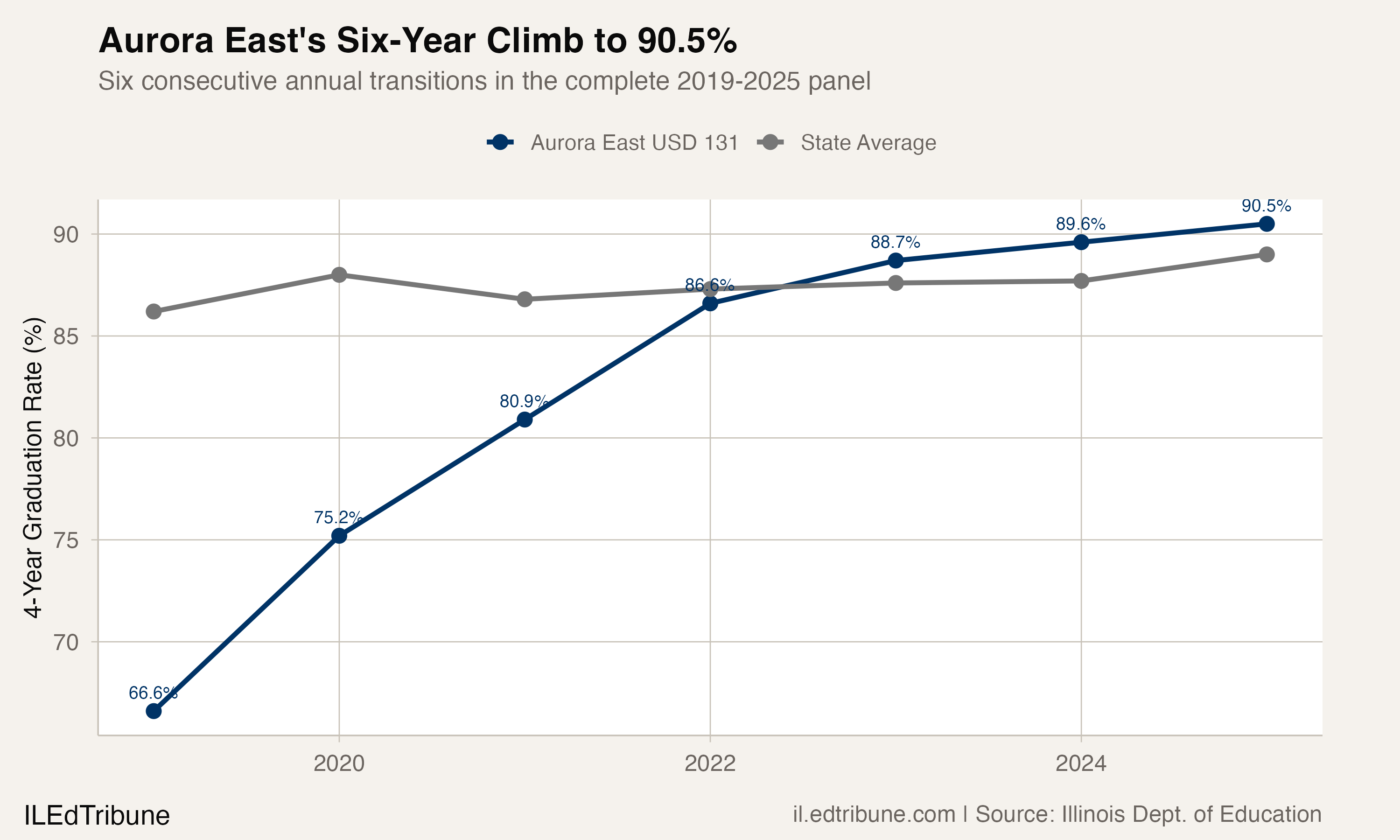
The four-year graduation rate at Aurora East USD 131↗ET increased in every annual transition from 2019 through 2025. It climbed from 66.6% to 90.5%, a 23.9-point gain across six consecutive transitions.
No other Illinois district with a complete reported rate for all seven years matched that active streak. The comparison includes 465 districts and uses stable district IDs; missing, flat, or declining transitions break a streak.
A gain every single year
The district improved every year in the panel:
- 2019: 66.6%
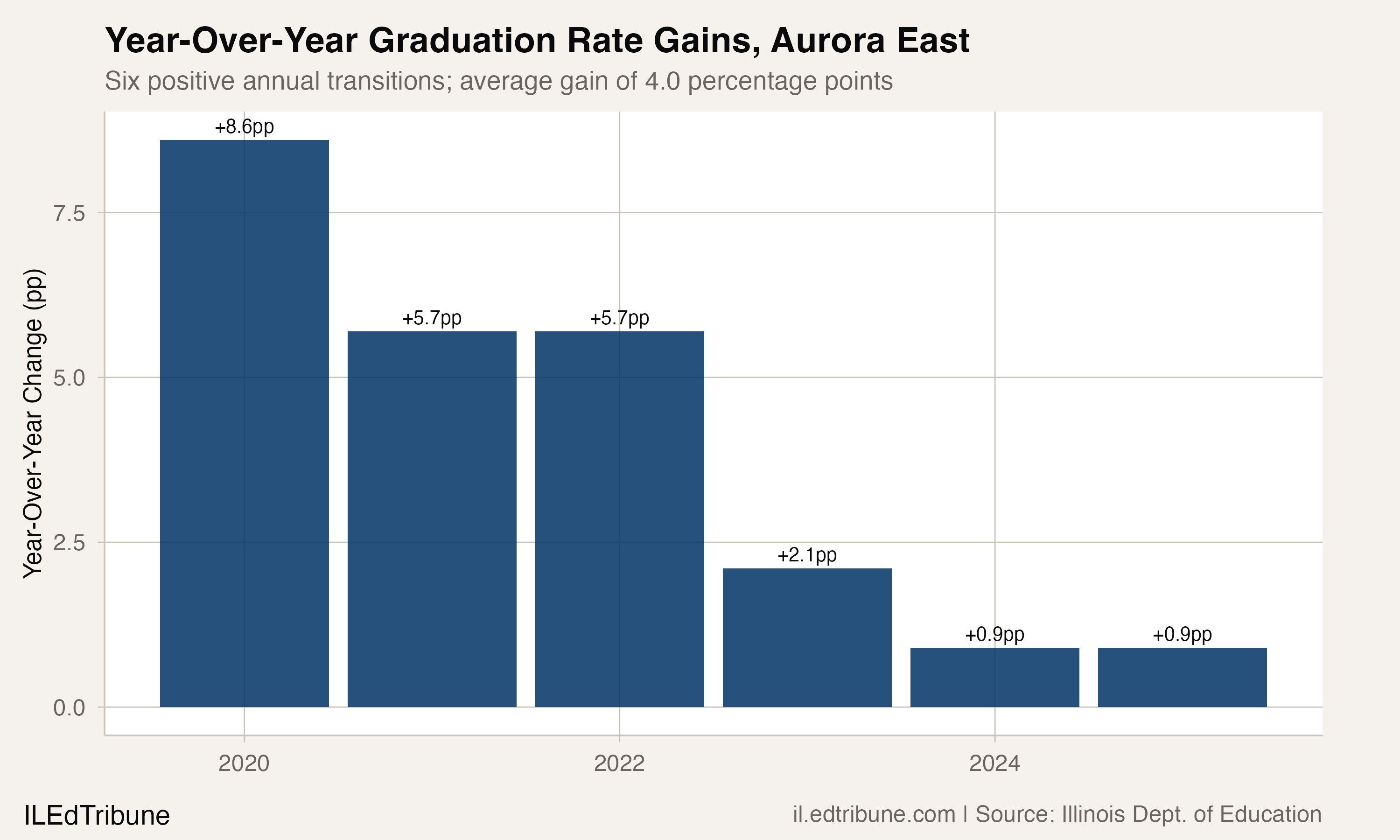
- 2020: 75.2% (+8.6)
- 2021: 80.9% (+5.7)
- 2022: 86.6% (+5.7)
- 2023: 88.7% (+2.1)
- 2024: 89.6% (+0.9)
- 2025: 90.5% (+0.9)
The largest increases came early. The final two transitions each added 0.9 points, but neither flattened or reversed the streak.
Above the state rate since 2023
Aurora East first moved above the Illinois rate in 2023, when the district reached 88.7% and the state was at 87.6%. The district remained ahead in 2024 and finished 2025 at 90.5%, 1.5 points above the state's 89.0%.
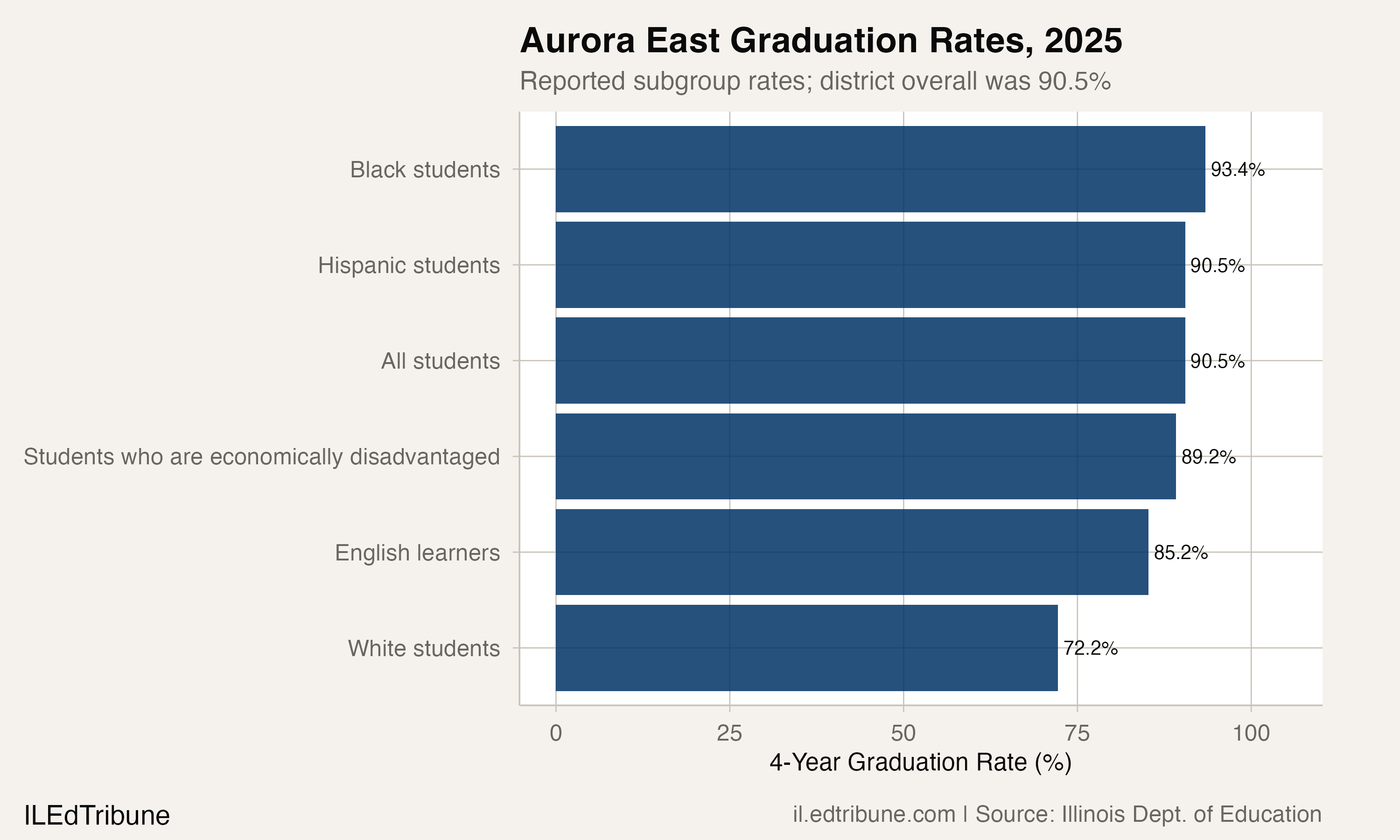
The 2025 rate for Hispanic students in Aurora East was 90.5%, compared with 86.4% statewide. English learners in the district graduated at 85.2%. The package reports 93.4% for Black students and 72.2% for white students.
Putting the streak in context
Aurora East's 23.9-point gain ranked fourth among the 465 districts with complete 2019-2025 rates. Three districts posted larger endpoint gains, but none improved in all six annual transitions.
The data establishes an unusually consistent turnaround. It does not identify which district practices caused it, and the package does not provide usable district cohort counts for a defensible size cutoff. The strongest supported conclusion is therefore about continuity across complete records, not about the largest or most "sizeable" districts.
Data source: Illinois State Board of Education.
Detailed code that reproduces the analysis and figures in this article is available exclusively to EdTribune subscribers.
Discussion
Sign in to join the discussion.
Loading comments...