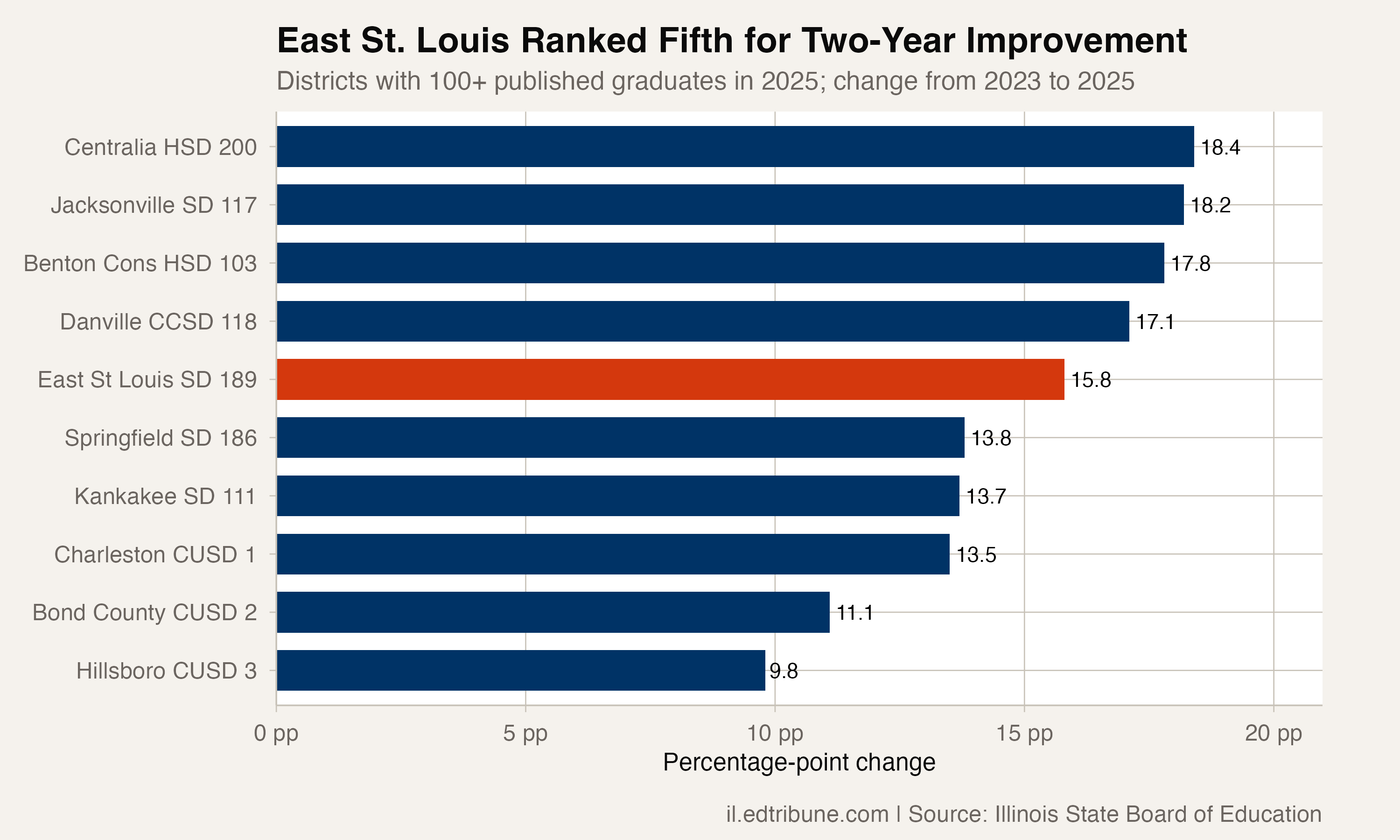
East St. Louis↗ET raised its four-year graduation rate from 68.7% for the class of 2023 to 84.5% for the class of 2025. The 15.8-point gain ranked fifth among 199 Illinois districts that published rates in both years and reported at least 100 graduates in 2025.
That comparison group accounts for 90.3% of the statewide published graduate count. The cutoff keeps very small graduating classes from dominating a rate-change ranking, but it is an editorial threshold, not a state category. At lower and higher cutoffs, East St. Louis's rank changes. Its fifth-place standing applies to the stated 100-graduate universe.
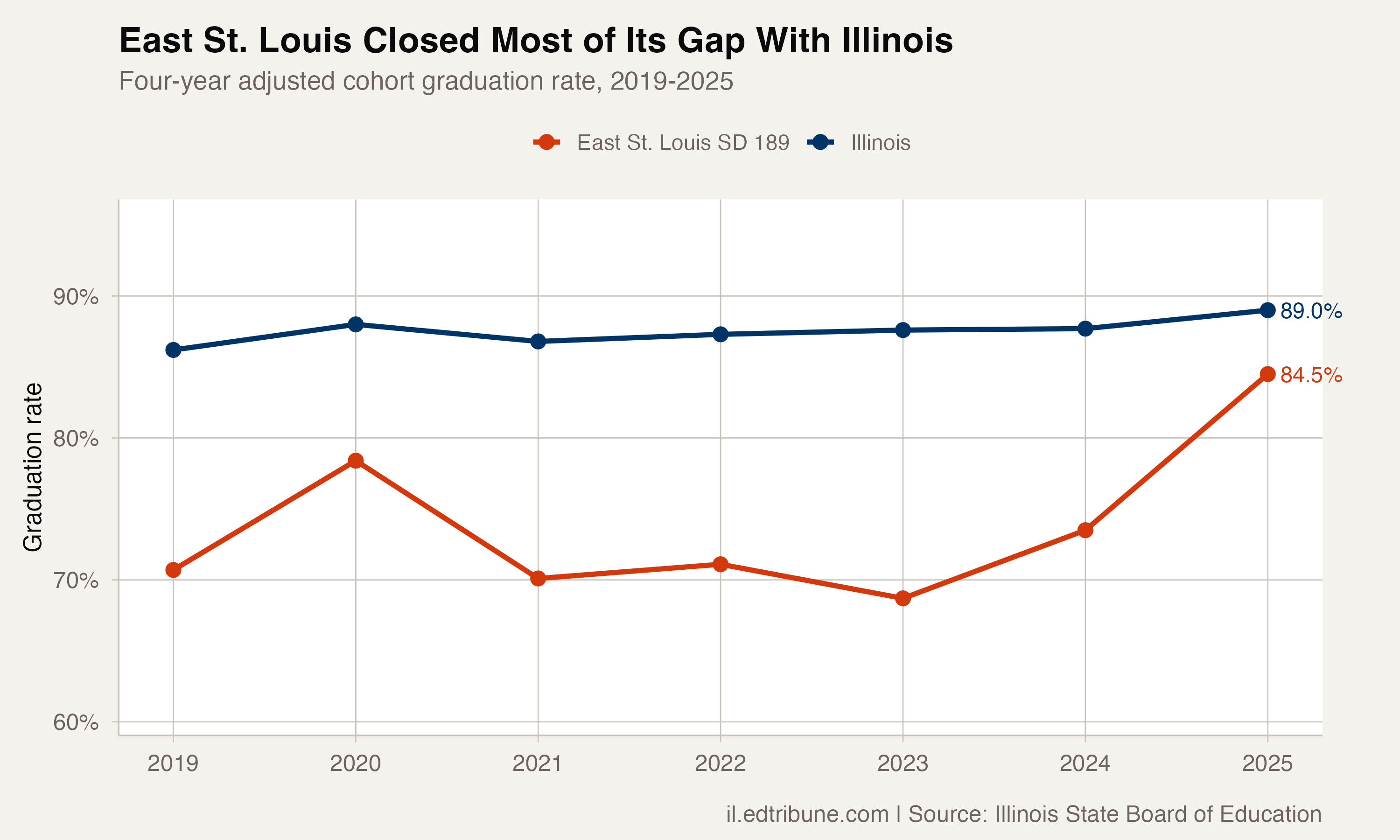
Most of the statewide gap disappeared
Illinois's statewide rate rose from 87.6% to 89.0% across the same two graduating classes, a 1.4-point gain. East St. Louis moved from 18.9 points below the state rate to 4.5 points below it.
The district's path was uneven before that closing. Its rate moved from 70.7% in 2019 to 78.4% in 2020, back to 70.1% in 2021, 71.1% in 2022 and 68.7% in 2023. It then rose to 73.5% in 2024 and 84.5% in 2025. The latest 11.0-point increase was the largest one-year gain in the district's seven-year available panel, and the final rate was the panel's high.
That history includes four reversals in direction. The latest result is clear improvement, but the published series alone cannot show whether it marks a durable new level.
Fifth in a clearly defined comparison
The state file reports 337 East St. Louis graduates in 2025. It does not publish a total cohort denominator for this district row, so the earlier cohort-size claim was not supportable and has been removed. The ranking uses the published graduate count only as an eligibility floor; it does not treat that numerator as the size of the full cohort.
Across all 471 districts with reported rates at both endpoints and a published 2025 graduate count, East St. Louis ranked 20th. Among districts with at least 100 graduates, it ranked fifth. The chart below shows the 10 largest gains in that declared 199-district universe.
Improvement across reported groups
The increase was visible across every reported group examined here. The rate among Black students rose from 68.9% to 85.1%, a 16.2-point gain. The rate among male students rose from 63.9% to 80.9%, up 17.0 points, while the rate among female students moved from 74.6% to 88.4%, up 13.8 points.
Students who were economically disadvantaged moved from 69.5% to 85.1%, a 15.6-point gain. Students with IEPs moved from 58.2% to 75.3%, a 17.1-point gain. Race, gender, economic-status and IEP groups overlap across dimensions, so these rates are separate views of the district and must not be added together.
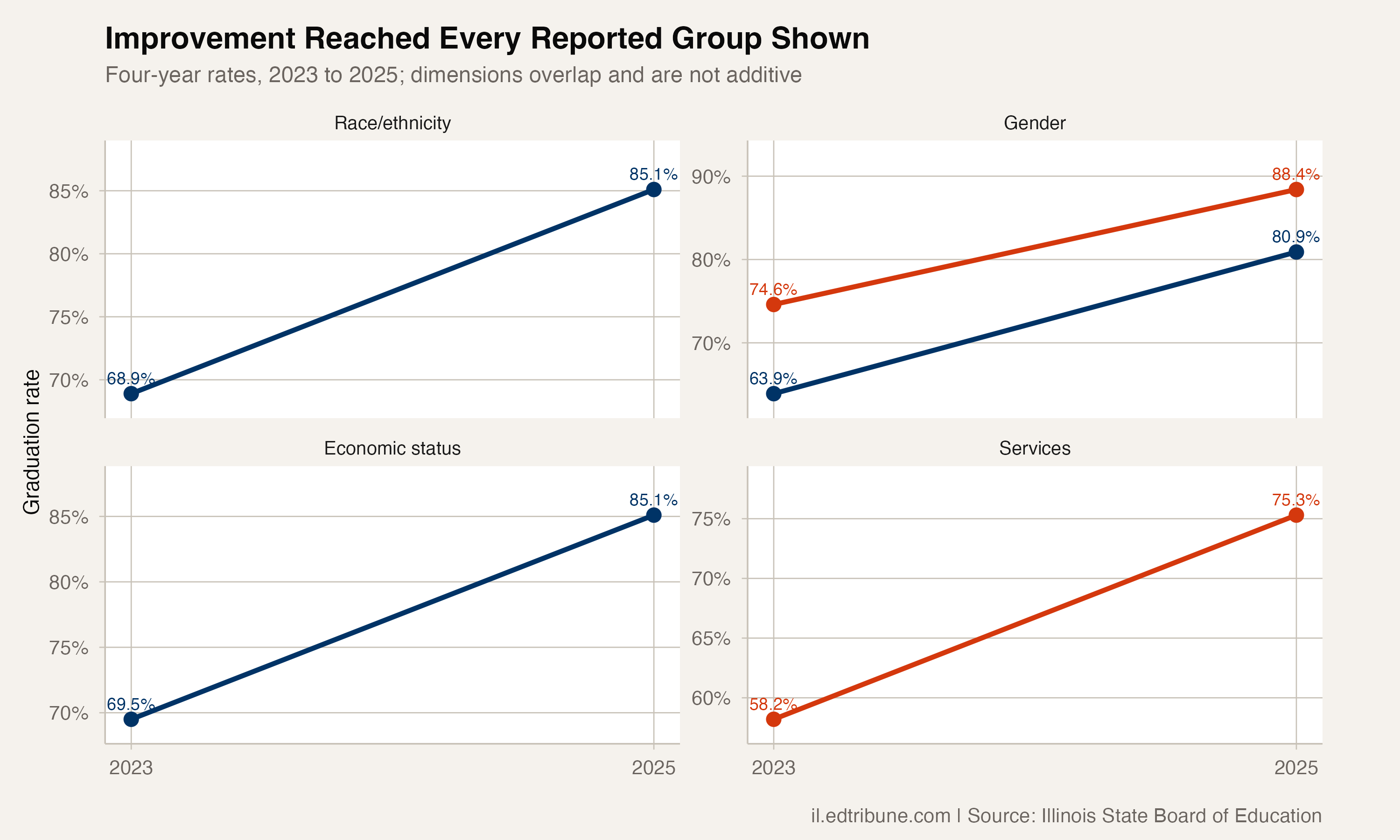
The state data establishes the breadth and size of the gains. It does not identify their cause. District programs, cohort-specific circumstances and other changes remain plausible explanations, but none is directly tested by the graduation file.
The next published graduating class will show whether East St. Louis held the ground it gained. For now, the verified finding is narrower than the old fastest-in-Illinois claim and still substantial: a 15.8-point rise in two years, fifth among the state's larger graduating groups, with most of the gap to the statewide rate erased.
Data source: Illinois State Board of Education. Analysis covers the four-year adjusted cohort graduation rate for public school districts, 2019-2025.
Detailed code that reproduces the analysis and figures in this article is available exclusively to EdTribune subscribers.
Discussion
Sign in to join the discussion.
Loading comments...