On the Illinois side of the Mississippi River, five school districts in St. Clair and Madison counties have chronic absenteeism rates above 50%. This cluster -- Brooklyn UD 188↗ET at 63.6%, Cahokia↗ET CUSD 187 at 61.1%, East St. Louis↗ET SD 189 at 60.2%, Venice↗ET CUSD 3 at 51.8%, and Madison↗ET CUSD 12 at 51.6% -- is one of the starkest regional concentrations in Illinois's 2024-25 attendance data.
The Metro East has long been one of the state's most economically distressed regions. But the attendance data reveals something beyond persistent poverty: a post-pandemic deterioration that, in at least one district, defies any pre-COVID precedent.
Venice: the sharpest five-year jump
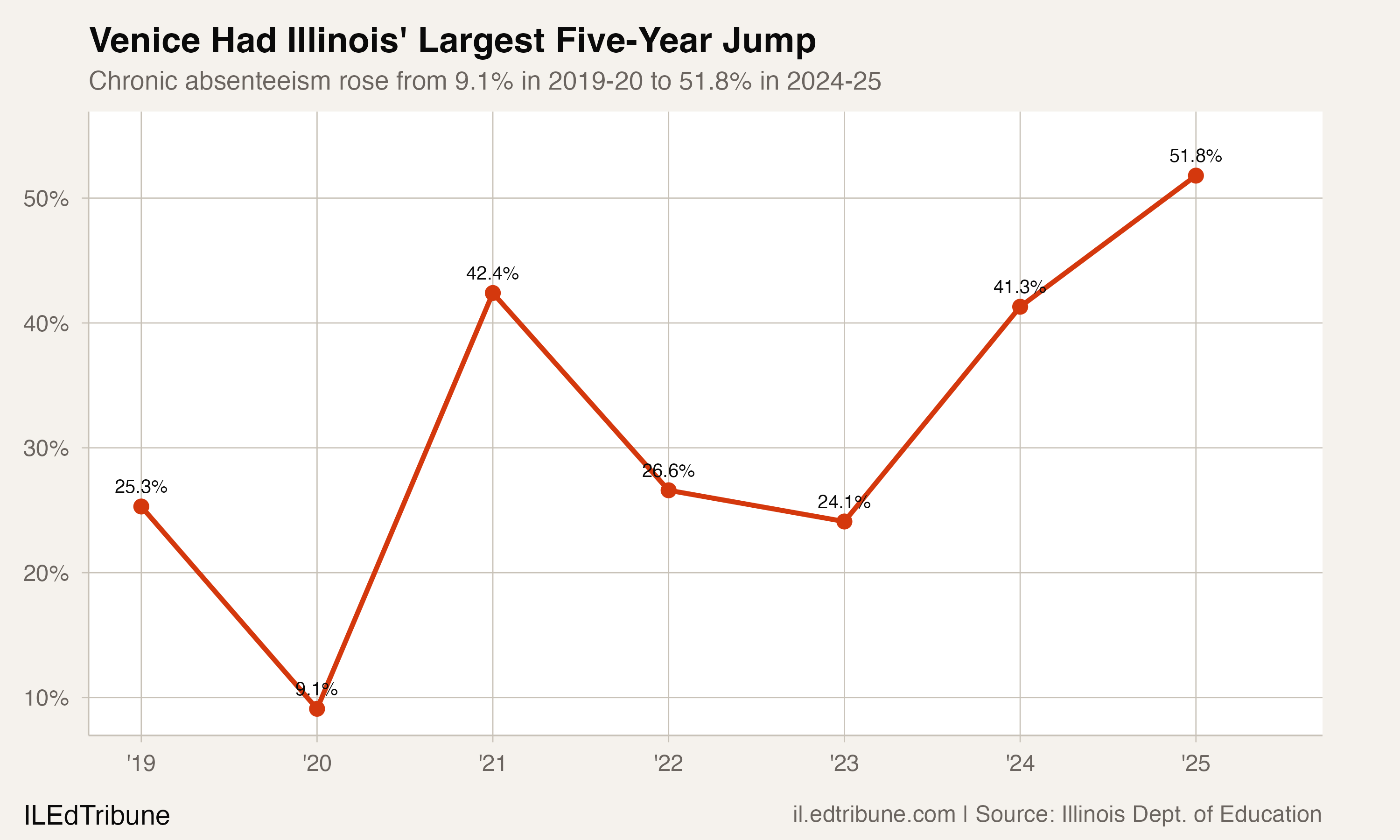
Venice CUSD 3 had a chronic absenteeism rate of 9.1% in 2019-20, slightly below the statewide rate of 11.0%. Five years later, it sits at 51.8%, an increase of 42.7 percentage points. That is the largest 2019-20 to 2024-25 increase of any Illinois district in the current data. The district serves fewer than 200 students, which makes rates more volatile, but a swing that large is still a warning sign.
Venice is an unincorporated community just north of East St. Louis. Its school district is small enough that the departure or arrival of a few families can move the needle, and the path has not been a straight line: 9.1% in 2019-20, 42.4% in 2020-21, 26.6% in 2021-22, 24.1% in 2022-23, 41.3% in 2023-24, and 51.8% in 2024-25. The volatility matters, but so does the endpoint. The district has moved from below the state average to majority-absent status.
East St. Louis: the paradox of improvement
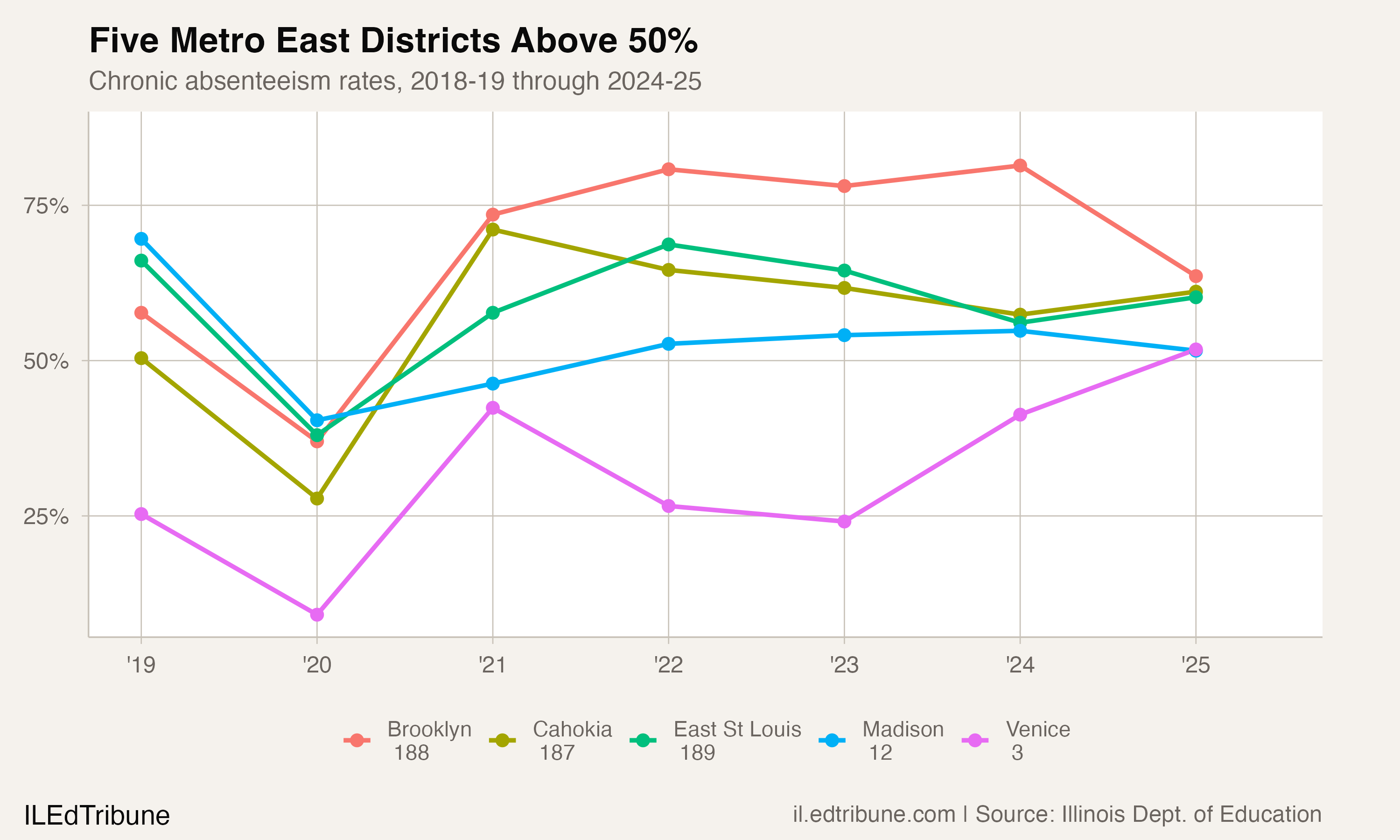
East St. Louis SD 189 presents the opposite narrative. Its chronic rate was 66.1% in 2018-19, already among the highest in the state before COVID. By 2024-25, it had improved to 60.2%. East St. Louis is lower than its pre-pandemic baseline, though 60.2% remains catastrophically high.
The district earned seven commendable school ratings in 2024, evidence that academic quality can improve even when attendance remains a crisis. The pattern suggests that East St. Louis is doing meaningful work with the students who show up, even as it struggles to get more of them through the door.
A regional problem
Brooklyn, Cahokia, and Madison tell variations of the same story: districts that were struggling before COVID, spiked during it, and have not recovered. The geographic clustering across St. Clair and Madison counties suggests shared pressures, but the attendance data alone cannot identify the mechanism. Poverty, transportation, health access, housing instability, and local economic conditions are plausible context, not direct evidence from the school data.
These five districts collectively serve a few thousand students. Their numbers are small in the context of a state with 1.8 million public school students. But they represent one of the clearest local manifestations of Illinois's attendance crisis: a cluster of districts where a majority of students are missing at least 10% of the school year.
Detailed code that reproduces the analysis and figures in this article is available exclusively to EdTribune subscribers.
Discussion
Sign in to join the discussion.
Loading comments...