Correction (September 30, 2026): An earlier version said Earlville's enrollment eased back by 2 students in 2025-26 and ranked the district 644th of 952 Illinois districts. That comparison mixed two differently defined state counts. Measured on the same state count for both years, enrollment rose by 1 student, from 405 to 406, and the district ranked 641st of 859 districts. This version also restates the long-term trend through 2024-25 on a single count.
The largest single group of children in Earlville CUSD 9↗ET is not in a grade. Fifty-five of them are in the district's early learning center, which is more students than any kindergarten, any first grade, any senior class Earlville has. The biggest actual grade in the district, first grade, has 34.
Jenette Fruit, who became superintendent in summer 2026 after years inside a district that enrolled 406 students in 2025-26, wants that number to go up.
"We are expanding our daycare as well as continuing to expand opportunities for our students," she said in written answers to The ILEdTribune.
It is a small sentence about a small program, and in a district this size it is close to a strategy.
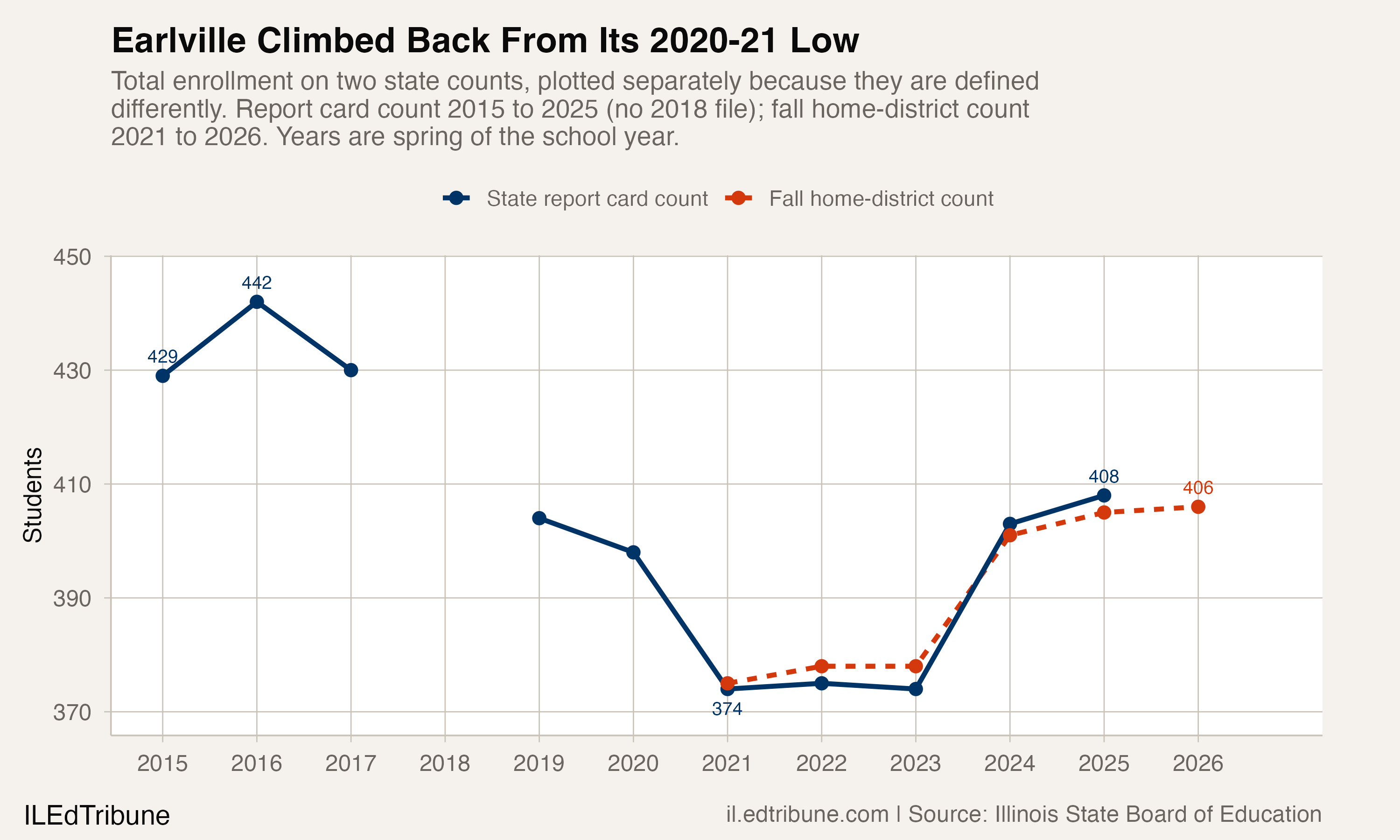
Earlville has done something most Illinois districts its size have not. On the state's report card count, it enrolled 429 students in 2014-15 and 408 in 2024-25, a loss of 21 students or 4.9 percent, while Illinois as a whole lost 10.0 percent. It gave up less than half the ground the state did.
The path there was not smooth. On that count, enrollment fell from a 2015-16 peak of 442 to a low of 374 in 2020-21, sat at 374 again in 2022-23, then jumped 29 students in 2023-24 and 5 more in 2024-25. The state's fall count, a separately defined tally that records each student under the home district responsible for them, carries the story into 2025-26, the latest year the state has published: 405 students in 2024-25 and 406 in 2025-26, a gain of one and the highest figure in that series, which begins with 2020-21. On the fall count Earlville is 31 students above its 2020-21 level of 375. For a district that ranked 641st of 859 in Illinois by size in 2025-26, 31 students is a meaningful fraction of the whole.
The two counts do not agree even for the same year (for 2024-25, 408 on the report card and 405 on the fall count), so the chart above draws them as separate lines and this article never subtracts one from the other. Illinois also published no district enrollment file for 2018, so the report card line breaks there rather than drawing a line across a year the state never reported.
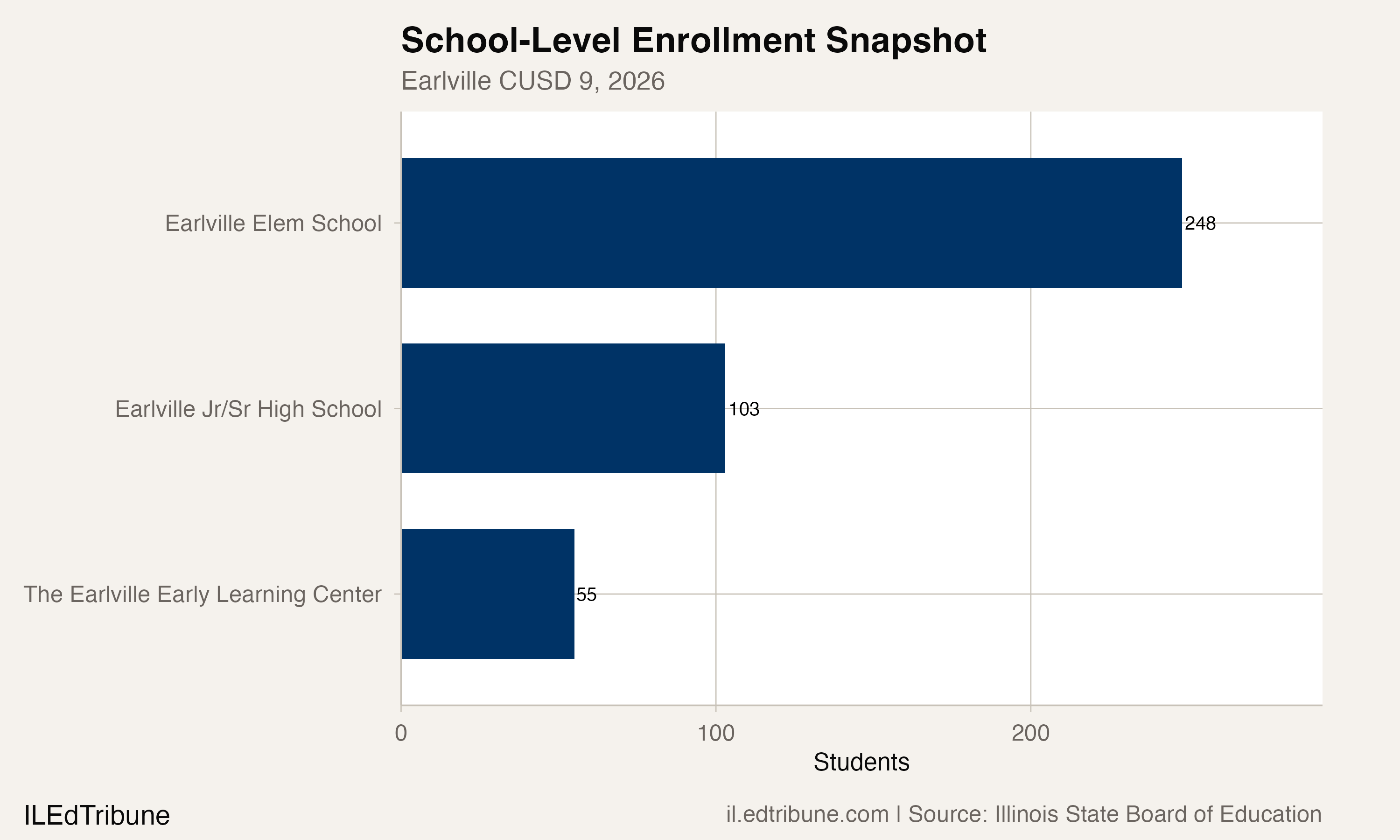
In 2025-26 the district ran three buildings: Earlville Elem School with 248 students, Earlville Jr/Sr High School with 103, and The Earlville Early Learning Center with 55. Split by grade band, that is 55 children in pre-kindergarten, 189 in kindergarten through sixth grade, and 162 in seventh through twelfth. The bands account for every student in the published total with nothing left over.
Set the early learning center against the grades and the shape of Fruit's plan becomes legible. Sixth grade has 18 students. Twelfth grade has 18. Kindergarten has 30. Against those, a 55-child preschool is not a side program, it is the largest room in the district and the one place where a rural district can meet families before anyone has decided where to enroll.
Fruit does not frame it as an enrollment tactic. Asked what drew her to stay, she gave the answer of someone who was never weighing offers.
"I love Earlville, the school and the community," she wrote. "We are all a family and I wanted to continue to be part of it."
That family framing is the whole of her stated agenda, and she is unembarrassed about it. "Our top priority this year is to continue to have a genuine sense of family across our district," she wrote. "A community where students, staff, and families all feel known, connected, and cared for. Everything else we do this year rests on that foundation."
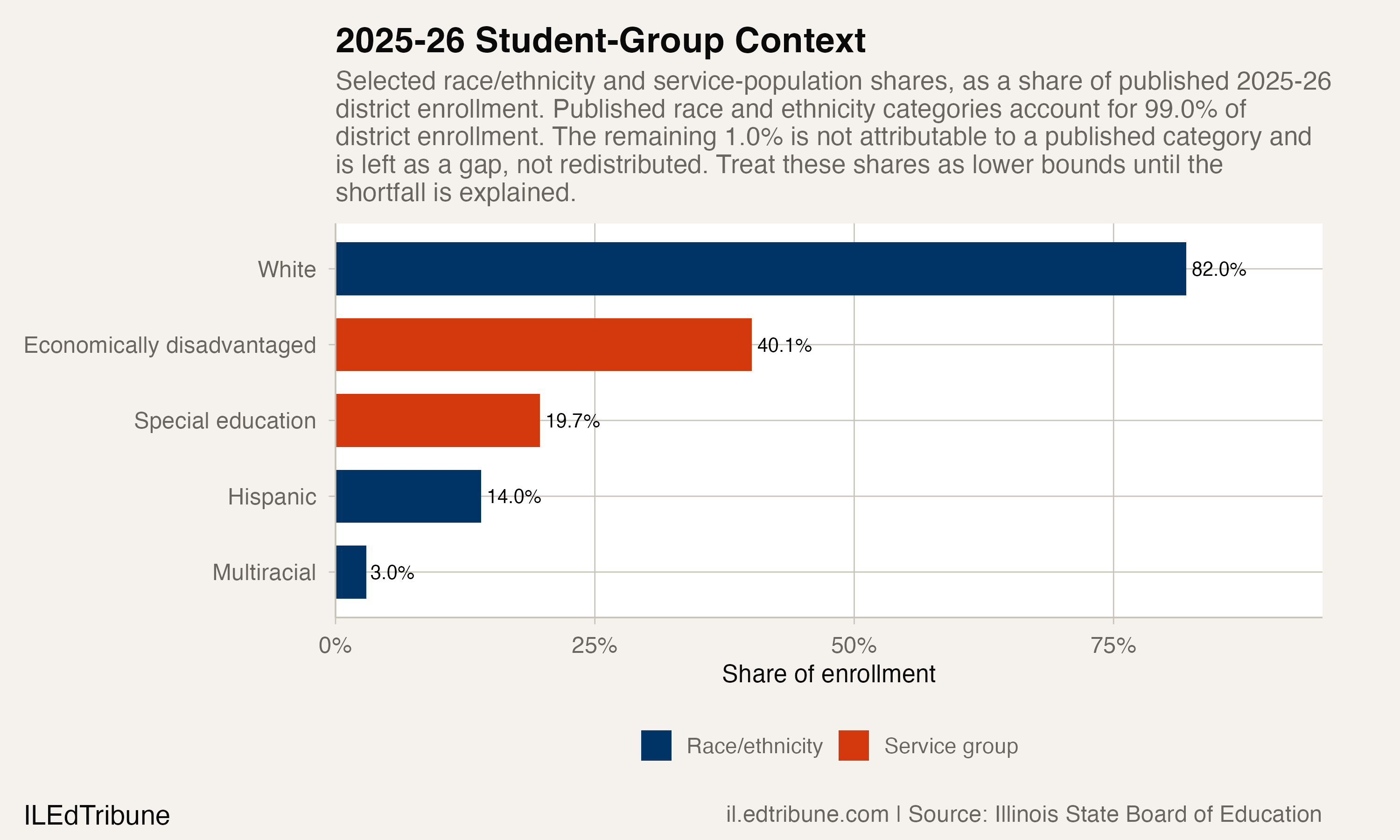
The students inside that community carry real need. In 2025-26, 163 Earlville students, 40.1 percent, were classified as economically disadvantaged, and 80 students, 19.7 percent, received special education services. Those two groups overlap with each other and with race, so they cannot be added. By race and ethnicity, the published categories were 333 white students, 57 Hispanic and 12 multiracial. Five further categories have no published count, and the published categories cover 99 percent of enrollment, so those shares are lower bounds.
Fruit's last answer is the one that gives the daycare line its edge.
"We may be small but we do a lot of out of the box thinking to ensure our students have a great experience," she wrote. "Just because our school is small doesn't mean our ideas have to be."
Whether the preschool holds is the question her first year actually turns on. Earlville has climbed back off its low and held its ground in 2025-26, its senior class and its sixth grade are the same size at 18, and the one part of the district that is bigger than any grade is the part with no grade at all. Fruit is betting she can grow the front door. Subsequent state data will show whether the children walk through it.
Enrollment, grade, school, demographic and student-group figures come from the Illinois State Board of Education, which publishes no district enrollment file for 2018. Jenette Fruit's quotes are from her written responses to The ILEdTribune in July 2026.
Detailed code that reproduces the analysis and figures in this article is available exclusively to EdTribune subscribers.
Discussion
Sign in to join the discussion.
Loading comments...