Correction (September 30, 2026): An earlier version said Indian Prairie's enrollment moved down by 66 students, or 0.3%, from 2024-25 to 2025-26, and described the district as the fourth-largest of 943 Illinois districts. That comparison mixed two differently defined state counts. Measured on the same state count for both years, enrollment fell by 242 students, or 0.9%, from 26,108 to 25,866. The district is the fourth-largest of 859 Illinois districts. This version also restates the long-term trend through 2024-25 on a single count.

John P. Price began leading Indian Prairie CUSD 204 without a preset playbook. His starting point is a lesson from Chicago and North Chicago: district offices serve students better when they begin with principals.
Price framed the idea through a saying he attributes to Arne Duncan: "you do not have great schools without great principals."
Price became superintendent of Indian Prairie CUSD 204↗ET this summer, succeeding Adrian Talley. The district's Board of Education announced the selection, and its current superintendent page now lists Price in the role.
In a professional biography he supplied to The ILEdTribune, Price traced that instructional focus from his work as principal of Audubon Elementary School through district leadership in Chicago and Evanston and the superintendency in North Chicago. Early elementary achievement, curriculum and classroom practice recur across that account.
Principals before a preset plan
His written answers sharpened the connection. Price said district administrators should "center the work of the principalship" by putting building leaders' support and development first. His next major Indian Prairie assignment is a new strategic plan intended to turn the district mission into concrete choices for students.
"Our strategic plan will identify the key moves that we need to make to move closer to realizing that mission," Price wrote.
That work begins at unusual scale. Indian Prairie enrolled 25,866 students last school year, 2025-26, the most recent published year, making it the fourth-largest of 859 Illinois districts. Its enrollment record combines a long decline with a much flatter recent path.
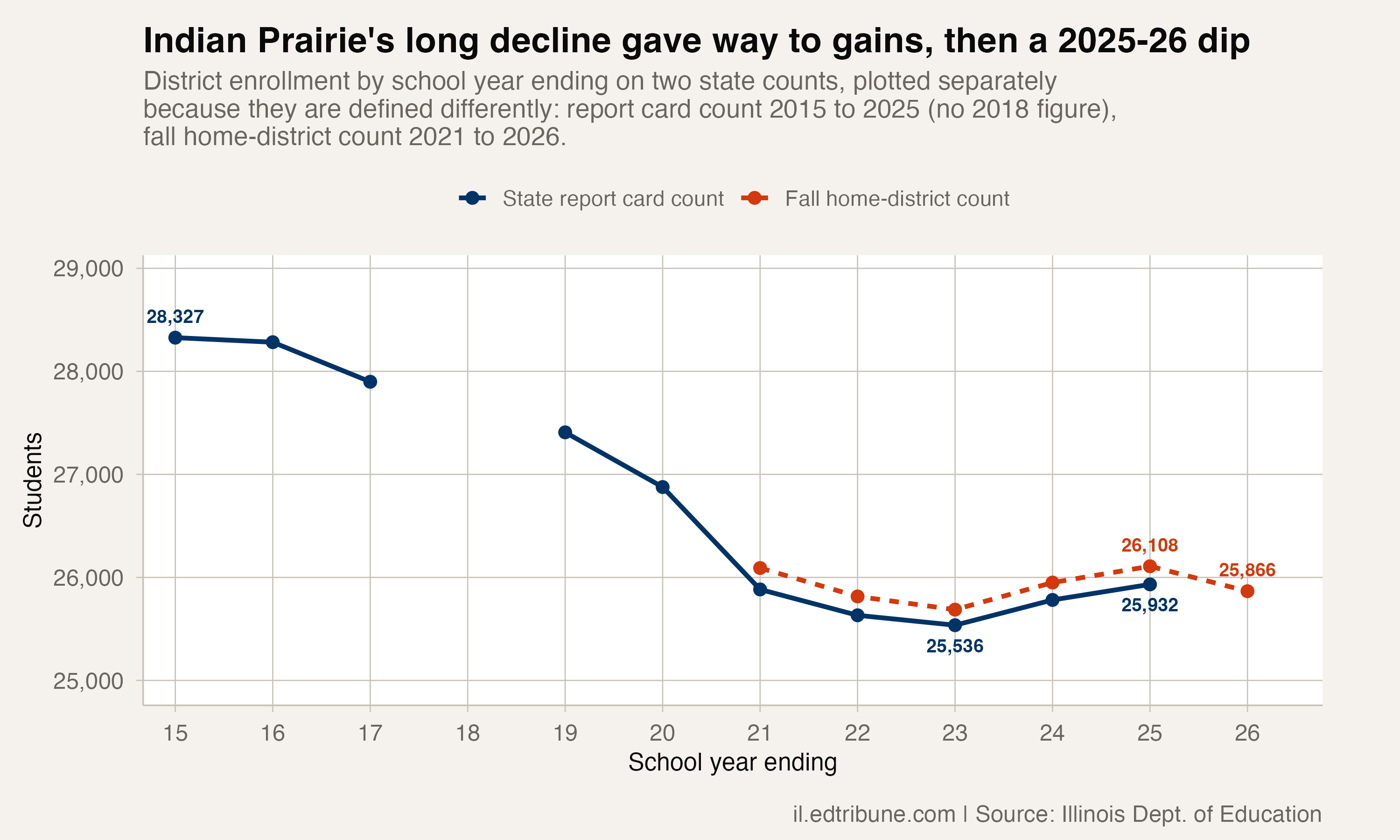
The longest view comes from the state's report card count, which runs through 2024-25. On it, the district enrolled 28,327 students in 2014-15 and 25,932 in 2024-25, a decline of 2,395 students, or 8.5%. Illinois enrollment fell 10.0% over the same endpoints, so Indian Prairie's percentage decline was 1.5 points smaller than the state's.
The long-window comparison does not describe a steady fall. On the report card count, Indian Prairie reached a low of 25,536 students in 2022-23, then added 396 students, or 1.6%, by 2024-25. The state's fall count, a separately defined tally that records each student under the home district responsible for them, shows its low in the same year and carries the record into 2025-26. After gains in each of the two prior years, it moved down by 242 students, or 0.9%, from 26,108 in 2024-25 to 25,866. The two counts do not agree even for the same year, so the chart above draws them as separate lines and this article never subtracts one from the other.
Those changes matter differently in a district this large than they would in a small system. A fraction of a percentage point still represents classrooms of students, while the longer record shapes decisions about staffing, programs and buildings. The state file establishes the movement but does not explain why families enroll, leave or move within the district.
Price's background offers an instructional lens for those decisions. The biography he provided describes a career that moved from school leadership to oversight of a network of Chicago schools, then to North Chicago. His answer about principals makes the intended operating model more specific: listen first to the people leading buildings, then align district-office support around their work.
He applied the same principle to his own arrival. "I do not have some magic plan that I've been hired to bring to Indian Prairie," Price wrote. He said strategies should be developed with the community around this district's strengths and needs.
That distinction matters. A strategic plan can respond to the students Indian Prairie serves and the learning conditions they need. It cannot be credited with an enrollment pattern that predates it.
The grade spine behind the plan
Indian Prairie's published 2025-26 grade distribution makes the planning question concrete. The district reported 1,451 students in kindergarten and 2,237 in 12th grade that year. Kindergarten enrollment was 64.9% of 12th-grade enrollment. Its 638 students in prekindergarten sit outside the published K-12 total but inside the district's overall enrollment.
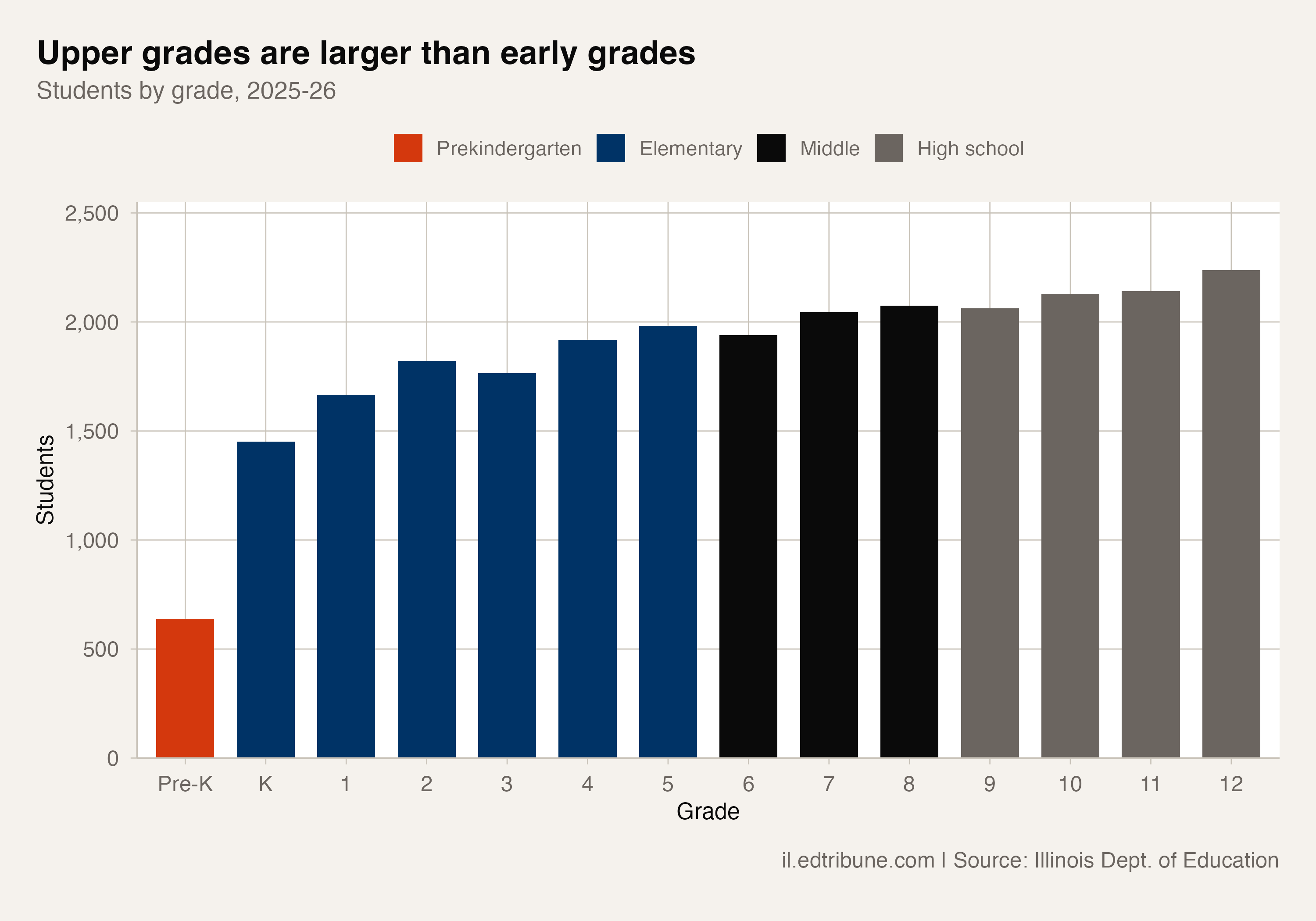
That is a planning signal, not a forecast. The state record cannot show how many students will enter, leave or transfer before a class reaches high school. It also cannot predict how programs, housing or district boundaries might change the path.
The grade spine does show why Price's long-running interest in early elementary instruction is relevant to the job in front of him. Indian Prairie must plan for a system whose older grades were larger in the published 2025-26 record while supporting the children entering its classrooms now.
A community the plan must recognize
The new plan will also be written for a district with several large racial and ethnic groups. Asian students were the largest published racial or ethnic group in Indian Prairie's 2025-26 enrollment, with 10,372 students, or 40.1% of the district total. The published race and ethnicity categories reconcile exactly to total enrollment that year.
Separately, 4,142 students were classified as English learners, equal to 16.0% of the district total. That service category overlaps with race and ethnicity and should not be added to them. Indian Prairie maintains a districtwide program for multilingual learners, making language access and instructional design part of the day-to-day landscape behind the planning process.
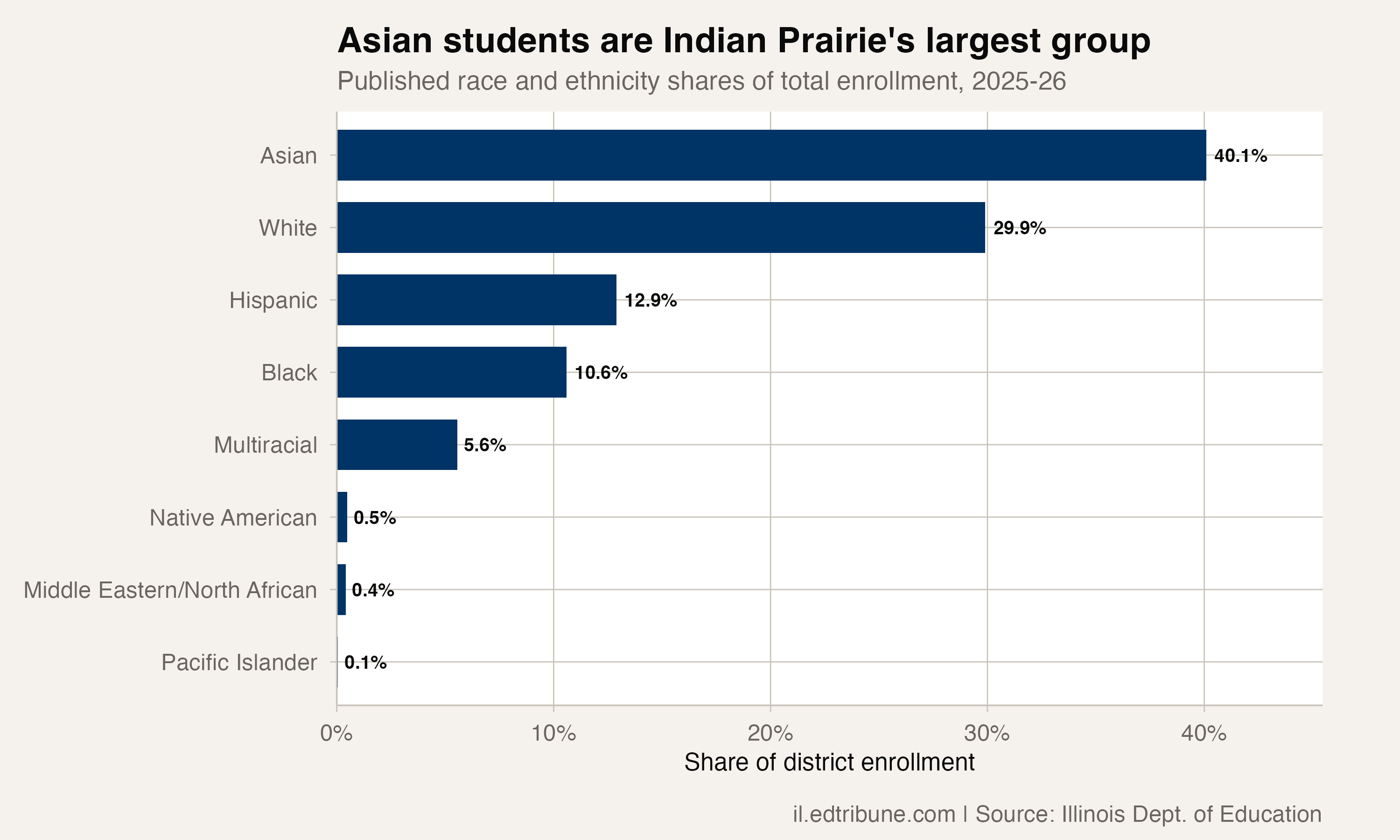
The enrollment file can describe that landscape. It cannot say which strategies will work for students or whether one initiative caused a result. Price's written answers provide direct evidence of his agenda, while the state record supplies the scale and composition of the district where that agenda will be tested.
Price wrote that he wants families and educators to see an accessible superintendent who will build partnerships and continue putting students first. The test of the new plan will be whether that listening becomes choices that fit a district whose most recent published count was 25,866 students, a grade spine that was wider at the top than the bottom in 2025-26, and a community whose families bring many languages and experiences to school.
The next strategic plan will show how Price, the district's principals and the wider community choose to do that.
Enrollment figures come from the Illinois State Board of Education: its report card count through 2024-25 and its fall enrollment count for 2020-21 through 2025-26. The report card series has no figure for the school year ending in 2018, so the chart breaks the line across that gap. Price responded in writing and supplied the professional biography, answers and headshot used for this profile.
Detailed code that reproduces the analysis and figures in this article is available exclusively to EdTribune subscribers.
Discussion
Sign in to join the discussion.
Loading comments...