Correction (October 1, 2026): An earlier version compared counts from two different state enrollment collections. On the Report Card count, Bloomingdale grew by 27 students from 2014-15 to 2024-25, not 6 through 2025-26, while Illinois fell 10.0%, not 11.4%. On the state's fall count, used at both ends, the district fell by 40 students in 2025-26, not 21, and by 124 students from its 2021-22 level of 1,374, not 104 from 1,354; the yearly declines were 30, 30, 24 and 40. Its rank is 308th of 859 public districts, not 309th of 952 rows that included non-district entities. The four-year run of declines, the school, grade and student-group figures, and the article's conclusions are unchanged.
Vicki King has taken over Bloomingdale SD 13↗ET, and the first thing worth saying about the district she now runs is that it did something almost no Illinois district did. It kept its students.
On the Illinois Report Card count, Bloomingdale enrolled 1,244 students in 2014-15 and 1,271 in 2024-25. That is a gain of 27 students, essentially flat across 10 reporting years, while Illinois lost 10.0 percent of its enrollment over the same span. In 2025-26, the most recent published year, the state's fall count put the district at 1,250 students, 308th of 859 Illinois public districts by size.
Holding steady while the state shrinks by a tenth is a real accomplishment, and it is also the part of the story that has already ended.
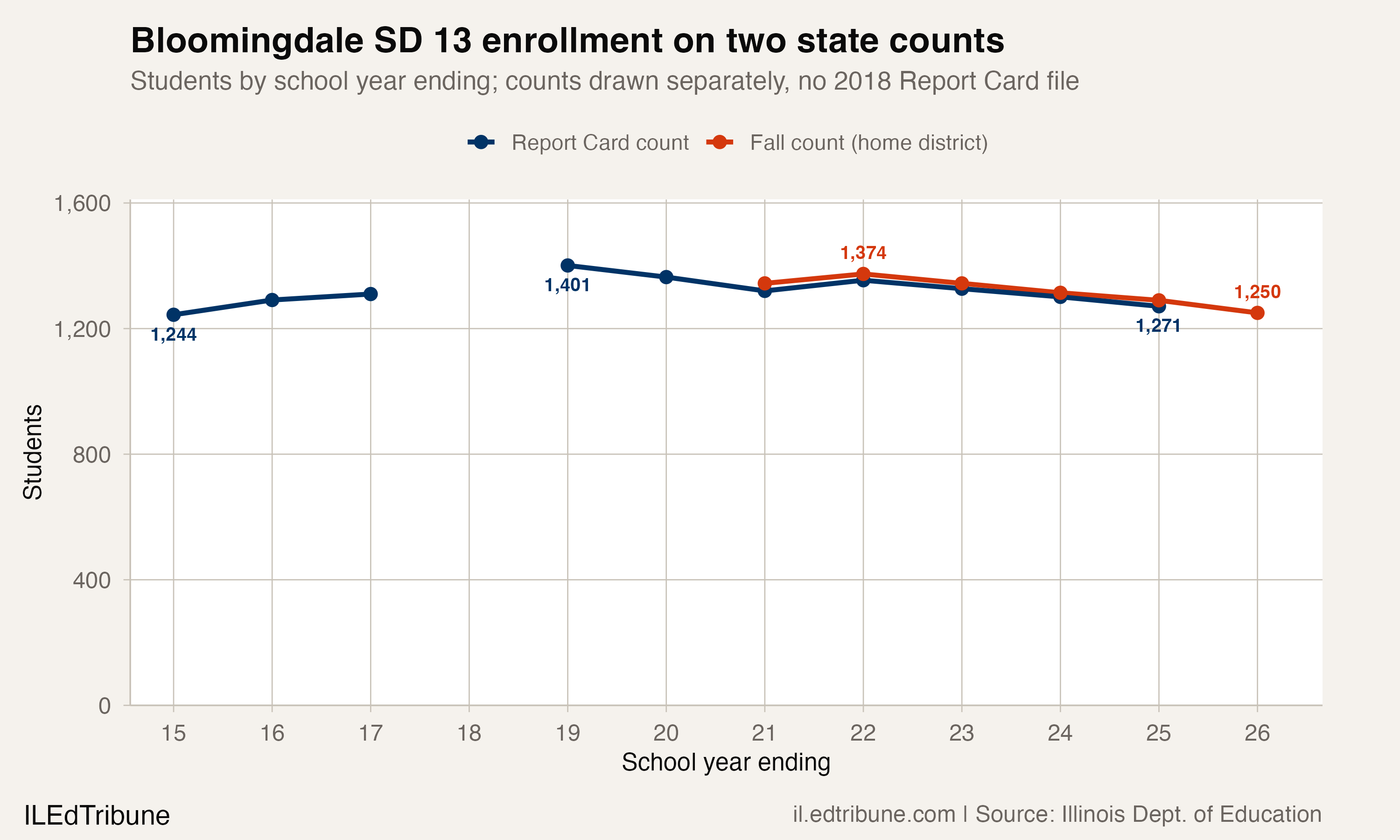
Enrollment peaked at 1,401 in 2018-19 on the Report Card count and has not come close since. More to the point, it has fallen in each of the last four years on the state's fall count, which assigns each student to a home district and is the only count published for 2025-26: down 30 in 2022-23, 30 in 2023-24, 24 in 2024-25 and 40 in 2025-26. That is 124 students gone from the 2021-22 level of 1,374, and it is the longest unbroken run of declines in either state count. The flat decade is real. So is the fact that all of the flatness happened in its first half.
Illinois published no Report Card enrollment file for 2018, so the chart above breaks there rather than drawing a line across a year the state never reported. It draws the two state counts as separate lines because they are not interchangeable.
King, who was appointed after a search the district built around community input, describes her opening months in terms of restraint rather than initiative.
Asked what drew her to the district, King pointed to fit. "What immediately drew me to Bloomingdale School District 13 was how closely the district’s mission aligns with my own core beliefs as an educator," she wrote. "Everything I do centers on the students- fostering their growth, ensuring they feel a deep sense of belonging, building their confidence, and preparing them for a bright future."
"As I step into this role, my immediate priority is simple: to listen and to learn," she said in written answers relayed by the district. "Before implementing new initiatives, I want to fully understand the unique landscape of our district so we can thoughtfully build upon our existing foundations."
She has put structure behind that. "I have established formal community listening hours where any stakeholder can schedule dedicated time to share their perspectives with me," she wrote, adding that the feedback will feed a strategic planning process the district is running this year.
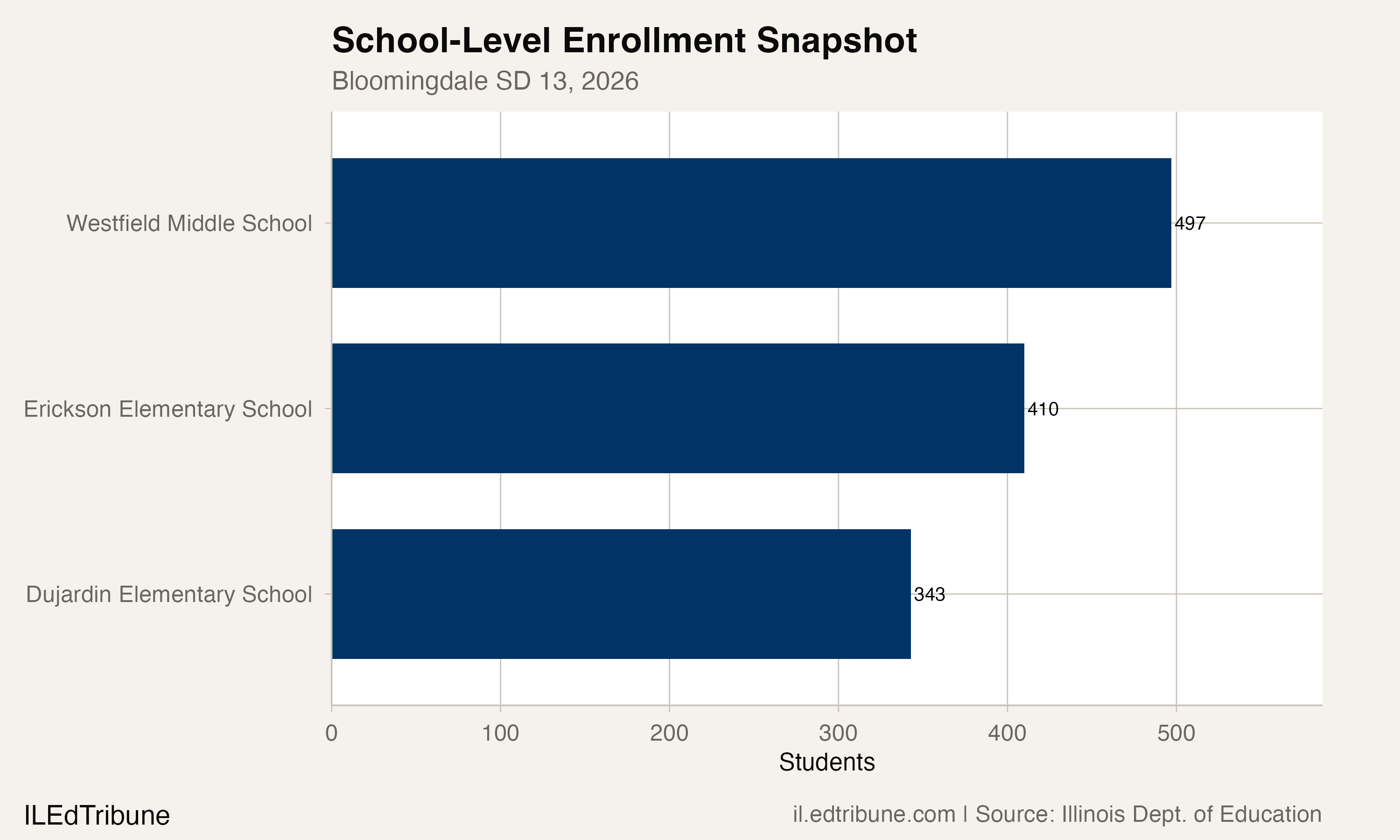
That strategic plan will run into a specific number. Bloomingdale's three buildings are Westfield Middle School at 497 students, Erickson Elementary at 410 and Dujardin Elementary at 343. Behind those totals, the district's grades get smaller as they get younger. Eighth grade enrolled 184 students in 2025-26. Kindergarten enrolled 92, almost exactly half. First grade enrolled 113, second grade 102, third grade 120.
This is a snapshot of a single year, not a forecast, and the two grades are different cohorts rather than the same children counted twice. A district can refill its lower grades through move-ins, and Bloomingdale plainly has before. But the arithmetic a strategic plan has to confront is visible in it: the classes leaving Westfield are consistently larger than the classes arriving at Erickson and Dujardin, and staffing, sections and building use are all sized to the older, larger end.
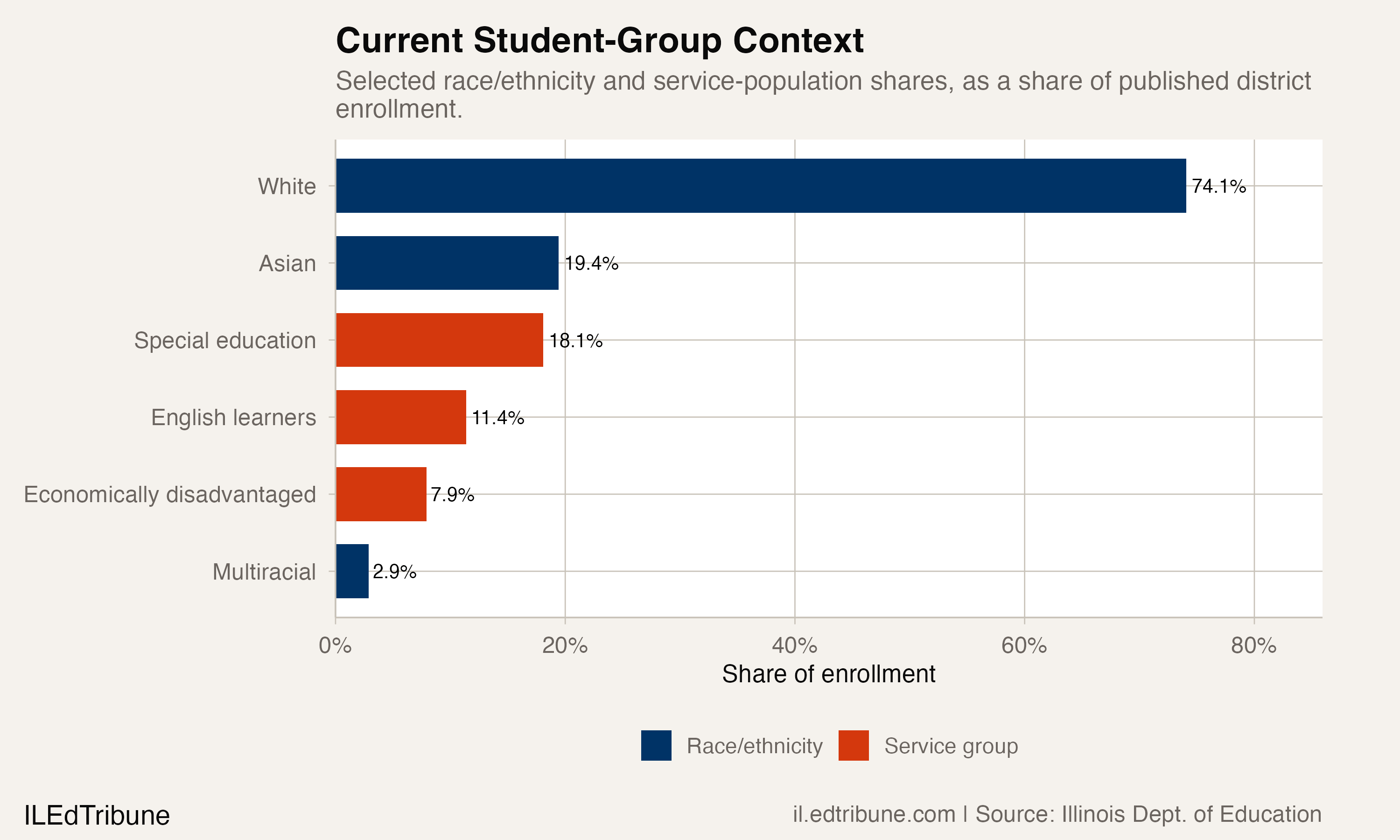
The district King inherits is also unusually advantaged by Illinois standards. Ninety-nine Bloomingdale students, 7.9 percent, were classified as economically disadvantaged in 2025-26. The statewide share that year was 47.5 percent, six times Bloomingdale's. At the same time 226 students, 18.1 percent, received special education services, and 142 students, 11.4 percent, were English learners. Those categories overlap with one another and with race and cannot be summed.
By race and ethnicity, the published 2025-26 categories were 926 white students, 243 Asian, 36 multiracial, 27 Hispanic and 12 Black. Three further categories were withheld; the published categories cover 99.5 percent of enrollment, so the shares are lower bounds.
King's answer on program strength leans on that stability rather than promising to disrupt it.
A district of this size, she wrote, "allows us to truly know our kids and families, creating a tight-knit environment where no one falls through the cracks." Her stated aim is for academic programs and student supports to remain "both holistic and equitable," and to "continue supporting our excellent staff to ensure we sustain this high standard."
Sustaining a standard is a defensible goal for a first year, and a listening period is a defensible way to spend one. The open question is whether the thing King is being asked to sustain is the district's academic reputation or its enrollment, because the record now separates them. The reputation is intact. The enrollment has fallen four years in a row, and the youngest grades in the building say the pressure is not finished.
Enrollment, grade, school, demographic and student-group figures come from the Illinois State Board of Education, which publishes no district enrollment file for 2018. Changes through 2024-25 use the Report Card count; the 2025-26 figures and every change ending in 2025-26 use the state's Fall Enrollment Report on both ends, and the two counts are never subtracted from each other. Dr. King's quotes were relayed in writing by the district in July 2026.
Detailed code that reproduces the analysis and figures in this article is available exclusively to EdTribune subscribers.
Discussion
Sign in to join the discussion.
Loading comments...