
Sean McNichols spent most of his career in school systems large enough that he could not have known every student's name. He now leads one where he can.
McNichols became superintendent of Grant Park CUSD 6↗ET on July 1, taking over a district that enrolled 464 students in 2025-26, the most recent school year in the state's published enrollment record.
"I am humbled and extremely excited to have assumed the role of school superintendent on July 1st," he wrote in response to questions from The ILEdTribune.
He came to Grant Park from Oak Lawn-Hometown Middle School, where he was principal. Before that, according to Shaw Local's Daily Journal, he worked in Chicago Public Schools as a teacher, coach, assistant principal and principal, and he holds a doctorate from Loyola University Chicago.
He succeeded John Palan, who retired after a long tenure in the job. In the welcome message posted on the district's website, McNichols thanked the Board of Education for the appointment and devoted a full paragraph to his predecessor before saying anything about his own plans.
"I have had the great fortune of stepping into some huge shoes with Dr. Palan being such an impactful leader for so many successful years," he wrote.
What he found on the first visit
McNichols said the decision to come to Grant Park turned on something he noticed before he had the job.
"From my very first visit to Grant Park, I felt something that is difficult to manufacture, a genuine sense of community and kindness," he wrote. "It became clear that Grant Park is a place where relationships matter, traditions are valued, and people genuinely care about supporting every child's success."
The district's own shorthand for that, used on its website and in his answers, is the GP Way.
Size is part of what drew him. "One of the greatest strengths of a district like Grant Park is the ability to know our scholars, families, and staff personally," he wrote. "Rather than leading from behind a desk, I want to be present in classrooms, hallways, events, and throughout the community."
A district that turned around while the state kept shrinking
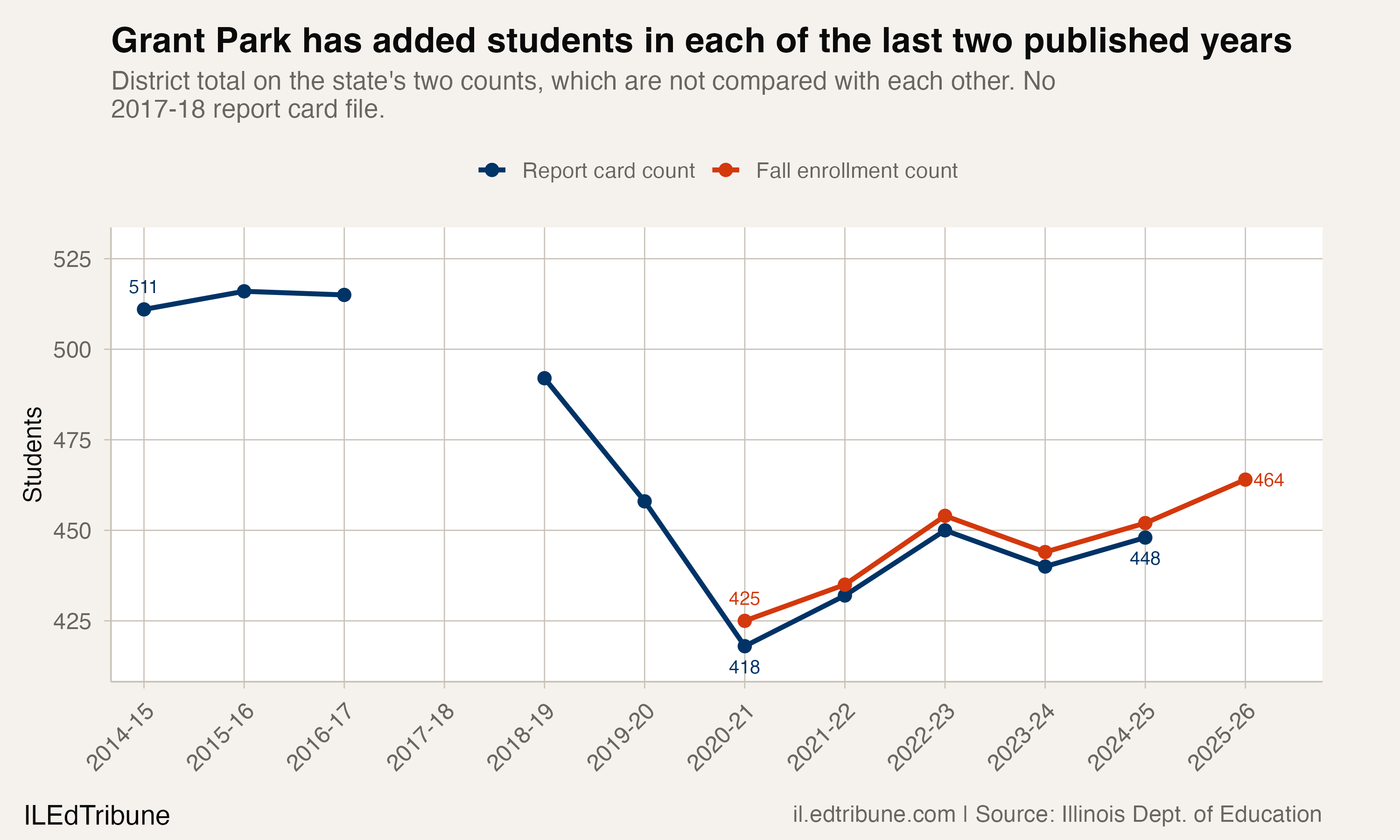
Illinois publishes two enrollment counts that count students a little differently, so this article never compares one with the other. The longer one, the annual report card count, runs through 2024-25. On it, Grant Park enrolled 511 students in 2014-15 and 448 in 2024-25, a decline of 63 students, or 12.3%. Illinois has no report card enrollment file for 2017-18, so the chart leaves a gap there rather than drawing a line through a year nobody measured.
The shape since then is what matters for a new superintendent, and the state's fall enrollment count, which begins in 2020-21, shows it. Grant Park counted 425 students that year, its low on both counts. By 2025-26 it had 464, an increase of 39 students, or 9.2%. The two most recent years each moved up, by 8 students and then by 12, or 2.7% in the latest year: two consecutive annual increases across three reporting years.
Illinois went the other way. On the same fall count, the state had 1,821,157 students in 2025-26, 3.8% below where it stood in 2020-21, the year Grant Park bottomed out.
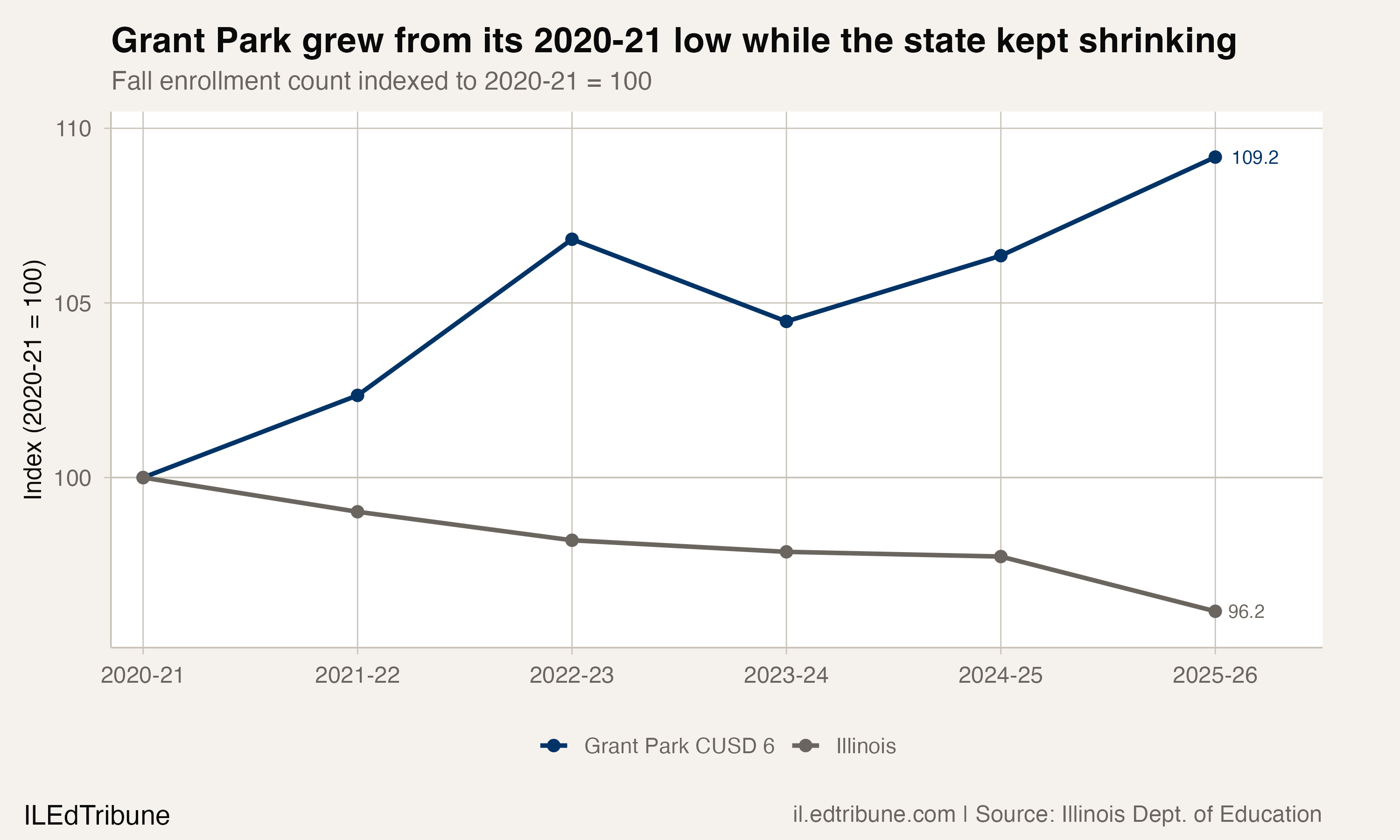
Growth is not the common experience in Illinois right now. Of the 858 districts with a positive fall count in both 2020-21 and 2025-26, 270 finished the period larger, or 31.5%. Grant Park is among them.
The record establishes the movement. It does not explain it. Nothing in the state's enrollment files shows whether a family arrived for the schools, for a house, or for a job, and the district's own numbers cannot separate those from one another.
McNichols was careful about the same distinction.
"Enrollment numbers are certainly important, but they are only one part of the story," he wrote. "The recent increase is encouraging, and I see it as an opportunity to continue building on the district's strengths while ensuring every student receives an outstanding educational experience."
Where the students actually are
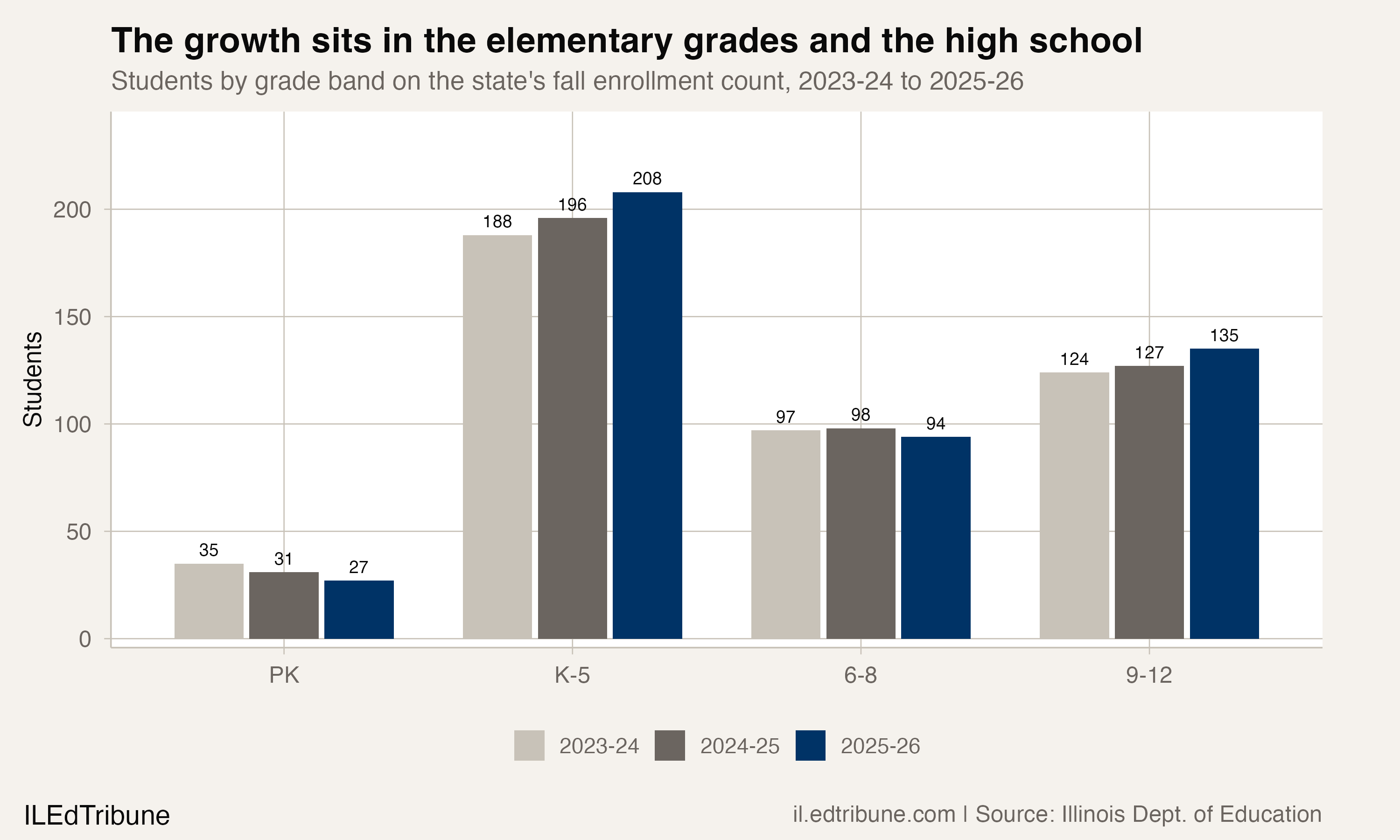
On the fall count, the three most recent years of grade-by-grade detail, 2023-24 through 2025-26, show where the growth sits. The elementary grades grew the most, from kindergarten through fifth grade adding 20 students to reach 208. The high school added 11, reaching 135. The middle grades were nearly flat, down 3 students to 94.
Prekindergarten moved the other way, falling by 8 students over the same three years to 27 in 2025-26. In a district whose total is rising, the youngest band is the one contracting. That is a planning signal for the kindergarten classes that follow it, not a forecast of them.
The landscape has other features he will have to plan around. In 2025-26 the district identified 210 students as low income, 45.3% of its published enrollment.
The first year
McNichols has been explicit about how he intends to spend the first year.
"Listening is one of the most important responsibilities of a new superintendent, and my goal is to spend this first year learning from the people who know Grant Park best," he wrote. "My first priority is understanding what our community values most, celebrating the traditions that make Grant Park special, and identifying opportunities where we can continue to grow."
He closed his answers on what he hopes people conclude about him, and put it in terms of method rather than outcome.
"Ultimately, I hope people come to know me as someone who leads with humility, transparency, and collaboration," he wrote. "I believe the best decisions are made by listening first, valuing different perspectives, and always asking what is in the best interest of our scholars."
A year of listening is a defensible plan in a district that is currently growing. It is also a year in which the prekindergarten line keeps moving, and the state has not yet published 2026-27 counts, so the numbers Grant Park is working from this fall are its own rather than the ones above.
Enrollment figures come from two Illinois State Board of Education public enrollment records: the annual report card count, 2014-15 through 2024-25, with no file for 2017-18, and the fall enrollment count, 2020-21 through 2025-26, the most recent year the state has published. The two count students differently, so every comparison here stays within one of them. McNichols responded in writing and supplied the professional headshot.
Detailed code that reproduces the analysis and figures in this article is available exclusively to EdTribune subscribers.
Discussion
Sign in to join the discussion.
Loading comments...