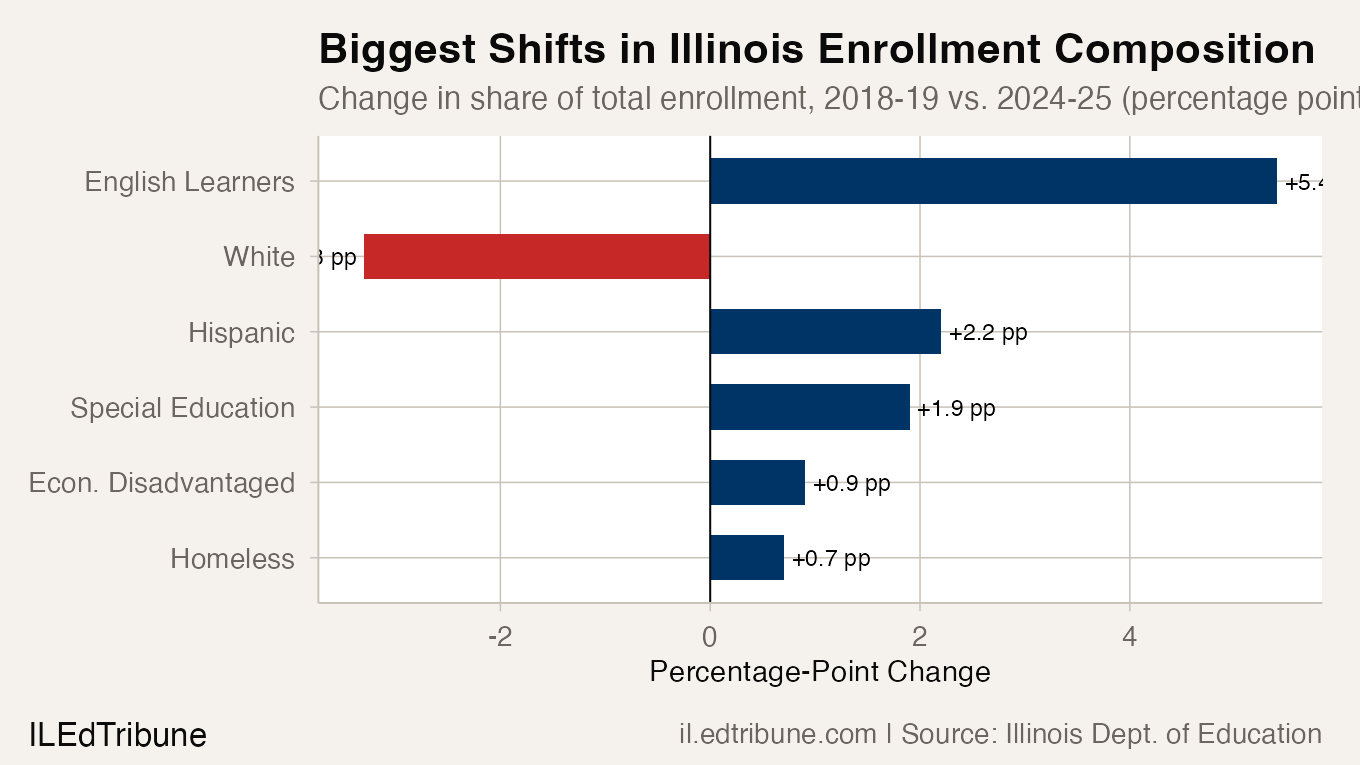
Illinois added 83,371 English learners over the past six years — even as the state lost 135,959 students overall. The English learner share of enrollment jumped from 12.1% to 17.5%, a 5.4 percentage-point shift that is the largest compositional change in any student group statewide. Nearly one in five Illinois students now receives English learner services, up from roughly one in eight in 2018-19.
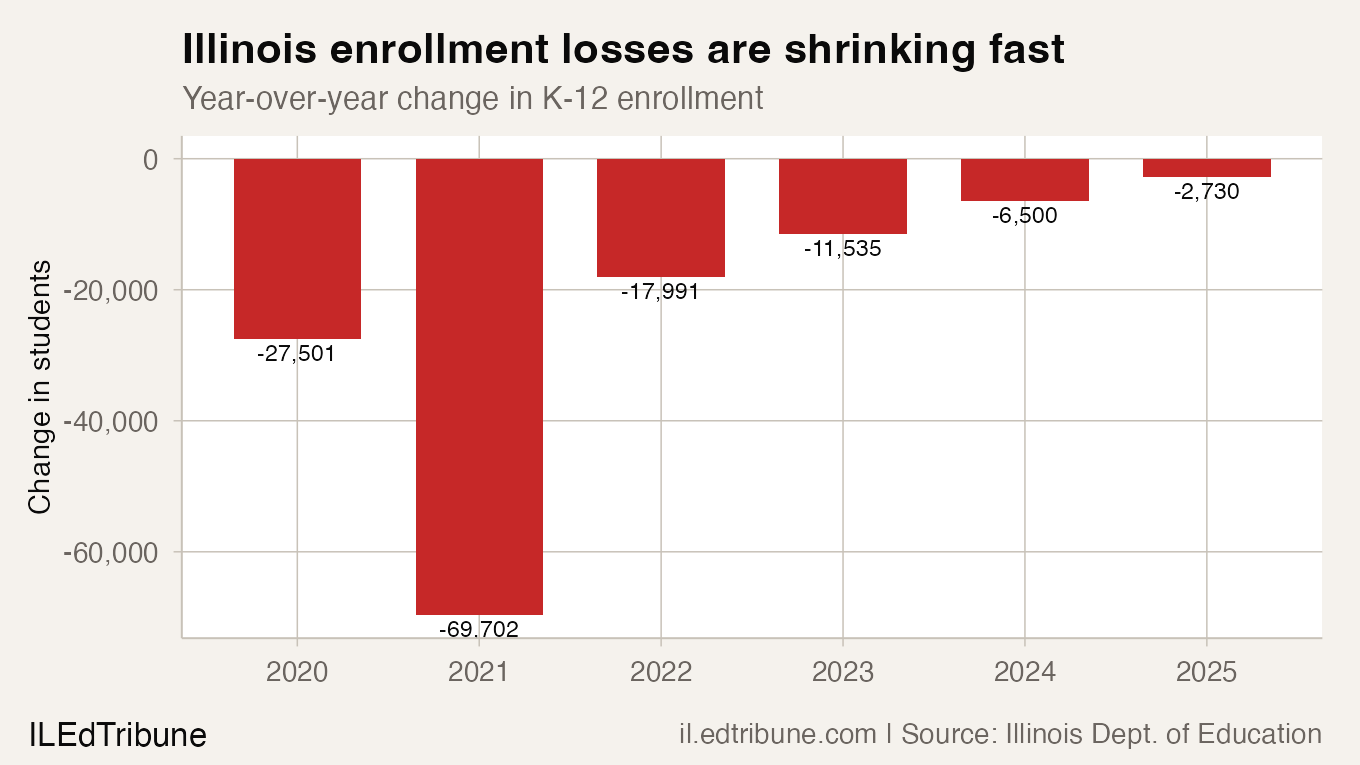
The overall decline, meanwhile, is decelerating fast. The state lost just 2,730 students in 2024-25, or 0.1% — a fraction of the 69,702 who left classrooms during the pandemic year. At this rate, 2025-26 could be the first year Illinois enrollment holds steady since the late 2010s. But the system approaching that plateau serves a fundamentally different student body than the one that started declining.
The pattern
Each year since the pandemic trough has been less bad than the last:
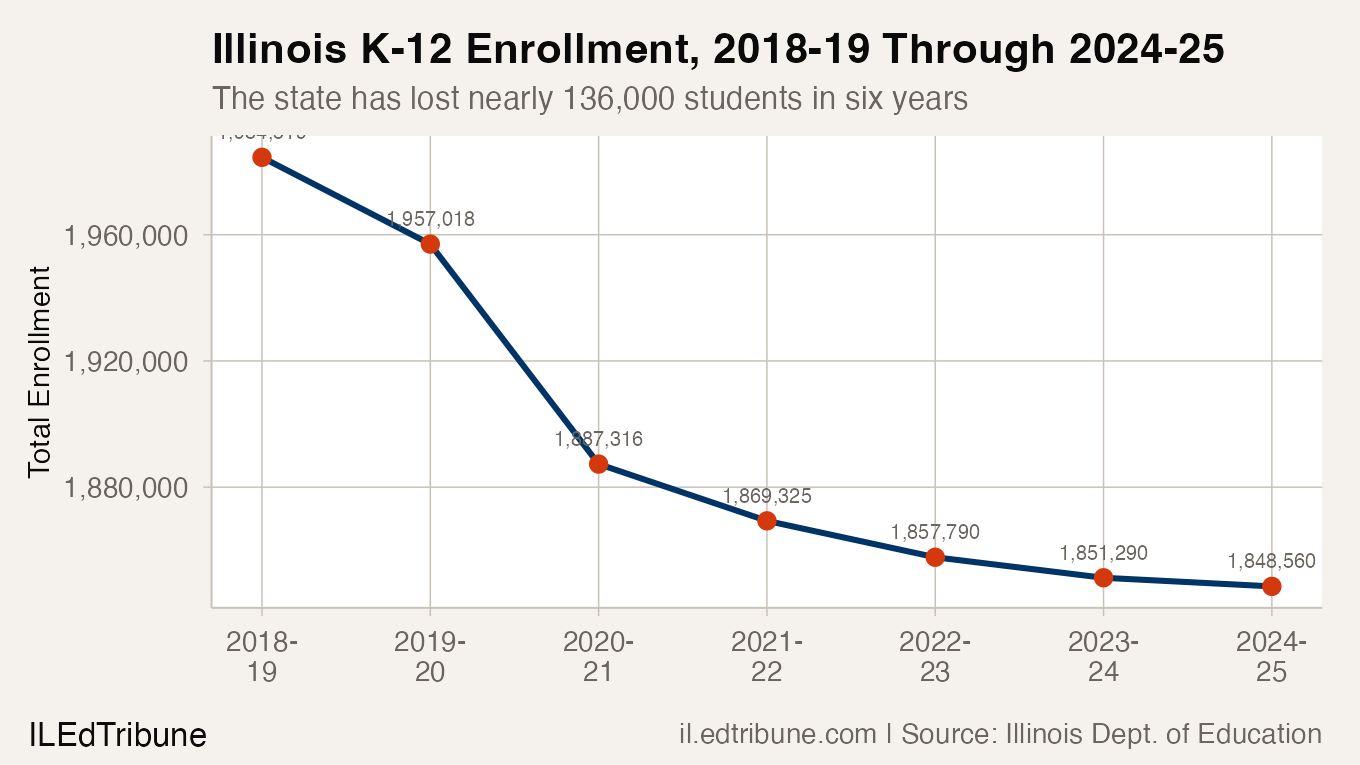
| Year | Enrollment | Change | Pct Change |
|---|---|---|---|
| 2018-19 | 1,984,519 | — | — |
| 2019-20 | 1,957,018 | -27,501 | -1.4% |
| 2020-21 | 1,887,316 | -69,702 | -3.6% |
| 2021-22 | 1,869,325 | -17,991 | -1.0% |
| 2022-23 | 1,857,790 | -11,535 | -0.6% |
| 2023-24 | 1,851,290 | -6,500 | -0.3% |
| 2024-25 | 1,848,560 | -2,730 | -0.1% |
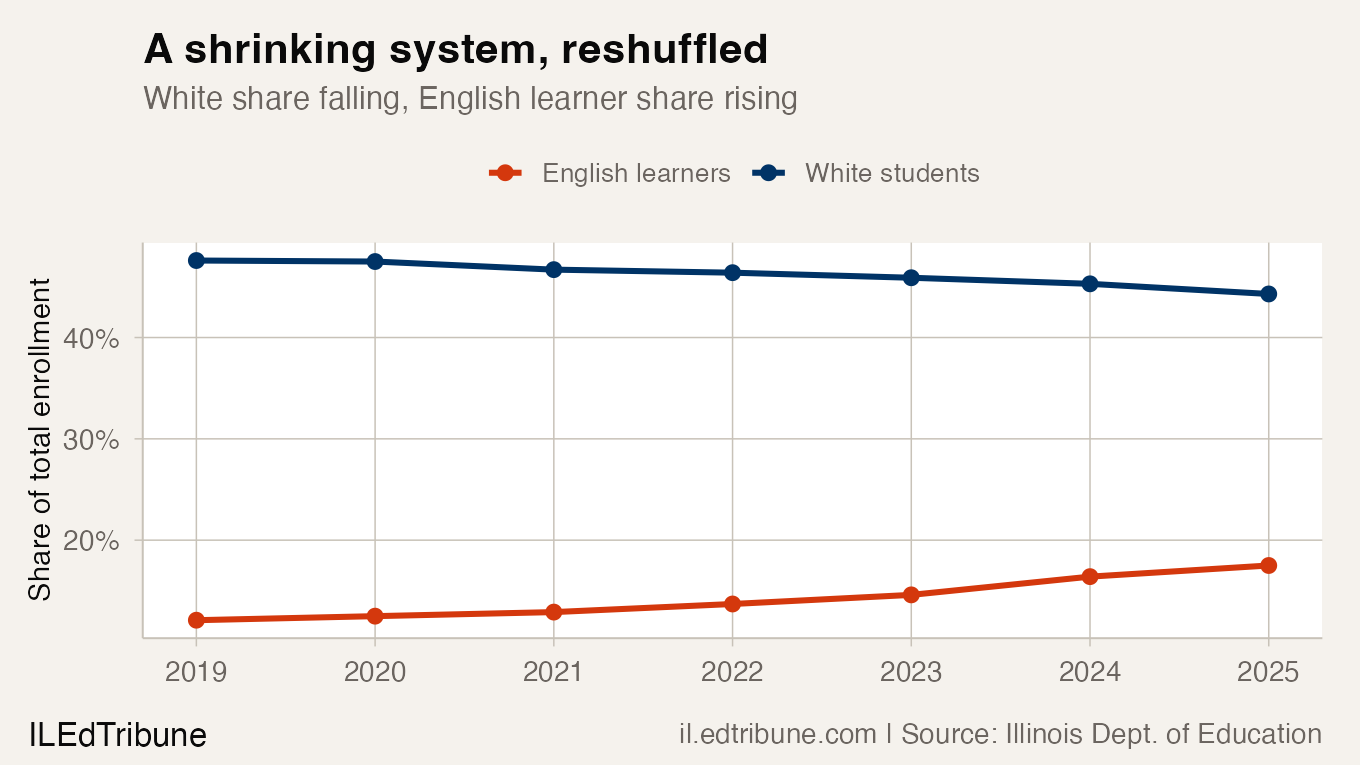
The 135,959-student decline since 2018-19 is overwhelmingly a story about white enrollment. White students account for 125,719 of those losses — 92.5% of the total decline — falling from 944,631 (47.6% of enrollment) to 818,912 (44.3%). Black enrollment fell by 30,100. Hispanic enrollment, by contrast, grew modestly by 4,775 students, and its share rose from 26.4% to 28.6%.
Running in the opposite direction from the topline: English learners grew from 240,127 to 323,498, gaining 83,371 students. The acceleration was sharpest in 2023-24, when the state added 32,375 English learners in a single year. Growth slowed to 19,886 in 2024-25 but remained well above the pre-pandemic pace.
Why this may be happening
The enrollment decline tracks Illinois's persistent domestic outmigration. The state lost 56,235 residents to other states in 2024 — third-worst nationally behind California and New York. The people leaving skew young: the state's under-18 population has shrunk by more than 172,000 since 2020, a 6% decline. White and Black communities have led the population decline, which aligns with the enrollment data showing those groups accounting for nearly all of the student losses.
International immigration has partially offset the departures. Illinois's total population grew slightly in 2024, buoyed by 112,000 international migrants over recent years. That influx concentrated in Chicago, where CPS gained 1,379 students in 2024-25 while the rest of the state lost 4,817. CPS attributed part of its enrollment increase to migrant families from Central and South American countries, with English language learners growing 11% — faster than any other student group in the district.
A third factor is expanded identification. Illinois has broadened its bilingual education infrastructure, with 637 school districts now operating Transitional Bilingual Education programs. More programs means more identification of students who qualify. The data cannot distinguish newly arrived students from students already enrolled who are newly identified as English learners — a distinction that matters for understanding whether the 83,371-student increase reflects actual demographic change, broader identification, or both.
What reporting suggests
The bilingual teacher shortage has intensified alongside the English learner surge. A 2024 analysis from the Latino Policy Forum noted that even before the recent growth, Illinois lacked the pipeline to staff bilingual classrooms:
"There is a huge shortage in special education, bilingual education, math teachers and science teachers." — Chicago Sun-Times, Apr. 2024
The state's response has included both funding and legislative action. ISBE's fiscal year 2025 budget recommended $35 million for supporting newcomers, which districts can use to hire bilingual educators. Separately, Illinois lawmakers passed legislation requiring ISBE to write guidelines by 2026 for schools creating or expanding dual language programs.
The funding formula itself is under pressure. Illinois's Evidence-Based Funding model, signed into law in 2017, was supposed to reach adequate funding for all districts by 2027. That timeline has now slipped to 2034, leaving three-quarters of the state's students in underfunded districts. The formula's hold-harmless provision protects districts from losing state aid when enrollment drops, but an enrollment decline worsens the overall funding gap by widening the distance between what districts receive and what the formula says they need.
What we don't know
The single largest uncertainty is what is driving the English learner count. The 83,371-student increase since 2018-19 could reflect new immigrant arrivals, broader identification of existing students who qualify for EL services, or both. ISBE does not publish enrollment by immigration status, making it impossible to separate the two. The 32,375 EL students added in 2023-24 — the largest single-year jump — coincided with peak migrant arrivals in Chicago, but the growth was statewide, not confined to CPS.
Whether the deceleration holds is also unclear. Illinois's population flatlined in 2025, with international immigration dropping sharply from the levels that had offset domestic outmigration in prior years. If immigration slows while domestic departures continue, the enrollment curve could resume its decline rather than reaching a plateau. Birth rates provide no cushion — Illinois births still exceed deaths, but only by about 11,000 per year, a narrow margin that has been shrinking.
The homeless student count — up 25.8% from 39,690 to 49,911 since 2018-19 — also demands scrutiny. Illinois saw a 116% increase in overall homelessness in 2024, driven largely by the migrant crisis. Federal housing officials attributed most of the increase to new arrivals, but non-migrant homelessness also rose 22%. Whether the school-level count reflects the same dynamics, or simply better identification under McKinney-Vento, is not clear from the enrollment data.
Budget pressure
Five hundred of the state's 863 districts lost students in 2024-25. The losses spread across suburban and downstate Illinois while Chicago grew, creating a geographic divide in who faces fiscal contraction. SD U-46 (Elgin) lost 423 students; Rockford gained 894.
| Subgroup | 2018-19 share | 2024-25 share | Shift |
|---|---|---|---|
| English learners | 12.1% | 17.5% | +5.4 pp |
| White | 47.6% | 44.3% | -3.3 pp |
| Hispanic | 26.4% | 28.6% | +2.2 pp |
| Special education | 18.4% | 20.3% | +1.9 pp |
| Econ. disadvantaged | 48.8% | 49.7% | +0.9 pp |
| Homeless | 2.0% | 2.7% | +0.7 pp |
Note: Race/ethnicity categories (white, Hispanic) are mutually exclusive. Service categories (English learners, special education, economically disadvantaged) overlap substantially with each other and with race — a student can be counted in multiple service categories.
Illinois funds schools through evidence-based funding weights that account for English learners, students with disabilities, and low-income students. Districts that lost base enrollment have absorbed per-pupil funding cuts, but the students who remain are more likely to qualify for supplemental weights whose instructional programs carry higher per-pupil costs. A system approaching flat enrollment with a 17.5% English learner share and a 20.3% special education identification rate needs a different staffing model than the one it had at 12.1% and 18.4%.
Data source
All figures derived from the Illinois State Board of Education enrollment files via the ilschooldata R package. Full analysis code:
2026-03-05-il-enrollment-overview-analysis.R